## Diagram: Agent-Cognitive Architecture Workflow
### Overview
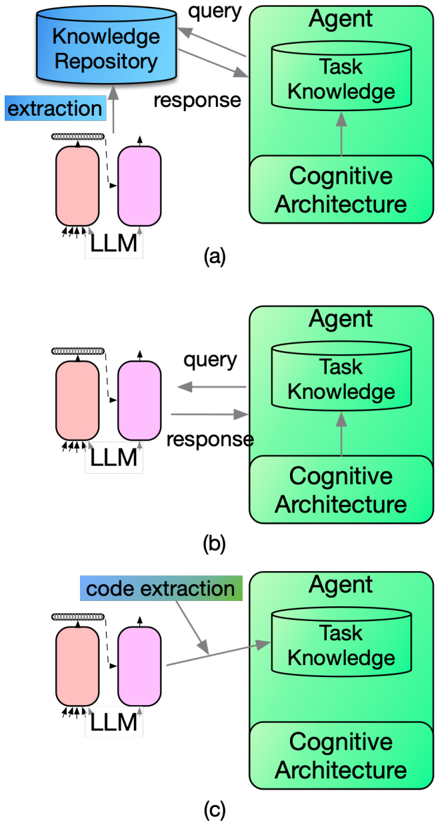
The diagram illustrates a three-stage workflow of an AI agent interacting with a knowledge repository and cognitive architecture. It uses color-coded components (blue, green, pink) and directional arrows to represent data flow, extraction processes, and response generation. Three sub-diagrams (a, b, c) show variations in interaction patterns.
### Components/Axes
1. **Key Elements**:
- **Knowledge Repository** (blue cylinder, top-left in (a))
- **Agent** (green rectangle, right side of all sub-diagrams)
- **Task Knowledge** (green cylinder within Agent)
- **Cognitive Architecture** (green rectangle below Task Knowledge)
- **LLM** (pink cylinder, left side of all sub-diagrams)
- **Extraction/Response Arrows** (black/dashed lines with labels)
2. **Process Flow**:
- **Extraction** (dashed arrow from LLM to Agent in (a))
- **Response** (solid arrow from Agent to LLM in (a))
- **Code Extraction** (green highlighted arrow in (c))
3. **Spatial Grounding**:
- **Knowledge Repository**: Top-left in (a), absent in (b/c)
- **Agent**: Center-right in all sub-diagrams
- **LLM**: Left side in all sub-diagrams
- **Arrows**:
- Solid arrows = direct data flow
- Dashed arrows = extraction processes
- Green highlights = code-specific operations
### Detailed Analysis
1. **Sub-diagram (a)**:
- **Flow**:
- LLM → Knowledge Repository (extraction)
- Knowledge Repository → Agent (response)
- **Components**: Full system with external knowledge integration
2. **Sub-diagram (b)**:
- **Flow**:
- LLM → Agent (direct query)
- Agent → LLM (response)
- **Components**: Simplified loop without external repository
3. **Sub-diagram (c)**:
- **Flow**:
- LLM → Agent (code extraction)
- Agent → LLM (response)
- **Components**: Specialized code-handling pathway
### Key Observations
1. **Modular Design**: The Agent's Cognitive Architecture is consistently separated from Task Knowledge across all sub-diagrams.
2. **Knowledge Dependency**: Sub-diagram (a) shows explicit reliance on external Knowledge Repository, while (b/c) operate in closed loops.
3. **Specialization**: Sub-diagram (c) introduces code extraction as a distinct process from general extraction in (a).
4. **Bidirectional Flow**: All sub-diagrams show cyclical interaction between LLM and Agent components.
### Interpretation
This diagram represents an AI agent framework with three operational modes:
1. **Knowledge-Augmented Mode** (a): Combines LLM capabilities with external knowledge repositories for enhanced responses.
2. **Self-Contained Mode** (b): Demonstrates basic agent-LLM interaction without external data sources.
3. **Code-Specialized Mode** (c): Highlights a dedicated pathway for handling code-related queries.
The color coding (blue for knowledge storage, green for cognitive processing, pink for language models) suggests a hierarchical relationship where:
- **Knowledge Repository** serves as foundational data source
- **Agent** acts as processing hub
- **LLM** handles language understanding/generation
The progressive simplification from (a)→(b)→(c) implies a design philosophy where complexity increases with specialized functionality, while maintaining core agent-cognitive architecture integration. The code extraction pathway in (c) indicates potential for domain-specific optimization within the general framework.