## Diagram: 3x3 Number Grid Layout
### Overview
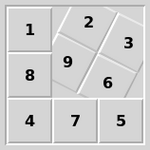
The image depicts a 3x3 grid composed of nine square cells, each containing a unique integer from 1 to 9. The numbers are arranged in a non-sequential, non-linear pattern, with no visible axes, legends, or annotations. The grid is divided into three rows and three columns, with numbers positioned in a specific spatial configuration.
### Components/Axes
- **Grid Structure**:
- **Rows**:
- Row 1 (top): Cells contain numbers 1, 2, 3 (left to right).
- Row 2 (middle): Cells contain numbers 8, 9, 6 (left to right).
- Row 3 (bottom): Cells contain numbers 4, 7, 5 (left to right).
- **Columns**:
- Column 1 (left): Numbers 1, 8, 4 (top to bottom).
- Column 2 (middle): Numbers 2, 9, 7 (top to bottom).
- Column 3 (right): Numbers 3, 6, 5 (top to bottom).
- **Spatial Grounding**:
- Numbers are centered within their respective cells.
- No axis labels, legends, or color-coding are present.
### Detailed Analysis
- **Number Placement**:
- **Top Row**: 1 (top-left), 2 (top-center), 3 (top-right).
- **Middle Row**: 8 (middle-left), 9 (middle-center), 6 (middle-right).
- **Bottom Row**: 4 (bottom-left), 7 (bottom-center), 5 (bottom-right).
- **Numerical Pattern**:
- The sequence does not follow a simple arithmetic or geometric progression.
- The middle cell (position 2,2) contains the highest value (9), while the corners (1,1; 1,3; 3,1; 3,3) contain the lowest values (1, 3, 4, 5).
### Key Observations
1. **Non-Sequential Arrangement**: Numbers are not ordered sequentially (e.g., 1-9 left to right, top to bottom).
2. **Central Dominance**: The central cell (9) is the largest value, suggesting a potential focal point.
3. **Diagonal Sums**:
- Top-left to bottom-right diagonal: 1 + 9 + 5 = 15.
- Top-right to bottom-left diagonal: 3 + 9 + 4 = 16.
- Only the first diagonal sums to 15, a common target in magic squares, but the other diagonal and rows/columns do not match.
### Interpretation
The grid likely represents a **puzzle or game setup**, such as a simplified version of a magic square or a Sudoku-like challenge. The central placement of 9 and the asymmetrical distribution of numbers suggest a deliberate design to test pattern recognition or problem-solving skills. The absence of labels or annotations implies the grid is self-contained, relying on the viewer to infer rules or objectives. The diagonal sum of 15 (for one diagonal) hints at a partial alignment with magic square principles, but the overall structure deviates from standard magic square requirements. This could indicate a custom puzzle or a step in a larger computational or mathematical process.