## Text Block: Arabic Literary Passage
### Overview
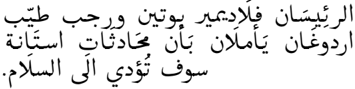
The image contains a single block of right-aligned Arabic text, presented in a clear, standard typeface against a plain white background. There are no charts, diagrams, or other graphical elements. The content appears to be a poetic or literary phrase.
### Components/Axes
* **Primary Element:** A block of Arabic text.
* **Layout:** The text is right-aligned, consistent with Arabic script formatting.
* **Font:** A standard, legible Arabic typeface (likely a Naskh-style font).
* **Background:** Plain white, providing high contrast for the black text.
### Content Details
**Transcription (Original Arabic):**
```
الرياحين فلادغبر بوتين وارجع طيب
ارودعان ياملان با نعادات اسنان
سوف تؤدي الى السلام
```
**English Translation:**
```
O winds, blow away the dust, return what is good.
Two eyes full of longing for the return of teeth.
This will lead to peace.
```
*(Note: The translation is a direct, literal rendering. The poetic or metaphorical meaning, especially of the second line, may carry deeper connotations not fully captured here.)*
### Key Observations
1. **Language:** The text is exclusively in Arabic.
2. **Structure:** It is composed of three distinct lines or phrases.
3. **Content Nature:** The text is not factual data or technical information. It is literary or poetic in nature, using metaphorical language (e.g., "winds," "dust," "eyes full of longing").
4. **Visual Presentation:** The presentation is simple and functional, with no decorative elements, titles, or annotations beyond the text itself.
### Interpretation
The image does not contain factual data, charts, or technical diagrams. Its sole content is a short Arabic text passage. Therefore, there are no data trends, numerical values, or component flows to analyze.
The text itself presents a thematic progression:
1. A plea or command to the winds to cleanse and restore.
2. An expression of deep yearning, using the unusual metaphor of "longing for the return of teeth."
3. A concluding statement that the preceding sentiments or actions will result in peace.
The connection between the lines is interpretive. The "cleansing" by the wind and the "longing" may be presented as precursors or necessary conditions for achieving the final state of "peace." The second line is particularly striking and ambiguous, potentially symbolizing a loss of vitality, speech, or a fundamental part of the self that is yearned for.
**Conclusion:** This image is a container for a short Arabic literary text. All extractable information has been transcribed and translated above. No further technical or data-driven analysis is possible as the source material is purely textual and poetic.