## Bar Chart: Generative Accuracy by Transformation Type
### Overview
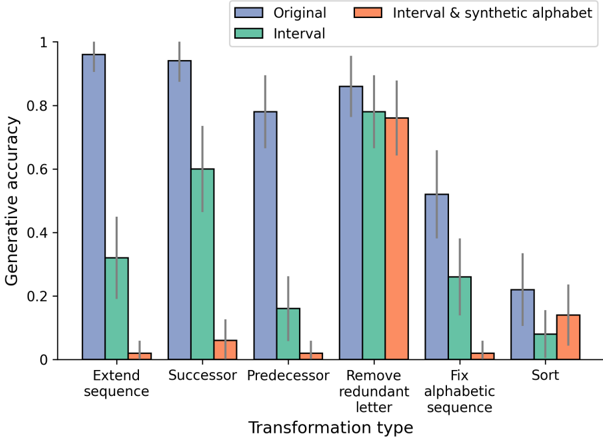
The image is a bar chart comparing the generative accuracy of three different models ("Original", "Interval", and "Interval & synthetic alphabet") across six different transformation types: "Extend sequence", "Successor", "Predecessor", "Remove redundant letter", "Fix alphabetic sequence", and "Sort". The chart includes error bars, presumably indicating standard deviation or confidence intervals.
### Components/Axes
* **Y-axis:** "Generative accuracy", ranging from 0 to 1 in increments of 0.2.
* **X-axis:** "Transformation type", with six categories: "Extend sequence", "Successor", "Predecessor", "Remove redundant letter", "Fix alphabetic sequence", and "Sort".
* **Legend:** Located at the top-right of the chart.
* Blue: "Original"
* Green: "Interval"
* Orange: "Interval & synthetic alphabet"
### Detailed Analysis
Here's a breakdown of the generative accuracy for each transformation type and model, including trend descriptions:
* **Extend sequence:**
* Original (Blue): Accuracy is approximately 0.97, with an error bar extending down to approximately 0.45.
* Interval (Green): Accuracy is approximately 0.32, with an error bar extending down to approximately 0.05.
* Interval & synthetic alphabet (Orange): Not present for this transformation.
* **Successor:**
* Original (Blue): Accuracy is approximately 0.95, with an error bar extending down to approximately 0.72.
* Interval (Green): Accuracy is approximately 0.60, with an error bar extending down to approximately 0.35.
* Interval & synthetic alphabet (Orange): Not present for this transformation.
* **Predecessor:**
* Original (Blue): Accuracy is approximately 0.78, with an error bar extending down to approximately 0.5.
* Interval (Green): Accuracy is approximately 0.16, with an error bar extending down to approximately 0.0.
* Interval & synthetic alphabet (Orange): Not present for this transformation.
* **Remove redundant letter:**
* Original (Blue): Accuracy is approximately 0.86, with an error bar extending down to approximately 0.7.
* Interval (Green): Accuracy is approximately 0.78, with an error bar extending down to approximately 0.65.
* Interval & synthetic alphabet (Orange): Accuracy is approximately 0.76, with an error bar extending down to approximately 0.6.
* **Fix alphabetic sequence:**
* Original (Blue): Accuracy is approximately 0.52, with an error bar extending down to approximately 0.05.
* Interval (Green): Accuracy is approximately 0.26, with an error bar extending down to approximately 0.0.
* Interval & synthetic alphabet (Orange): Not present for this transformation.
* **Sort:**
* Original (Blue): Accuracy is approximately 0.22, with an error bar extending down to approximately 0.0.
* Interval (Green): Accuracy is approximately 0.08, with an error bar extending down to approximately 0.0.
* Interval & synthetic alphabet (Orange): Accuracy is approximately 0.14, with an error bar extending down to approximately 0.0.
### Key Observations
* The "Original" model consistently outperforms the "Interval" model across all transformation types.
* The "Interval & synthetic alphabet" model is only present for "Remove redundant letter" and "Sort" transformations.
* The "Extend sequence" transformation has the highest accuracy for the "Original" model.
* The "Sort" transformation has the lowest accuracy for all models.
* The error bars are relatively large, indicating substantial variability in the data.
### Interpretation
The data suggests that the "Original" model is better at generalizing across different types of sequence transformations compared to the "Interval" model. The "Interval & synthetic alphabet" model shows mixed results, performing similarly to the other models for "Remove redundant letter" but slightly better than "Interval" for "Sort". The large error bars indicate that the performance of each model can vary significantly depending on the specific input sequence. The "Sort" transformation appears to be the most challenging for all models, possibly due to the complexity of rearranging sequences. The absence of "Interval & synthetic alphabet" for most transformations suggests it might be specifically designed or optimized for certain types of tasks.