## Diagram: Sequential Cell Averaging Process
### Overview
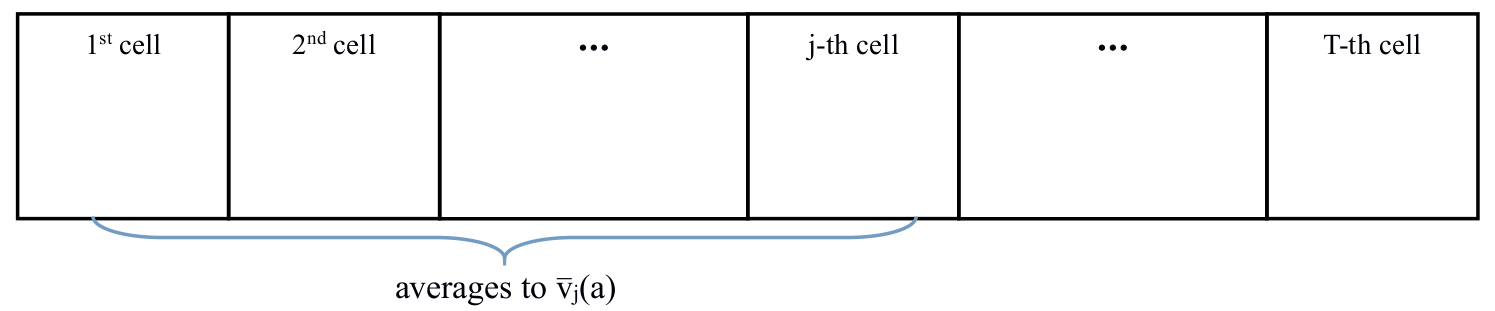
The diagram illustrates a linear sequence of labeled cells (1st to T-th) with a blue arrow connecting the first and last cells. The arrow is annotated with "averages to v̄_j(a)", indicating a mathematical operation applied across the sequence.
### Components/Axes
- **Cells**:
- Labeled sequentially as "1st cell", "2nd cell", ..., "j-th cell", ..., "T-th cell".
- Positioned horizontally in a row, separated by vertical black lines.
- **Arrow**:
- Blue, curved line spanning from the left edge of the 1st cell to the right edge of the T-th cell.
- Label: "averages to v̄_j(a)" (with a macron over "v" and subscript "j(a)").
### Content Details
- **Cell Labels**:
- Explicitly marked as ordinal numbers (1st, 2nd, ..., j-th, ..., T-th).
- "j-th cell" and "T-th cell" use ellipses (...) to denote omitted intermediate labels.
- **Arrow Annotation**:
- Mathematical notation: "v̄_j(a)" (average of variable "a" across cells, indexed by "j").
### Key Observations
1. The sequence implies a progressive relationship between cells, with the averaging operation applied to the entire range.
2. The use of "T-th" suggests a variable or large number of cells, common in algorithmic or statistical contexts.
3. The curved arrow emphasizes a holistic operation rather than sequential processing.
### Interpretation
This diagram likely represents a **data aggregation or system modeling process** where:
- The cells symbolize discrete units (e.g., time steps, spatial regions, or computational nodes).
- The averaging operation (v̄_j(a)) aggregates values across all cells, possibly for normalization, trend analysis, or error reduction.
- The variable "T" indicates scalability, allowing the process to adapt to different system sizes.
The structure aligns with concepts in **signal processing**, **machine learning**, or **statistical analysis**, where averaging over a sequence is a common preprocessing step. The absence of numerical values suggests a conceptual framework rather than empirical data.