## Heatmap: Classification Accuracies
### Overview
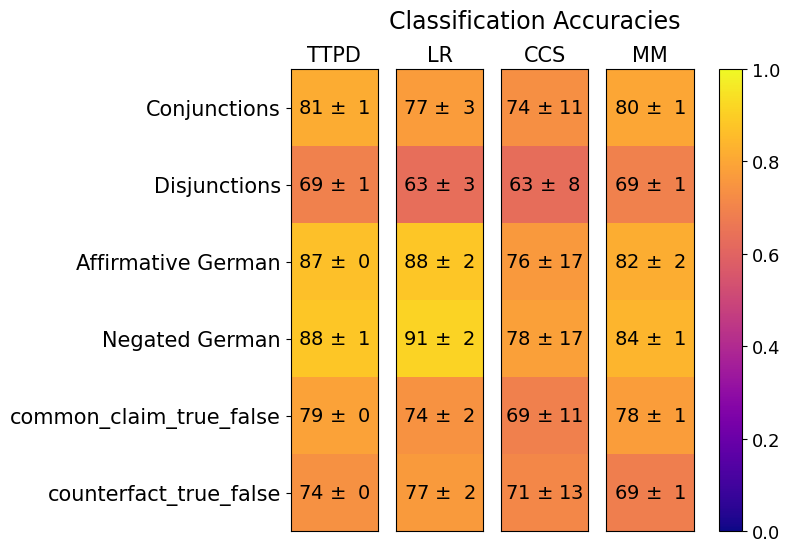
This image presents a heatmap displaying classification accuracies for six different linguistic phenomena across four different classification methods. The heatmap uses a color gradient from blue (low accuracy) to yellow (high accuracy) to represent the accuracy values. Each cell in the heatmap represents the accuracy of a specific method on a specific linguistic phenomenon, along with a standard deviation.
### Components/Axes
* **Title:** "Classification Accuracies" (centered at the top)
* **Y-axis (Rows):** Represents the linguistic phenomena. The categories are:
* Conjunctions
* Disjunctions
* Affirmative German
* Negated German
* common\_claim\_true\_false
* counterfact\_true\_false
* **X-axis (Columns):** Represents the classification methods. The categories are:
* TTPD
* LR
* CCS
* MM
* **Color Scale (Legend):** Located on the right side of the heatmap. Ranges from 0.0 (dark blue) to 1.0 (bright yellow), representing accuracy. The scale is linear.
* **Data Values:** Each cell contains an accuracy value in the format "X ± Y", where X is the accuracy (as a percentage) and Y is the standard deviation.
### Detailed Analysis
The heatmap displays the following accuracy values (approximated from the image):
| | TTPD | LR | CCS | MM |
| :-------------------- | :------ | :----- | :----- | :----- |
| Conjunctions | 81 ± 1 | 77 ± 3 | 74 ± 11| 80 ± 1 |
| Disjunctions | 69 ± 1 | 63 ± 3 | 63 ± 8 | 69 ± 1 |
| Affirmative German | 87 ± 0 | 88 ± 2 | 76 ± 17| 82 ± 2 |
| Negated German | 88 ± 1 | 91 ± 2 | 78 ± 17| 84 ± 1 |
| common\_claim\_true\_false | 79 ± 0 | 74 ± 2 | 69 ± 11| 78 ± 1 |
| counterfact\_true\_false | 74 ± 0 | 77 ± 2 | 71 ± 13| 69 ± 1 |
**Trend Verification & Observations:**
* **TTPD:** Generally performs well, with accuracies mostly in the 79-88% range. It shows a slight dip for "Disjunctions" and "counterfact\_true\_false".
* **LR:** Shows relatively consistent performance across all categories, with accuracies ranging from 63% to 91%. It achieves its highest accuracy on "Negated German".
* **CCS:** Exhibits the most variability and generally lower accuracies compared to other methods, with values ranging from 63% to 78%. The standard deviations are also the highest for CCS.
* **MM:** Performs well, similar to TTPD, with accuracies mostly in the 69-84% range.
### Key Observations
* "Negated German" consistently shows the highest accuracies across all methods, particularly for LR (91 ± 2).
* "Disjunctions" and "counterfact\_true\_false" generally have the lowest accuracies, especially for CCS.
* CCS has the largest standard deviations, indicating greater inconsistency in its performance.
* TTPD and MM show similar performance profiles.
### Interpretation
The heatmap suggests that the classification task is more challenging for disjunctions and counterfactual statements than for conjunctions, affirmative German, or negated German. The LR method appears to be particularly effective at classifying negated German, while CCS struggles across all categories. The differences in performance between the methods could be due to variations in their underlying algorithms or their sensitivity to the specific features of the linguistic phenomena being classified. The high standard deviations for CCS suggest that its performance is more sensitive to the specific dataset or training parameters used. The overall high accuracies (above 0.7) indicate that the classification task is generally feasible, but there is room for improvement, particularly for the more challenging linguistic phenomena and with the CCS method. The data suggests that the choice of classification method should be tailored to the specific linguistic phenomenon being analyzed.