## Line Chart: Qwen2.5-7B
### Overview
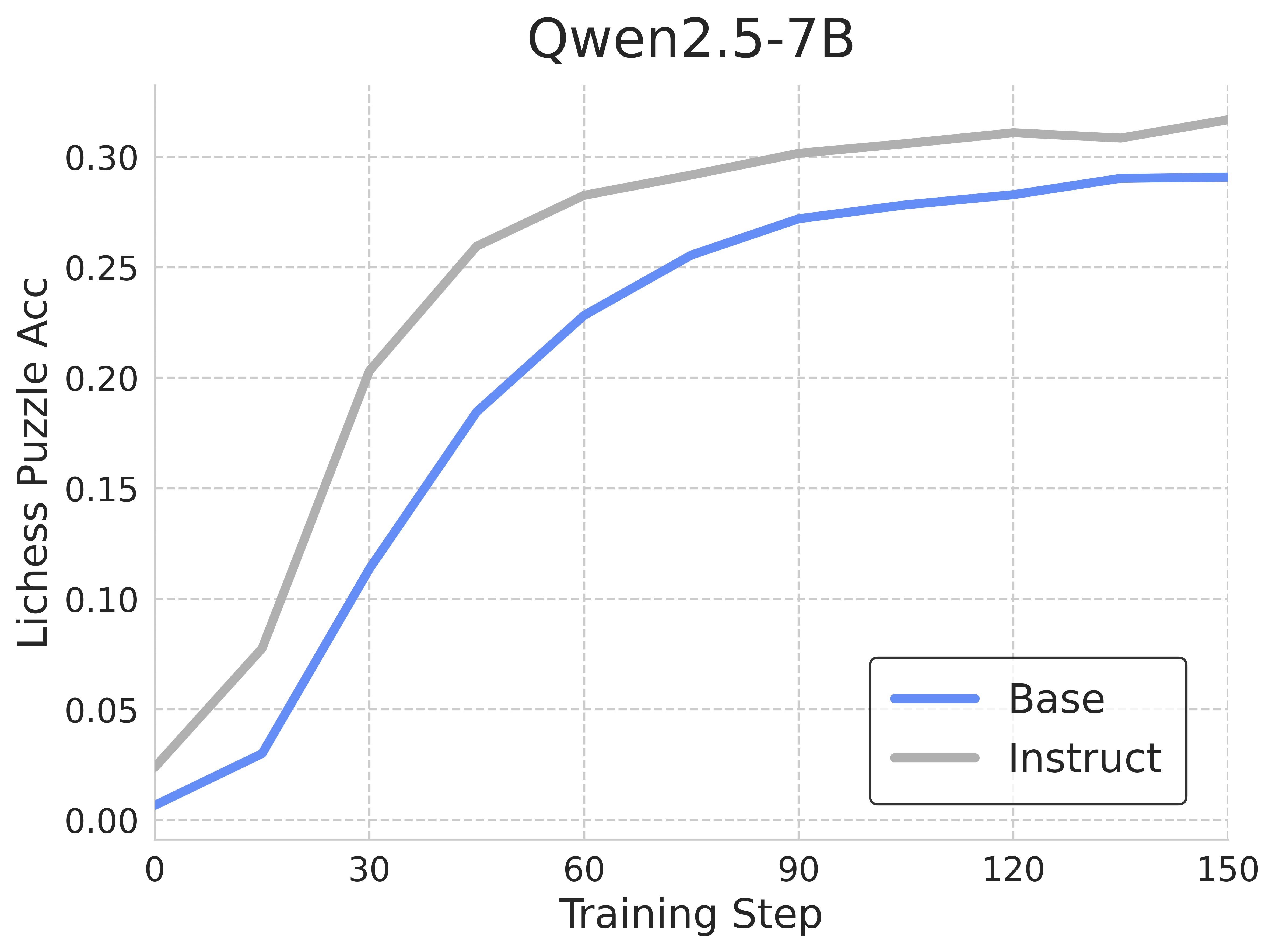
The image is a line chart comparing the performance of two models, "Base" and "Instruct," on a "Lichess Puzzle Acc" metric over a range of "Training Steps." The chart displays the accuracy of each model as it increases with training.
### Components/Axes
* **Title:** Qwen2.5-7B
* **X-axis:** Training Step, with markers at 0, 30, 60, 90, 120, and 150.
* **Y-axis:** Lichess Puzzle Acc, with markers at 0.00, 0.05, 0.10, 0.15, 0.20, 0.25, and 0.30.
* **Legend:** Located in the bottom-right corner.
* Blue line: Base
* Gray line: Instruct
### Detailed Analysis
* **Base (Blue):** The blue line represents the "Base" model. It starts at approximately 0.01 accuracy at training step 0. The line slopes upward, reaching approximately 0.18 at step 30, 0.23 at step 60, 0.28 at step 90, and plateaus around 0.29 at step 120 and 150.
* **Instruct (Gray):** The gray line represents the "Instruct" model. It starts at approximately 0.02 accuracy at training step 0. The line slopes upward, reaching approximately 0.20 at step 30, 0.29 at step 60, and plateaus around 0.30 at step 90, 120, and 150.
### Key Observations
* Both models show an increase in "Lichess Puzzle Acc" as the "Training Step" increases.
* The "Instruct" model consistently outperforms the "Base" model throughout the training steps.
* Both models exhibit a period of rapid improvement in accuracy, followed by a plateau as training progresses.
### Interpretation
The chart demonstrates the impact of training on the performance of two models, "Base" and "Instruct," in solving Lichess puzzles. The "Instruct" model, presumably trained with specific instructions or a different training methodology, consistently achieves higher accuracy than the "Base" model. The plateauing of both lines suggests that further training beyond a certain point yields diminishing returns in terms of accuracy improvement. The "Instruct" model's superior performance indicates that the training approach used for this model is more effective for this particular task.