## Chart Type: Multi-Panel Chart
### Overview
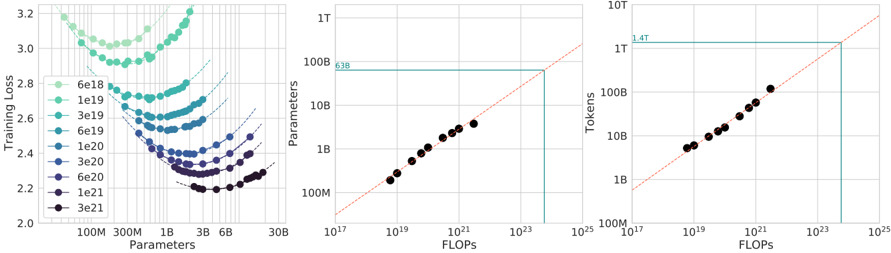
The image presents a multi-panel chart consisting of three sub-charts. The first chart (left) shows the relationship between "Training Loss" and "Parameters" for different model sizes. The second chart (middle) shows the relationship between "Parameters" and "FLOPs". The third chart (right) shows the relationship between "Tokens" and "FLOPs". All charts use logarithmic scales on both axes.
### Components/Axes
**Left Chart:**
* **X-axis:** Parameters (log scale), labeled with 100M, 300M, 1B, 3B, 6B, 30B
* **Y-axis:** Training Loss (linear scale), labeled from 2.0 to 3.2 in increments of 0.2.
* **Legend:** Located in the middle-left of the chart. The legend entries are:
* 6e18 (light green)
* 1e19 (green)
* 3e19 (teal)
* 6e19 (dark teal)
* 1e20 (blue)
* 3e20 (dark blue)
* 6e20 (purple)
* 1e21 (dark purple)
* 3e21 (black)
**Middle Chart:**
* **X-axis:** FLOPs (log scale), labeled with 10^17, 10^19, 10^21, 10^23, 10^25
* **Y-axis:** Parameters (log scale), labeled with 100M, 1B, 10B, 100B, 1T
* A horizontal teal line extends from the y-axis at 63B.
* A dashed red line extends diagonally from the bottom left to the top right.
**Right Chart:**
* **X-axis:** FLOPs (log scale), labeled with 10^17, 10^19, 10^21, 10^23, 10^25
* **Y-axis:** Tokens (log scale), labeled with 100M, 1B, 10B, 100B, 1T, 10T
* A horizontal teal line extends from the y-axis at 1.4T.
* A dashed red line extends diagonally from the bottom left to the top right.
### Detailed Analysis
**Left Chart:**
Each line represents a different model size (parameter count). The x-axis represents the number of parameters, and the y-axis represents the training loss. Each line shows a U-shaped curve, indicating that there is an optimal number of parameters for minimizing training loss for each model size.
* **6e18 (light green):** The line starts at approximately (100M, 3.1), decreases to a minimum around (300M, 2.9), and then increases to approximately (6B, 3.1).
* **1e19 (green):** The line starts at approximately (100M, 2.9), decreases to a minimum around (300M, 2.7), and then increases to approximately (6B, 2.9).
* **3e19 (teal):** The line starts at approximately (100M, 2.7), decreases to a minimum around (300M, 2.5), and then increases to approximately (6B, 2.7).
* **6e19 (dark teal):** The line starts at approximately (100M, 2.6), decreases to a minimum around (300M, 2.4), and then increases to approximately (6B, 2.6).
* **1e20 (blue):** The line starts at approximately (100M, 2.5), decreases to a minimum around (300M, 2.3), and then increases to approximately (6B, 2.5).
* **3e20 (dark blue):** The line starts at approximately (100M, 2.4), decreases to a minimum around (300M, 2.25), and then increases to approximately (6B, 2.4).
* **6e20 (purple):** The line starts at approximately (100M, 2.3), decreases to a minimum around (300M, 2.2), and then increases to approximately (6B, 2.3).
* **1e21 (dark purple):** The line starts at approximately (100M, 2.25), decreases to a minimum around (300M, 2.15), and then increases to approximately (6B, 2.25).
* **3e21 (black):** The line starts at approximately (100M, 2.2), decreases to a minimum around (300M, 2.1), and then increases to approximately (6B, 2.2).
**Middle Chart:**
The black dots represent data points showing the relationship between the number of parameters and the number of FLOPs. The data points generally follow a linear trend on the log-log scale, indicating a power-law relationship. The teal line intersects the data points at approximately 63B parameters and 10^23 FLOPs. The red dashed line represents a 1:1 relationship.
* The data points are approximately: (10^18, 200M), (10^19, 500M), (10^20, 2B), (10^21, 10B), (10^22, 50B), (10^23, 63B)
**Right Chart:**
The black dots represent data points showing the relationship between the number of tokens and the number of FLOPs. The data points generally follow a linear trend on the log-log scale, indicating a power-law relationship. The teal line intersects the data points at approximately 1.4T tokens and 10^23 FLOPs. The red dashed line represents a 1:1 relationship.
* The data points are approximately: (10^18, 200M), (10^19, 500M), (10^20, 2B), (10^21, 10B), (10^22, 50B), (10^23, 1.4T)
### Key Observations
* **Left Chart:** As the model size increases, the minimum training loss decreases, but the curves become flatter.
* **Middle Chart:** There is a strong correlation between the number of parameters and the number of FLOPs.
* **Right Chart:** There is a strong correlation between the number of tokens and the number of FLOPs.
* The teal lines in the middle and right charts indicate a specific FLOPs value (around 10^23) and the corresponding parameter count (63B) and token count (1.4T).
### Interpretation
The charts suggest that increasing model size (number of parameters) initially leads to a decrease in training loss, but there are diminishing returns. The middle and right charts indicate that the number of parameters and the number of tokens are both strongly correlated with the number of FLOPs. The teal lines highlight a specific point where a certain number of FLOPs corresponds to a particular number of parameters and tokens. This information can be used to optimize model training and resource allocation. The red dashed lines show the point where the x and y axis are equal.