## Text Analysis: Anecdotal Query Response
### Overview
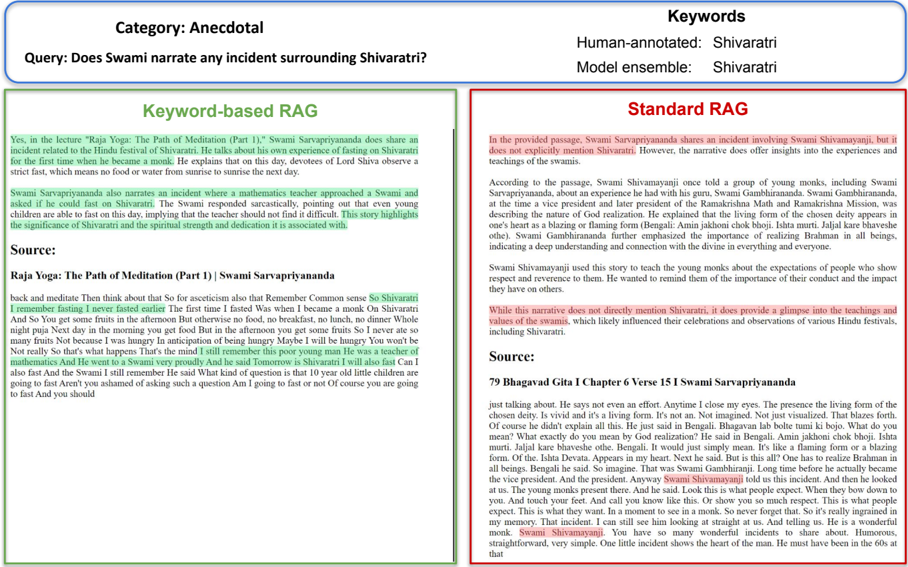
The image presents a comparison of two different approaches to answering a query about whether Swami narrates any incident surrounding Shivaratri. The approaches are "Keyword-based RAG" and "Standard RAG." The image also includes the category of the query ("Anecdotal") and keywords used.
### Components/Axes
* **Category:** Anecdotal
* **Query:** Does Swami narrate any incident surrounding Shivaratri?
* **Keywords:**
* Human-annotated: Shivaratri
* Model ensemble: Shivaratri
* **Keyword-based RAG:** A block of text providing an answer to the query, highlighting the presence of an incident related to Shivaratri in Swami Sarvapriyananda's lecture. It also includes a source citation.
* **Standard RAG:** A block of text providing an answer to the query, mentioning an incident involving Swami Shivamayanji, but not explicitly mentioning Shivaratri. It also includes a source citation.
### Detailed Analysis or Content Details
**Keyword-based RAG:**
* The text confirms that Swami Sarvapriyananda shares an incident related to the Hindu festival of Shivaratri in his lecture "Raja Yoga: The Path of Meditation (Part 1)."
* It mentions his own experience of fasting on Shivaratri when he became a monk.
* It narrates an incident where a mathematics teacher approached a Swami to ask about fasting on Shivaratri, with the Swami responding sarcastically.
* The source is identified as "Raja Yoga: The Path of Meditation (Part 1) | Swami Sarvapriyananda."
* The text contains additional details about fasting and memories related to Shivaratri.
**Standard RAG:**
* The text states that Swami Sarvapriyananda shares an incident involving Swami Shivamayanji, but it does not explicitly mention Shivaratri.
* It summarizes a story told by Swami Shivamayanji about an experience with his guru, Swami Gambhirananda, describing the nature of God realization.
* It includes a phrase in Bengali: "Amin jakhoni chok bhoji. Ishta murti. Jaljal kare bhaveshe othe."
* Translation: (Approximate) "The moment I close my eyes, the chosen deity appears."
* It mentions that Swami Shivamayanji used the story to teach young monks about expectations and the importance of their conduct.
* The source is identified as "79 Bhagavad Gita I Chapter 6 Verse 15 I Swami Sarvapriyananda."
* The text contains additional details about the experience and teachings.
### Key Observations
* The Keyword-based RAG directly addresses the query by confirming the presence of an incident related to Shivaratri.
* The Standard RAG provides a related incident but does not explicitly mention Shivaratri, focusing on the teachings and experiences of the swamis.
* Both approaches provide source citations for their information.
### Interpretation
The image demonstrates two different approaches to answering a query using Retrieval-Augmented Generation (RAG). The Keyword-based RAG focuses on directly answering the query by identifying content that explicitly mentions the keywords (Shivaratri). The Standard RAG, on the other hand, provides a related narrative that may not directly address the query but offers insights into the experiences and teachings of the swamis. The inclusion of Bengali phrases in the Standard RAG response adds cultural context and depth to the narrative. The choice between these approaches depends on the desired level of specificity and the goal of the information retrieval process.