## Diagram Type: Comparative Analysis of RAG Methods
### Overview
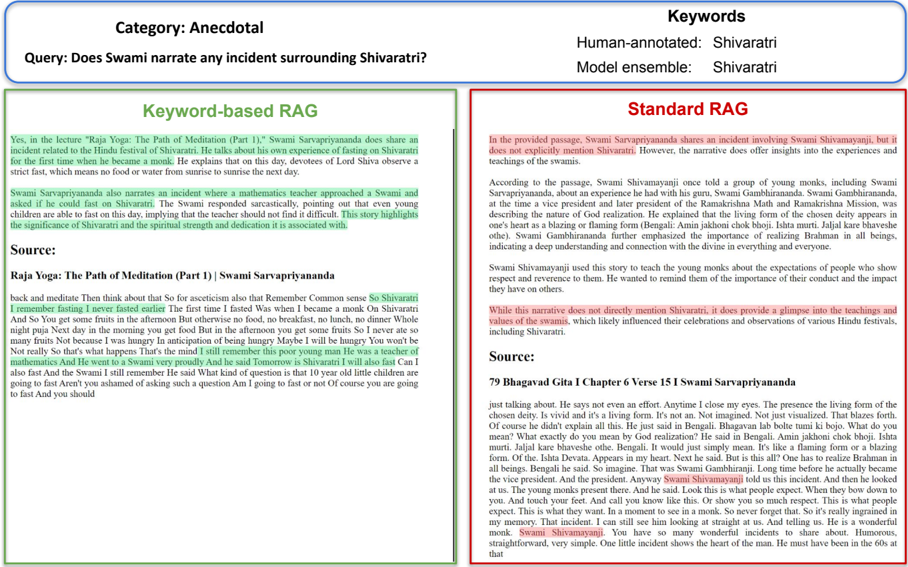
The image is a structured comparison diagram evaluating two different Retrieval-Augmented Generation (RAG) approaches—"Keyword-based RAG" and "Standard RAG"—in response to a specific query. The diagram is divided into distinct sections using color-coded borders (green for the left column, red for the right) to visually separate the two methods and their outputs.
### Components/Axes
**Header Section (Top):**
- **Left Side:** `Category: Anecdotal`
- **Right Side:** `Keywords`
- **Query (Centered below header):** `Query: Does Swami narrate any incident surrounding Shivaratri?`
- **Keywords (Top-right, under "Keywords"):**
- `Human-annotated: Shivaratri`
- `Model ensemble: Shivaratri`
**Main Comparison Area (Two Columns):**
1. **Left Column (Green Border):** Titled `Keyword-based RAG`.
2. **Right Column (Red Border):** Titled `Standard RAG`.
### Detailed Analysis
#### **Left Column: Keyword-based RAG**
- **Response Text:** Provides a direct affirmative answer to the query.
- States that in the lecture "Raja Yoga: The Path of Meditation (Part 1)", Swami Sarvapriyananda shares an incident related to the Hindu festival of Shivaratri.
- Describes the incident: Swami talks about his first experience of fasting on Shivaratri as a monk, explaining the tradition of a strict fast (no food or water from sunrise to sunset).
- Mentions a second anecdote: Swami Sarvapriyananda narrates an incident where a young monk questioned the necessity of fasting, and Swami Shivananda pointed out that even children can fast, highlighting the significance of Shivaratri and the spiritual strength it represents.
- **Source Citation:** `Source: Raja Yoga: The Path of Meditation (Part 1) | Swami Sarvapriyananda`
- **Embedded Text:** The response includes a block of quoted text from the source material, describing the fasting experience and the conversation with the young monk.
#### **Right Column: Standard RAG**
- **Response Text:** Provides a nuanced, indirect answer.
- States that the provided passage involves Swami Sarvapriyananda sharing an incident involving Swami Shivananda, but it "does not explicitly mention Shivaratri."
- Explains that the passage offers insights into the experiences and teachings of the swamis.
- Details the incident: Swami Shivananda told a group of young monks (including Swami Sarvapriyananda) about an experience with his guru, Swami Gambhirananda. The story is about the nature of God realization, describing the living form of the chosen deity as a "blazing or flaming form."
- Interprets the purpose: Swami Shivananda used this story to teach the young monks about the expectations of people and the importance of their conduct and impact.
- Concludes that while the narrative doesn't directly mention Shivaratri, it provides a glimpse into the teachings and values that likely influenced the swamis' celebrations.
- **Source Citation:** `Source: 79 Bhagavad Gita 1 Chapter 6 Verse 15 | Swami Sarvapriyananda`
- **Embedded Text:** The response includes a longer block of quoted text from the source, detailing the story told by Swami Shivananda about God realization and the expectations of a monk's conduct.
### Key Observations
1. **Divergent Answers:** The two RAG methods yield fundamentally different responses to the same query. Keyword-based RAG finds and confirms a direct, relevant incident. Standard RAG retrieves a related but not directly on-topic passage, leading to a more interpretive answer.
2. **Source Material:** Each method cites a different source lecture by Swami Sarvapriyananda, indicating they retrieved information from different parts of the available corpus.
3. **Visual Coding:** The use of green (associated with "go" or "correct") for the direct answer and red (associated with "stop" or "incorrect") for the indirect answer visually implies a judgment on the effectiveness of each method for this specific query.
4. **Content Specificity:** The Keyword-based RAG output is focused on the festival of Shivaratri and fasting. The Standard RAG output is focused on a philosophical teaching about God realization and monastic conduct.
### Interpretation
This diagram serves as a case study or evaluation metric for RAG system performance. It demonstrates a scenario where a **keyword-focused retrieval strategy** successfully pinpoints a specific, relevant anecdote that directly answers a user's question about a named event (Shivaratri). In contrast, a **standard retrieval strategy** (which may rely more on semantic similarity or broader context) retrieves a thematically related but factually distinct narrative, resulting in an answer that acknowledges the lack of a direct match while still attempting to provide value.
The underlying message is that the choice of RAG methodology significantly impacts the precision and relevance of generated answers, especially for queries targeting specific facts or events. The "Keyword-based" approach appears more effective for factual recall in this instance, while the "Standard" approach provides broader contextual understanding but fails the direct factual query. The diagram likely aims to highlight the importance of hybrid or optimized retrieval strategies that can balance precision and contextual richness.