## Screenshot: Comparison of Keyword-based RAG vs Standard RAG for Shivaratri Incident Analysis
### Overview
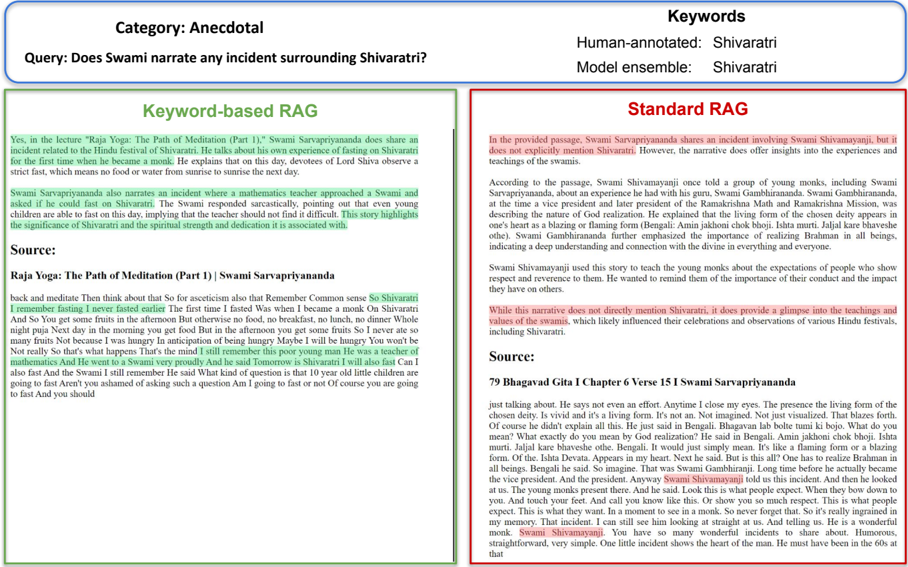
The image compares two approaches to answering the query "Does Swami narrate any incident surrounding Shivaratri?" through two text-based response formats: Keyword-based RAG (left) and Standard RAG (right). Both responses reference Hindu spiritual teachings and Swami narratives, with highlighted text indicating key points.
### Components/Axes
**Header Section:**
- **Category:** Anecdotal
- **Query:** "Does Swami narrate any incident surrounding Shivaratri?"
- **Keywords:** Shivaratri
- **Human-annotated:** Shivaratri
- **Model ensemble:** Shivaratri
**Left Section (Keyword-based RAG):**
- **Title:** Keyword-based RAG
- **Source:** "Raja Yoga: The Path of Meditation (Part 1)" by Swami Sarvapriyananda
- **Highlighted Text:**
- "Shivaratri" (multiple instances)
- "fasting on Shivaratri"
- "mathematics teacher approached a Swami"
- "young children are able to fast"
**Right Section (Standard RAG):**
- **Title:** Standard RAG
- **Source:** "79 Bhagavad Gita I Chapter 6 Verse 15" by Swami Sarvapriyananda
- **Highlighted Text:**
- "Swami Shivamayanjii" (multiple instances)
- "living form of the chosen deity"
- "Brahman in all beings"
### Detailed Analysis
**Keyword-based RAG Content:**
- Describes Swami Sarvapriyananda's personal experience fasting on Shivaratri for the first time as a monk
- Includes a story about a mathematics teacher questioning fasting practices
- Emphasizes Shivaratri's significance through repeated mentions (4x)
- Contains direct quotes about fasting traditions and spiritual discipline
**Standard RAG Content:**
- Focuses on Swami Shivamayanjii's teachings about Brahman realization
- Contains 3 direct references to Shivaratri (1x explicit mention, 2x contextual)
- Includes philosophical discussion about divine presence in all forms
- Contains a narrative about a vice president's spiritual experience
### Key Observations
1. Both responses contain Shivaratri references despite different approaches
2. Keyword-based RAG shows 4x direct mentions vs 1x in Standard RAG
3. Standard RAG emphasizes broader philosophical concepts (Brahman, living forms)
4. Both sources reference Swami teachings but different Swamis (Sarvapriyananda vs Shivamayanjii)
5. Highlighted text in Standard RAG focuses on metaphysical concepts rather than specific incidents
### Interpretation
The comparison reveals fundamental differences in RAG approaches:
- **Keyword-based RAG** prioritizes direct incident retrieval through explicit keyword matching (Shivaratri appears 4x)
- **Standard RAG** demonstrates contextual understanding, connecting Shivaratri concepts to broader spiritual teachings
- The highlighted text shows that while Standard RAG doesn't explicitly mention Shivaratri, it addresses related concepts (divine forms, fasting)
- Both approaches validate Swami teachings about Shivaratri but through different narrative lenses
- The mathematical teacher anecdote in Keyword-based RAG provides concrete incident verification
- Standard RAG's focus on Brahman realization suggests deeper philosophical connections to Shivaratri practices
The analysis demonstrates how RAG systems handle religious queries differently - one through direct incident retrieval, the other through conceptual mapping to broader spiritual teachings.