TECHNICAL ASSET FINGERPRINT
05a0fd64e6c50ea30faef361
Click to view fullscreen
Press ESC or click to close
FOUND IN PAPERS
EXPERT: gemini-2.5-flash-lite-free VERSION 1
RUNTIME: google-free/gemini-2.5-flash-lite
INTEL_VERIFIED
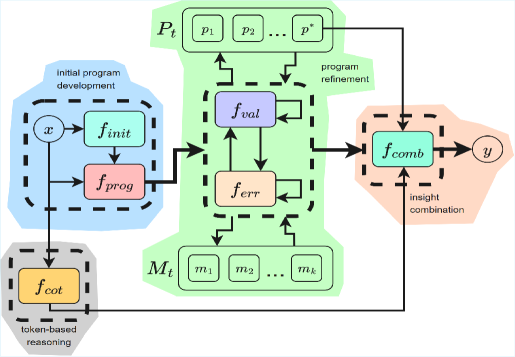
## Diagram: Program Synthesis and Refinement Process
### Overview
This diagram illustrates a process for program synthesis and refinement. It depicts several functional components and their interconnections, organized into distinct stages: "Initial program development," "program refinement," and "insight combination." The process starts with an input `x` and progresses through various functions to produce an output `y`.
### Components/Axes
The diagram does not feature traditional axes or scales as it is a process flow diagram. The key components are represented by labeled boxes and circles, with arrows indicating the flow of information or control.
**Key Components:**
* **Input `x`**: Represented by a circle, this is the initial input to the system.
* **`f_init`**: A cyan-colored rectangle within the "Initial program development" block. It takes `x` as input.
* **`f_prog`**: A coral-colored rectangle within the "Initial program development" block. It takes `x` and the output of `f_init` as input.
* **`f_cot`**: A yellow-colored rectangle within the "token-based reasoning" block. It takes `x` as input.
* **`P_t`**: A green-colored rectangle containing `p_1`, `p_2`, ..., `p*`. This likely represents a set of programs or program candidates.
* **`M_t`**: A green-colored rectangle containing `m_1`, `m_2`, ..., `m_k`. This likely represents a set of metrics or intermediate results.
* **`f_val`**: A blue-colored rectangle within the "program refinement" block. It takes input from `P_t` and `M_t`, and has internal feedback loops.
* **`f_err`**: A coral-colored rectangle within the "program refinement" block. It takes input from `P_t` and `M_t`, and has internal feedback loops.
* **`f_comb`**: A cyan-colored rectangle within the "insight combination" block. It takes input from `f_prog`, `f_val`, and `f_err`.
* **Output `y`**: Represented by a circle, this is the final output of the system.
**Process Stages (indicated by shaded regions and dashed borders):**
* **Initial program development** (light blue shaded region, dashed border): Contains `x`, `f_init`, and `f_prog`.
* **Program refinement** (light green shaded region, dashed border): Contains `f_val` and `f_err`, and interacts with `P_t` and `M_t`.
* **Token-based reasoning** (light grey shaded region, dashed border): Contains `f_cot`.
* **Insight combination** (light orange shaded region, dashed border): Contains `f_comb`.
**Flow Arrows:**
* Thick black arrows indicate primary data flow.
* Thin black arrows indicate secondary or feedback flow.
* Zig-zag arrows indicate iterative refinement or processing.
### Detailed Analysis or Content Details
1. **Initial Program Development**:
* Input `x` is fed into `f_init`.
* Input `x` is also fed into `f_prog`.
* The output of `f_init` is fed into `f_prog`.
* The output of `f_prog` is a thick black arrow pointing towards the "program refinement" block.
2. **Token-based Reasoning**:
* Input `x` is fed into `f_cot`.
* The output of `f_cot` is a black arrow pointing towards `f_comb`.
3. **Program Refinement**:
* The output of `f_prog` (from "Initial program development") is fed into `f_val`.
* `f_val` receives input from `P_t` and `M_t`.
* `f_err` receives input from `P_t` and `M_t`.
* There are internal feedback loops for both `f_val` and `f_err` (indicated by zig-zag arrows pointing back to themselves).
* The output of `f_val` is fed into `P_t` (specifically `p*`).
* The output of `f_err` is fed into `M_t`.
* Both `f_val` and `f_err` have outputs that feed into `f_comb`.
4. **Insight Combination**:
* `f_comb` receives input from `f_prog` (thick arrow), `f_val`, and `f_err`.
* `f_comb` also receives input from `f_cot` (token-based reasoning).
* The output of `f_comb` leads to the final output `y`.
### Key Observations
* The diagram outlines an iterative process where initial program development is followed by refinement.
* The "program refinement" block appears to be a core loop involving validation (`f_val`) and error estimation (`f_err`), which in turn influence the set of programs (`P_t`) and metrics (`M_t`).
* "Token-based reasoning" (`f_cot`) acts as a separate input stream that contributes to the final combination.
* The final output `y` is a result of combining insights from multiple sources: the initial program (`f_prog`), validation and error metrics (`f_val`, `f_err`), and token-based reasoning (`f_cot`).
### Interpretation
This diagram likely represents a system for automated program synthesis or code generation, possibly within a machine learning context.
* **Initial Program Development**: This stage seems to be responsible for generating a baseline program or set of programs based on an input `x`. `f_init` might be an initial generator, and `f_prog` could be a more refined version or a different type of program generator.
* **Program Refinement**: This is a crucial iterative loop. `f_val` likely evaluates the quality or correctness of programs in `P_t`, and `f_err` might estimate the errors or shortcomings of these programs. The outputs of these functions then feed back into `P_t` and `M_t`, suggesting that the system learns and improves its programs over time by adjusting them based on validation and error feedback. The presence of `p*` in `P_t` suggests a potential "best" program candidate.
* **Token-based Reasoning**: `f_cot` suggests that the system might leverage symbolic reasoning or natural language processing techniques (hence "token-based") to inform the program synthesis process. This could be used to interpret the input `x` or to guide the generation of code.
* **Insight Combination**: `f_comb` acts as a fusion mechanism, bringing together the results from the initial development, the refined programs, and the token-based reasoning to produce the final output `y`. This suggests a multi-modal approach to program synthesis, where different sources of information are integrated for a more robust outcome.
In essence, the diagram depicts a sophisticated system that starts with an input, develops an initial program, iteratively refines it using validation and error feedback, incorporates external reasoning, and finally combines all these elements to produce a desired output. This architecture is common in areas like program synthesis, program repair, and complex task execution where multiple sources of information and iterative improvement are necessary.
DECODING INTELLIGENCE...