## Line Chart: Epsilon Opt vs. Alpha for Different Sigma Values
### Overview
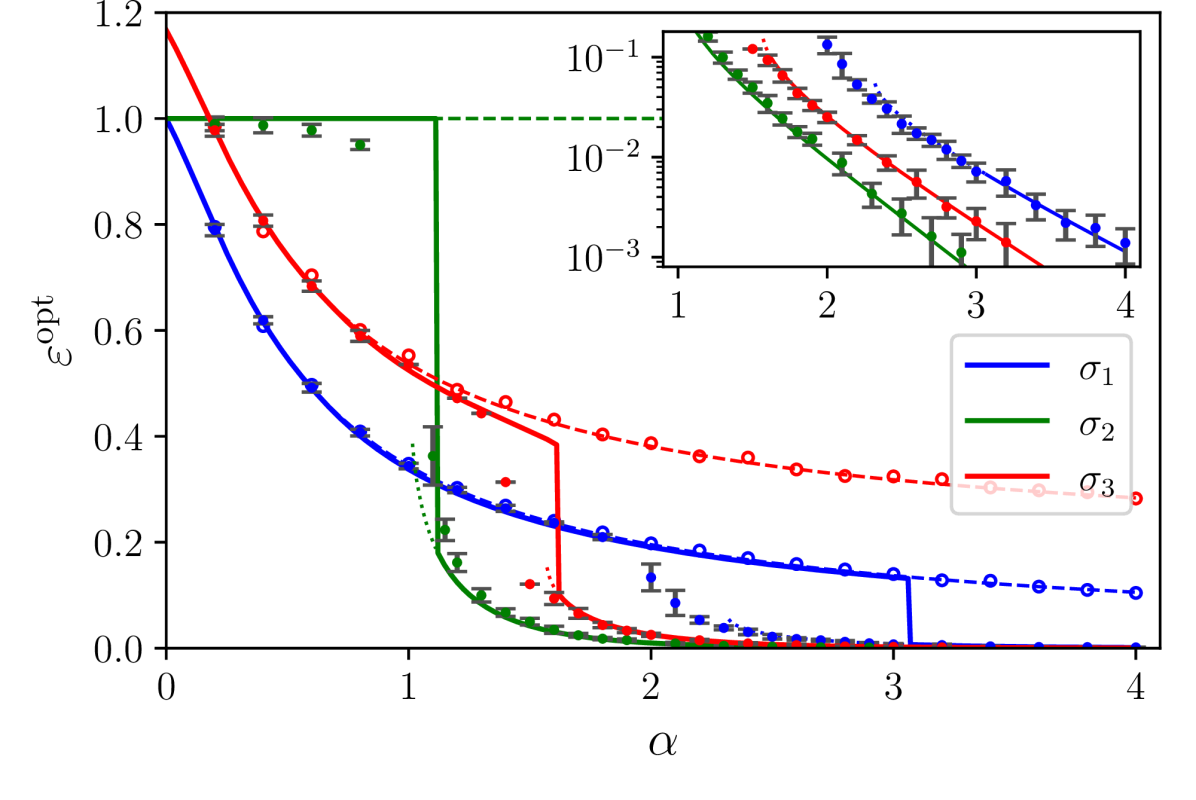
The image is a line chart displaying the relationship between epsilon opt (εopt) and alpha (α) for three different sigma values (σ1, σ2, σ3). The chart includes an inset plot showing the same data on a log scale for the y-axis. Data points are marked with circles and error bars.
### Components/Axes
* **Main Chart:**
* X-axis: α (alpha), ranging from 0 to 4.
* Y-axis: εopt (epsilon opt), ranging from 0 to 1.2.
* Legend (bottom-right):
* Blue line: σ1
* Green line: σ2
* Red line: σ3
* **Inset Chart (top-right):**
* X-axis: α (alpha), ranging from approximately 1 to 4.
* Y-axis: Logarithmic scale, ranging from 10^-3 to 10^-1.
* Data series are the same as the main chart.
### Detailed Analysis
* **σ1 (Blue Line):**
* Trend: Decreases from approximately 1.0 at α = 0 to approximately 0.15 at α = 3, then drops to 0.0 at α = 3.1.
* Data Points:
* α = 0, εopt ≈ 1.0
* α = 1, εopt ≈ 0.4
* α = 2, εopt ≈ 0.15
* α = 3, εopt ≈ 0.15
* α > 3.1, εopt = 0
* **σ2 (Green Line):**
* Trend: Remains constant at approximately 1.0 from α = 0 to α = 1.1, then drops to 0.0.
* Data Points:
* α < 1.1, εopt ≈ 1.0
* α > 1.1, εopt = 0
* **σ3 (Red Line):**
* Trend: Decreases from approximately 1.2 at α = 0 to approximately 0.45 at α = 1.7, then drops to 0.3 at α = 1.8, and remains relatively constant.
* Data Points:
* α = 0, εopt ≈ 1.2
* α = 1, εopt ≈ 0.75
* α = 2, εopt ≈ 0.3
* α = 3, εopt ≈ 0.3
* α = 4, εopt ≈ 0.3
### Key Observations
* σ2 exhibits a step function behavior, dropping sharply to zero at α ≈ 1.1.
* σ1 decreases gradually before dropping to zero at α ≈ 3.1.
* σ3 decreases gradually and then plateaus at approximately 0.3.
* The inset plot confirms the exponential decay of the data series.
### Interpretation
The chart illustrates how epsilon opt (εopt) changes with alpha (α) for different values of sigma (σ). The different sigma values seem to represent different thresholds or sensitivities. σ2 has the lowest threshold, dropping to zero at a low α value, while σ1 and σ3 have higher thresholds and exhibit more gradual decreases. The inset plot highlights the exponential decay behavior of the data, suggesting a relationship where epsilon opt decreases exponentially with increasing alpha. The error bars on the data points indicate the uncertainty in the measurements.