## Diagram: Kanizsa Triangle Illusion
### Overview
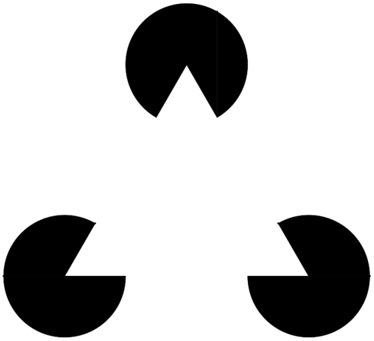
The image depicts the Kanizsa triangle illusion, a well-known optical illusion where a triangle is perceived even though it is not explicitly drawn. The illusion is created by three black circles with wedge-shaped sections removed, arranged in a triangular pattern, and three black angles.
### Components/Axes
* **Black Circles:** Three black circles, each with a 60-degree sector removed.
* **White Triangle:** An illusory white triangle perceived in the center of the arrangement.
* **Background:** White background.
### Detailed Analysis
The image consists of three black circles, each with a wedge-shaped section removed. These circles are positioned such that the removed sections point towards the center of the arrangement. This arrangement creates the illusion of a white triangle in the center, even though no actual lines are drawn to form the triangle. The triangle appears brighter than the surrounding white background.
### Key Observations
* The primary observation is the perception of a white triangle that is not actually present in the image.
* The black circles act as "inducers" that trigger the visual system to complete the shape of the triangle.
### Interpretation
The Kanizsa triangle illusion demonstrates how the human visual system actively interprets and organizes visual information. The brain fills in the missing information to perceive a complete shape, even when only partial cues are present. This illusion highlights the constructive nature of perception, where our brains actively create and interpret the visual world rather than passively receiving it. The illusion is a classic example of Gestalt principles of perception, specifically the principle of closure, where the brain tends to perceive complete forms even when they are incomplete.