## Diagram: Tripartite Circular Symbol
### Overview
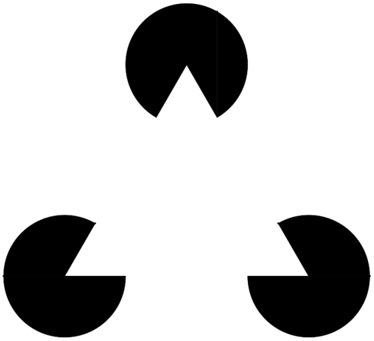
The image is a black-and-white graphic symbol composed of three identical geometric shapes arranged in a triangular formation on a plain white background. Each shape is a solid black circle with a 90-degree (quarter-circle) wedge removed, creating a "Pac-Man" or pie-chart-with-a-missing-slice appearance. The three shapes are positioned at the vertices of an implied equilateral triangle, with their open "mouths" oriented inward toward the center of the composition.
### Components/Axes
* **Primary Components:** Three identical black circular shapes.
* **Shape Geometry:** Each shape is a circle with a 90-degree sector removed. The cutout is a right angle, with the two straight edges meeting at the circle's center.
* **Spatial Arrangement:** The three shapes are placed at the top-center, bottom-left, and bottom-right positions, forming the points of an equilateral triangle.
* **Orientation:**
* **Top Shape:** The cutout opens downward, toward the center of the triangle.
* **Bottom-Left Shape:** The cutout opens to the right and slightly upward, toward the center.
* **Bottom-Right Shape:** The cutout opens to the left and slightly upward, toward the center.
* **Color:** All shapes are solid black (#000000). The background is solid white (#FFFFFF).
* **Text/Labels:** There is no text, numerical data, axis labels, legends, or titles present in the image.
### Detailed Analysis
* **Symmetry:** The composition exhibits rotational symmetry of 120 degrees. Rotating the image by one-third of a full turn would result in an identical visual arrangement.
* **Negative Space:** The white space between the three black shapes forms a central, roughly triangular area. The inward-facing cutouts create three white "pathways" leading from the edges of the image to this central space.
* **Visual Weight:** The three black shapes carry equal visual weight, creating a balanced and stable composition.
### Key Observations
* The design is minimalist, using only two colors and simple geometric forms.
* The orientation of the cutouts is precise and intentional, directing the viewer's eye toward the center of the arrangement.
* The image contains no gradients, textures, or shadows; it is a flat, two-dimensional graphic.
### Interpretation
This image is a symbolic diagram, not a data chart. It presents no factual data or quantitative information. Its meaning is derived from its form and arrangement.
* **Symbolic Potential:** The tripartite structure is a common archetype representing concepts like trinity, cycles (beginning, middle, end), or interconnected systems. The inward-facing openings suggest convergence, collaboration, or a shared focal point. The missing sectors could symbolize incompleteness, potential, or the need for the three parts to combine to form a whole.
* **Relationship Between Elements:** The three components are identical and equally spaced, implying equality and interdependence. Their orientation creates a dynamic tension, pulling visual energy toward the center of the triangle, which remains an empty, defined space.
* **Notable Anomalies:** There are no anomalies in the traditional data sense. The design is perfectly symmetrical and consistent. The only "notable" feature is the complete absence of any textual or numerical information, defining it purely as a visual symbol or icon.
**Conclusion:** The image is a geometric symbol, not a technical document containing extractable text or data. Its informational content is purely visual and symbolic, representing unity, convergence, or a cyclical relationship between three equal parts.