## Chart Type: Line Chart - Average Incorrect Flips per Iteration
### Overview
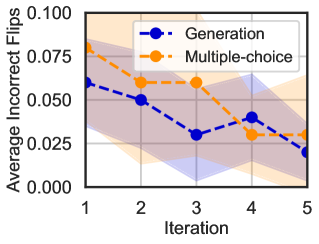
This image displays a 2D line chart comparing the "Average Incorrect Flips" for two different methods, "Generation" and "Multiple-choice," across five "Iterations." Each method is represented by a distinct dashed line with circular markers and an associated shaded region indicating variability or confidence.
### Components/Axes
The chart is structured with a Y-axis on the left and an X-axis at the bottom. A legend is positioned in the top-right corner.
* **Y-axis (Vertical Axis)**:
* **Label**: "Average Incorrect Flips"
* **Range**: From 0.000 to 0.100.
* **Major Ticks**: 0.000, 0.025, 0.050, 0.075, 0.100.
* **X-axis (Horizontal Axis)**:
* **Label**: "Iteration"
* **Range**: From 1 to 5.
* **Major Ticks**: 1, 2, 3, 4, 5.
* **Legend**: Located in the top-right quadrant of the plot area.
* A blue circle marker connected by a dashed blue line represents "Generation".
* An orange circle marker connected by a dashed orange line represents "Multiple-choice".
### Detailed Analysis
The chart presents two data series, each showing a trend of "Average Incorrect Flips" as "Iteration" increases.
1. **"Generation" Series (Blue dashed line with circle markers)**:
* **Visual Trend**: This line generally shows a decreasing trend in "Average Incorrect Flips" over iterations, with a slight increase at Iteration 4 before a final sharp decrease.
* **Data Points (approximate)**:
* Iteration 1: Approximately 0.060
* Iteration 2: Approximately 0.050
* Iteration 3: Approximately 0.029
* Iteration 4: Approximately 0.040
* Iteration 5: Approximately 0.020
* **Shaded Area**: A light blue shaded region surrounds the "Generation" line, indicating the variability or confidence interval for this method's performance. This region is relatively narrow, suggesting lower variability compared to "Multiple-choice" at early iterations.
2. **"Multiple-choice" Series (Orange dashed line with circle markers)**:
* **Visual Trend**: This line also shows a general decreasing trend, starting higher than "Generation" and remaining higher for the first three iterations. It then experiences a significant drop between Iteration 3 and 4, crossing below the "Generation" line, and then levels off.
* **Data Points (approximate)**:
* Iteration 1: Approximately 0.080
* Iteration 2: Approximately 0.060
* Iteration 3: Approximately 0.060
* Iteration 4: Approximately 0.030
* Iteration 5: Approximately 0.030
* **Shaded Area**: A light orange shaded region surrounds the "Multiple-choice" line, indicating its variability or confidence interval. This region is notably wider at Iteration 1 compared to "Generation," suggesting higher initial variability.
### Key Observations
* Both "Generation" and "Multiple-choice" methods demonstrate an overall reduction in "Average Incorrect Flips" as the number of "Iterations" increases, suggesting an improvement or learning effect over time.
* Initially, at Iteration 1, the "Multiple-choice" method has a higher "Average Incorrect Flips" (~0.080) compared to "Generation" (~0.060).
* For Iterations 1, 2, and 3, the "Generation" method consistently shows lower "Average Incorrect Flips" than the "Multiple-choice" method.
* Between Iteration 3 and Iteration 4, the "Multiple-choice" method experiences a sharp decrease in "Average Incorrect Flips," dropping from ~0.060 to ~0.030. During this same period, "Generation" shows a slight increase from ~0.029 to ~0.040.
* At Iteration 4, the "Multiple-choice" method's performance (lower incorrect flips) surpasses that of the "Generation" method.
* By Iteration 5, both methods achieve relatively low and comparable levels of "Average Incorrect Flips," with "Generation" at ~0.020 and "Multiple-choice" at ~0.030.
* The shaded regions for both series overlap significantly, particularly from Iteration 3 onwards, suggesting that the differences in mean performance might not always be statistically significant, especially in later iterations.
### Interpretation
This chart illustrates the comparative performance of two distinct methods, "Generation" and "Multiple-choice," in a task where "Average Incorrect Flips" is a metric of error or inefficiency, with lower values being more desirable.
The "Generation" method appears to offer a more consistent and initially superior performance, maintaining lower incorrect flips for the first three iterations. Its improvement curve is relatively smooth, with a minor setback at Iteration 4 before achieving its lowest error rate at Iteration 5.
Conversely, the "Multiple-choice" method starts with a higher error rate and shows slower initial improvement. However, it demonstrates a significant breakthrough or optimization between Iteration 3 and 4, leading to a dramatic reduction in incorrect flips. This suggests that while "Multiple-choice" might have a steeper learning curve or require more iterations to stabilize, it can achieve competitive performance.
The crossing of the lines at Iteration 4 is a critical point, indicating a shift in relative effectiveness. The "Multiple-choice" method, despite its higher initial error, manages to outperform "Generation" at Iteration 4. However, "Generation" recovers and slightly surpasses "Multiple-choice" again by Iteration 5, achieving the lowest overall "Average Incorrect Flips."
The overlapping confidence intervals (shaded regions) are important. They suggest that while the mean values differ, there's a degree of uncertainty, and the true difference between the methods might not always be statistically significant, especially when the lines are close. The wider initial confidence interval for "Multiple-choice" at Iteration 1 implies greater variability in its early performance compared to "Generation."
In summary, both methods improve over time, but their performance trajectories differ. "Generation" offers more stable and initially better performance, while "Multiple-choice" shows a delayed but significant improvement, making it competitive in later stages. The choice between methods might depend on the desired performance at specific iterations or the tolerance for initial variability.