## Diagram: Proof Flow of Unitary Idempotent Identity Theorem
### Overview
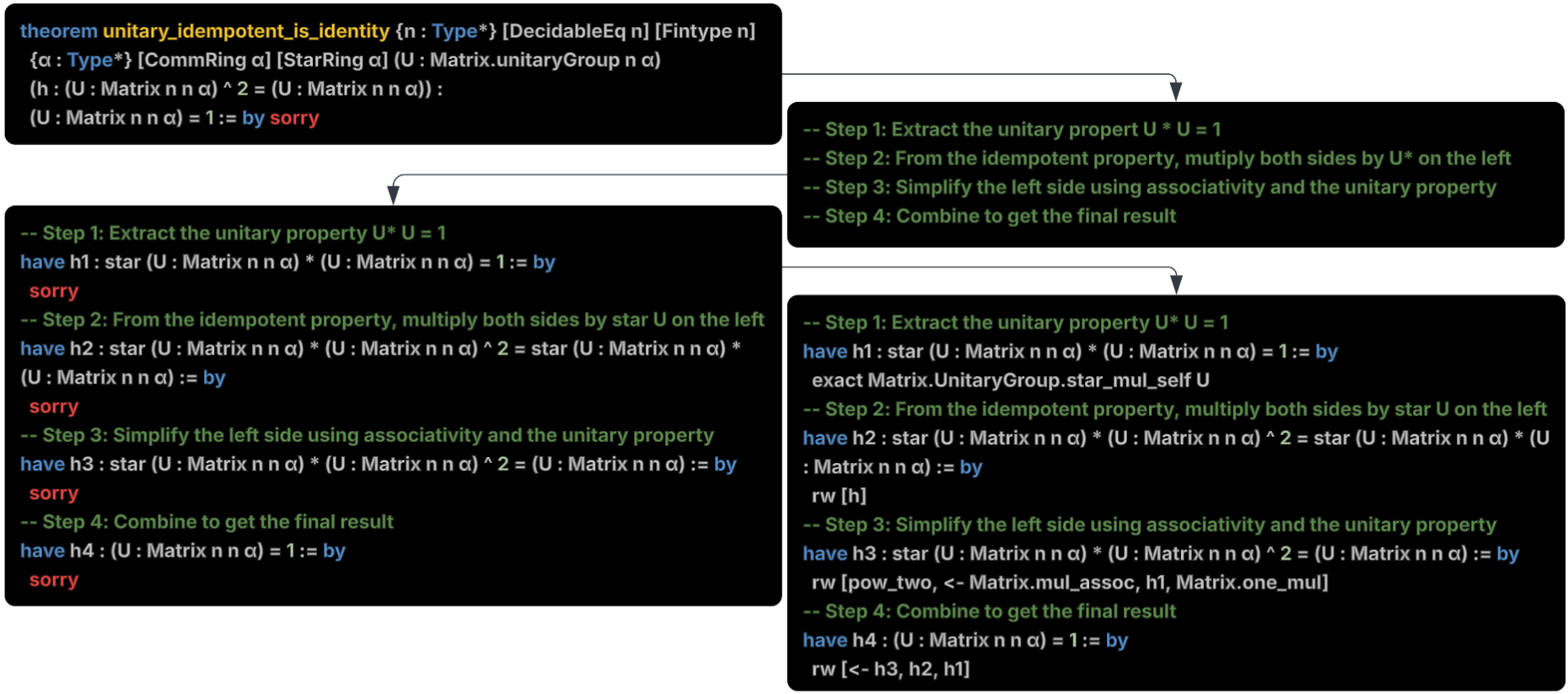
The image presents a diagram illustrating the proof of the theorem "unitary_idempotent_is_identity". It outlines the steps involved in proving that if a unitary matrix U is also idempotent (U^2 = U), then U must be the identity matrix (U = 1). The diagram shows the initial theorem statement and two different approaches to the proof, one marked with "sorry" indicating an incomplete or unsuccessful attempt, and the other showing a successful proof using specific Lean tactics.
### Components/Axes
* **Header:** Contains the theorem statement:
* `theorem unitary_idempotent_is_identity {n: Type*} [DecidableEq n] [Fintype n] {a: Type*} [CommRing a] [StarRing α] (U: Matrix.unitaryGroup n a) (h: (U: Matrix n n a) ^ 2 = (U: Matrix n n α)) : (U: Matrix n n a) = 1 := by sorry`
* **Nodes:** Three rectangular nodes, each containing a series of steps.
* The top node outlines the general steps of the proof.
* The bottom-left node shows an attempt at the proof that ends with "sorry" at each step.
* The bottom-right node shows a successful proof using Lean tactics.
* **Arrows:** Arrows indicate the flow of the proof from the initial statement to the subsequent steps.
### Detailed Analysis or ### Content Details
**Top Node (General Steps):**
* Step 1: Extract the unitary property U* U = 1
* Step 2: From the idempotent property, multiply both sides by U* on the left
* Step 3: Simplify the left side using associativity and the unitary property
* Step 4: Combine to get the final result
**Bottom-Left Node (Unsuccessful Proof):**
* Step 1: Extract the unitary property U* U = 1
* `have h1: star (U: Matrix n n a) * (U: Matrix n n a) = 1 := by sorry`
* Step 2: From the idempotent property, multiply both sides by star U on the left
* `have h2: star (U: Matrix n n a) * (U: Matrix n n a) ^ 2 = star (U: Matrix n n a) * (U: Matrix n n a) := by sorry`
* Step 3: Simplify the left side using associativity and the unitary property
* `have h3: star (U: Matrix n n a) * (U: Matrix n n a) ^ 2 = (U: Matrix n n a) := by sorry`
* Step 4: Combine to get the final result
* `have h4: (U: Matrix n n a) = 1 := by sorry`
**Bottom-Right Node (Successful Proof):**
* Step 1: Extract the unitary property U* U = 1
* `have h1: star (U: Matrix n n a) * (U: Matrix n n a) = 1 := by exact Matrix.UnitaryGroup.star_mul_self U`
* Step 2: From the idempotent property, multiply both sides by star U on the left
* `have h2: star (U: Matrix n n a) * (U: Matrix n n a) ^ 2 = star (U: Matrix n n a) * (U : Matrix n n a) := by rw [h]`
* Step 3: Simplify the left side using associativity and the unitary property
* `have h3: star (U: Matrix n n a) * (U: Matrix n n a) ^ 2 = (U: Matrix n n a) := by rw [pow_two, <- Matrix.mul_assoc, h1, Matrix.one_mul]`
* Step 4: Combine to get the final result
* `have h4: (U: Matrix n n a) = 1 := by rw [<- h3, h2, h1]`
### Key Observations
* The diagram illustrates two attempts to prove the theorem.
* The left branch represents an unsuccessful attempt, indicated by the "sorry" statements.
* The right branch represents a successful proof, utilizing specific Lean tactics such as `exact Matrix.UnitaryGroup.star_mul_self U` and `rw` (rewrite) with various lemmas.
### Interpretation
The diagram demonstrates the process of proving a mathematical theorem within a formal proof system like Lean. It highlights the contrast between an incomplete or naive approach (left branch) and a successful proof achieved by applying specific tactics and lemmas (right branch). The "sorry" statements indicate points where the proof could not be completed with the given information or tactics. The successful proof demonstrates the application of unitary and idempotent properties, along with associativity and identity properties of matrix multiplication, to arrive at the conclusion that U = 1. The diagram effectively visualizes the logical flow and the steps required to formally prove the theorem.