\n
## Diagram: Proof of Unitary Idempotent Identity
### Overview
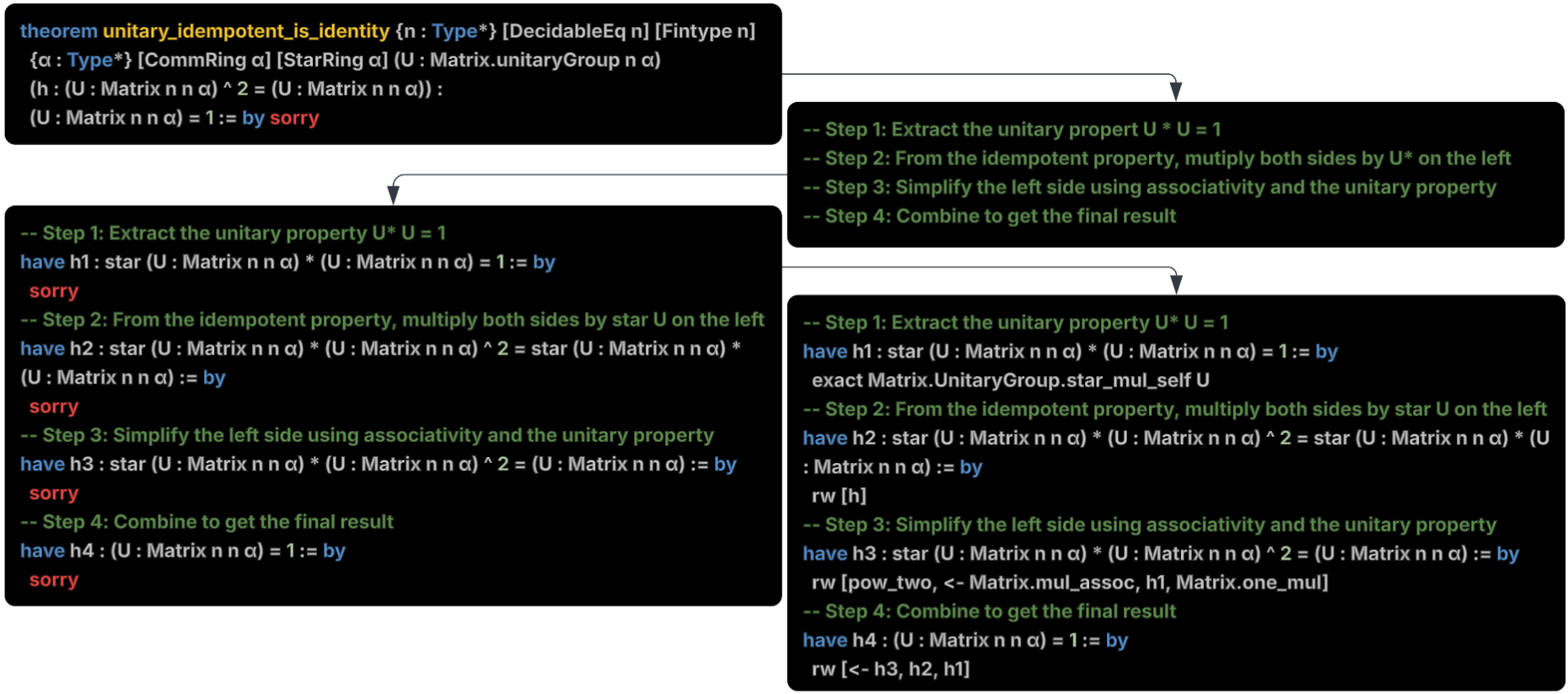
The image presents a diagram illustrating a mathematical proof, specifically concerning the unitary idempotent identity. The diagram is structured as a flow chart, outlining a series of steps to demonstrate the identity. The proof appears to be formalized within a type theory context, likely Coq, given the syntax used. The diagram is split into three main sections, each representing a different branch of the proof.
### Components/Axes
The diagram consists of interconnected boxes representing steps in the proof. Arrows indicate the flow of logic. Each box contains text representing mathematical statements and annotations. The diagram is organized into three columns, with the first two columns representing different proof branches and the third column representing the final result.
### Detailed Analysis or Content Details
**Left Column:**
* **Theorem:** `theorem unitary_idempotent_is_identity (n : Type*) [DecidableEq n] [Fintype n] (a : (U : Matrix n n c) * (U : Matrix n n c)) :`
* **Goal:** `(U : Matrix n n c) = 1:= by sorry`
* **Step 1:** `have h1: star (U : Matrix n n c) * (U : Matrix n n c) = 1:= by sorry`
* **Step 2:** `have h2: star (U : Matrix n n c) * (U : Matrix n n c) ^ 2 = star (U : Matrix n n c) * (U : Matrix n n c) := by sorry`
* **Step 3:** `have h3: star (U : Matrix n n c) * (U : Matrix n n c) ^ 2 = (U : Matrix n n c) := by sorry`
* **Step 4:** `have h4: (U : Matrix n n c) = 1:= by sorry`
**Center Column:**
* **Step 1:** `Extract the unitary property U* U = 1`
* **Step 2:** `From the idempotent property, multiply both sides by U* on the left`
* **Step 3:** `Simplify the left side using associativity and the unitary property`
* **Step 4:** `Combine to get the final result`
**Right Column:**
* **Step 1:** `Extract the unitary property U* U = 1`
* **Step 2:** `From the idempotent property, multiply both sides by U* on the left`
* **Step 3:** `Simplify the left side using associativity and the unitary property`
* **Step 4:** `Combine to get the final result`
* `have h4: (U : Matrix n n c) = 1:= by sorry`
* `rw [h1, h2, h3]`
* `rw [pow_two, < Matrix_mul_assoc, h1, Matrix_one_mul]`
**Annotations:**
* `Type*`: Indicates a type in the type theory.
* `DecidableEq n`: Indicates decidable equality for type `n`.
* `Fintype n`: Indicates a finite type `n`.
* `Matrix n n c`: Represents an n x n matrix with elements from type `c`.
* `star`: Likely represents the conjugate transpose of a matrix.
* `sorry`: Placeholder indicating a step that needs to be completed.
* `pow_two`: A rewrite rule for squaring a value.
* `Matrix_mul_assoc`: A rewrite rule for matrix multiplication associativity.
* `Matrix_one_mul`: A rewrite rule for multiplying a matrix by the identity matrix.
* `rw`: Rewrite rule application.
### Key Observations
The diagram shows a proof structure with multiple steps, each marked as "by sorry," indicating that the actual proof details are missing. The left column presents the theorem and intermediate results (h1, h2, h3, h4), while the center and right columns provide a high-level description of the proof steps. The right column also shows rewrite rule applications (`rw`) to simplify the expression.
### Interpretation
The diagram outlines a proof strategy for the unitary idempotent identity. The core idea is to leverage the unitary property (U*U = 1) and the idempotent property to demonstrate the identity. The "sorry" placeholders suggest that the proof is incomplete or under development. The use of rewrite rules in the right column indicates a tactic-based proof approach, common in interactive theorem provers like Coq. The diagram serves as a roadmap for completing the proof, highlighting the key steps and the expected transformations. The notation suggests a formal mathematical setting, likely within a proof assistant environment. The diagram is not presenting data in the traditional sense, but rather a logical structure for a mathematical argument.