## Diagram: Maze Structures with Colored Markers
### Overview
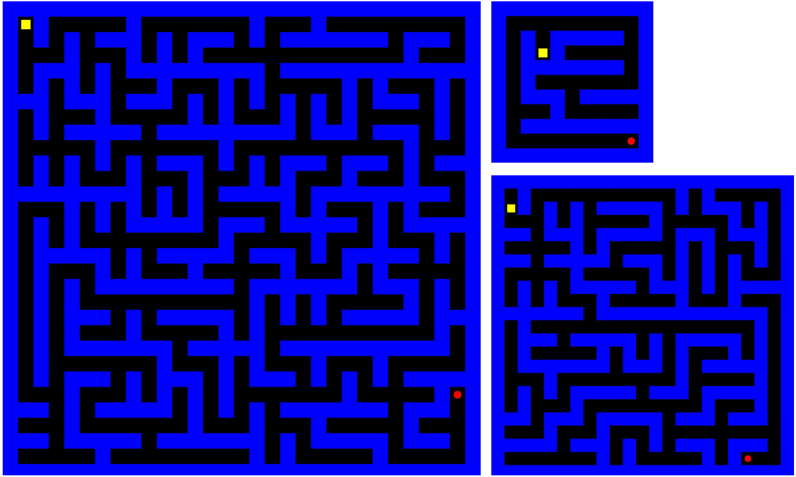
The image displays three maze diagrams of varying sizes (large, medium, small) arranged in a grid layout. Each maze is composed of black pathways on a blue background, with colored dots (yellow and red) positioned at specific nodes. No textual labels, legends, or axis markers are present.
### Components/Axes
- **Maze Layouts**:
- **Large Maze (Left)**: Dominates the left side, occupying ~60% of the image width.
- **Medium Maze (Bottom-Right)**: Positioned below the large maze, ~30% width.
- **Small Maze (Top-Right)**: Overlaps the top-right corner, ~15% width.
- **Colored Markers**:
- **Yellow Dots**: Appear at the top-left corner of the large maze and the top-left corner of the small maze.
- **Red Dots**: Located at the bottom-right corner of the large maze, bottom-right corner of the medium maze, and bottom-right corner of the small maze.
### Detailed Analysis
- **Maze Complexity**:
- The large maze exhibits the highest complexity, with dense, intertwining pathways.
- The medium and small mazes have simpler, more linear structures.
- **Marker Placement**:
- Yellow dots are consistently placed at the **top-left** of their respective mazes.
- Red dots are consistently placed at the **bottom-right** of their respective mazes.
- **No Textual Elements**:
- No labels, legends, or axis titles are visible.
### Key Observations
1. **Marker Consistency**: Yellow and red dots are positioned at fixed corners across all mazes, suggesting a potential symbolic or navigational purpose.
2. **Size Correlation**: Larger mazes have more intricate pathways, while smaller mazes are simplified.
3. **Absence of Labels**: No textual information is provided to explain the purpose or context of the mazes or markers.
### Interpretation
The image likely represents a visual puzzle or navigation challenge, with colored markers indicating start/end points or objectives. The lack of textual labels implies the mazes are designed for intuitive interpretation, possibly for a game or cognitive test. The consistent placement of markers across mazes suggests a standardized framework, though the absence of explicit instructions leaves the exact purpose ambiguous. The size variation may indicate difficulty scaling or spatial constraints in different contexts.