## Maze Diagram: Three Mazes of Varying Complexity
### Overview
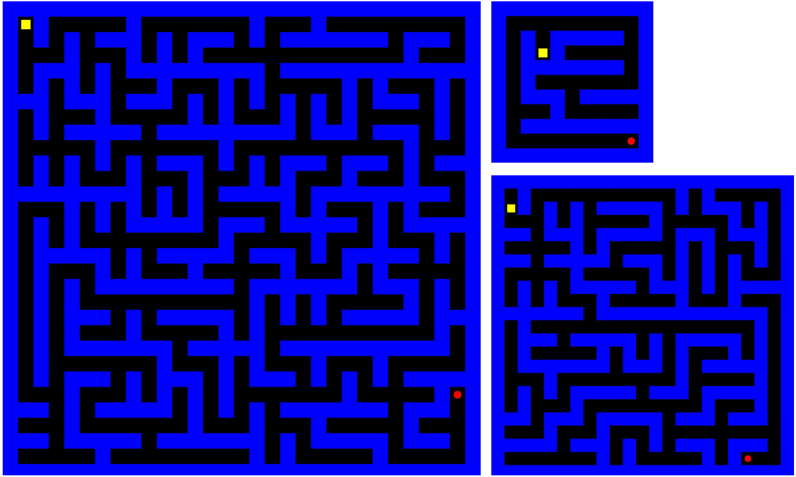
The image presents three distinct mazes, each enclosed within a square or rectangular boundary. The mazes are rendered in a blue and black color scheme, with a yellow starting point and a red ending point. The mazes vary in size and complexity.
### Components/Axes
* **Maze Walls:** Represented by black lines.
* **Maze Paths:** Represented by blue lines.
* **Start Point:** A yellow square located near the top-left corner of each maze.
* **End Point:** A red square located near the bottom-right corner of the largest maze, and near the bottom-right corner of the smaller mazes.
* **Maze 1:** The largest maze, located on the left side of the image.
* **Maze 2:** A smaller maze, located on the top-right side of the image.
* **Maze 3:** A medium-sized maze, located on the bottom-right side of the image.
### Detailed Analysis or Content Details
* **Maze 1 (Large):** The start point is located in the top-left corner. The end point is located in the bottom-right corner. The maze has a high level of complexity, with numerous twists and turns.
* **Maze 2 (Small):** The start point is located in the top-left corner. The end point is located in the bottom-right corner. The maze has a low level of complexity, with fewer twists and turns.
* **Maze 3 (Medium):** The start point is located in the top-left corner. The end point is located in the bottom-right corner. The maze has a medium level of complexity, with a moderate number of twists and turns.
### Key Observations
* All three mazes share a consistent color scheme and design.
* The mazes vary significantly in size and complexity.
* The start and end points are consistently located in the top-left and bottom-right corners, respectively.
### Interpretation
The image likely serves as a visual representation of problem-solving challenges of varying difficulty. The mazes, with their different levels of complexity, could symbolize different levels of difficulty in a task or problem. The consistent placement of start and end points suggests a standardized goal, while the varying paths represent different routes or strategies to achieve that goal. The image could be used to illustrate concepts related to algorithms, pathfinding, or problem-solving strategies.