\n
## Diagram: Mazes
### Overview
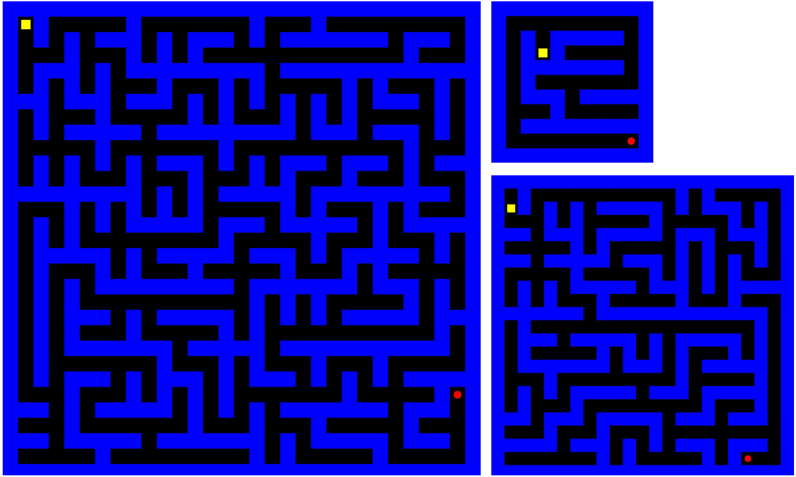
The image depicts three mazes. The mazes are constructed with black lines on a blue background. Each maze has a distinct starting point marked with a yellow square and an ending point marked with a red square. The mazes vary in size and complexity.
### Components/Axes
There are no axes or legends present in this image. The components are solely the mazes themselves, defined by their black pathways on a blue background, and the start/end markers.
### Detailed Analysis or Content Details
* **Maze 1 (Top-Left):** This is the largest and most complex maze. The starting point (yellow square) is located in the top-left corner, and the ending point (red square) is located in the bottom-right corner. The maze consists of a dense network of interconnected pathways.
* **Maze 2 (Top-Right):** This maze is smaller and less complex than Maze 1. The starting point (yellow square) is in the top-left corner, and the ending point (red square) is in the bottom-right corner. The pathways are more straightforward.
* **Maze 3 (Bottom-Center):** This maze is of intermediate size and complexity. The starting point (yellow square) is in the top-left corner, and the ending point (red square) is in the bottom-right corner. The pathways are more intricate than Maze 2 but less so than Maze 1.
### Key Observations
All three mazes share a common color scheme (black pathways on a blue background) and a consistent start/end point convention (yellow start, red end). The complexity of the mazes increases from Maze 2 to Maze 3 to Maze 1. There is no numerical data or quantifiable information present.
### Interpretation
The image presents a visual challenge – solving mazes. The varying complexity suggests a potential progression in difficulty. The image doesn't offer any specific data or insights beyond the visual representation of the mazes themselves. It's a purely graphical representation of a problem-solving activity. The mazes could be used for testing spatial reasoning, problem-solving skills, or as a recreational activity. The lack of any additional context or information limits the depth of interpretation. The image is a demonstration of maze design, and the differences in complexity could be used to illustrate different levels of challenge.