## Diagram: Alignment of Intelligence and Goals with Extrinsic/Intrinsic Mechanisms
### Overview
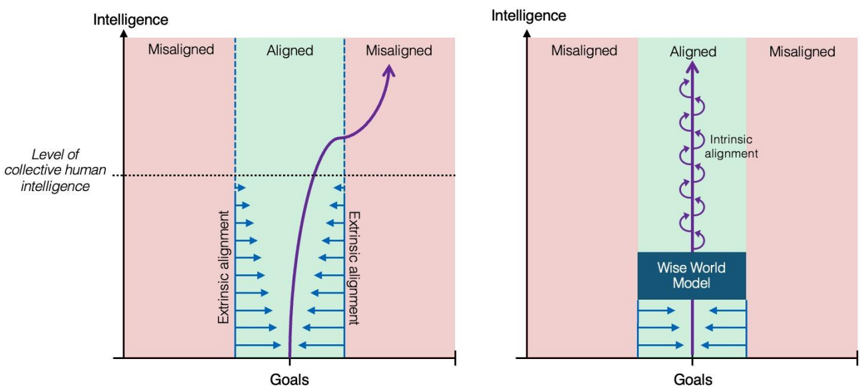
The image contains two side-by-side diagrams comparing alignment dynamics between collective human intelligence and goal-oriented systems. Both diagrams use a coordinate system with "Intelligence" (vertical axis) and "Goals" (horizontal axis), divided into three horizontal regions: "Misaligned" (pink), "Aligned" (green), and "Misaligned" (pink). Arrows and curves illustrate alignment mechanisms, with the right diagram introducing a "Wise World Model" component.
### Components/Axes
1. **Axes**:
- **Vertical Axis**: "Intelligence" (labeled with "Level of collective human intelligence" at the midpoint)
- **Horizontal Axis**: "Goals" (divided into three regions: Misaligned → Aligned → Misaligned)
2. **Regions**:
- **Left Diagram**:
- Pink (Misaligned) on left and right
- Green (Aligned) in the center
- **Right Diagram**: Same regional division as left
3. **Legends/Markers**:
- **Arrows**: Blue, labeled "Extrinsic alignment" (left) and "Intrinsic alignment" (right)
- **Curves**:
- Left: Purple curve starting in left Misaligned, dipping into Aligned, then rising into right Misaligned
- Right: Vertical purple line labeled "Intrinsic alignment" within Aligned region
- **Box**: Blue box labeled "Wise World Model" at the bottom of the right diagram
### Detailed Analysis
1. **Left Diagram**:
- **Extrinsic Alignment Arrows**: Point toward the purple curve from the Aligned region, suggesting external mechanisms guide the system toward alignment.
- **Purple Curve**: Starts in left Misaligned, dips into Aligned (indicating temporary alignment), then ascends into right Misaligned (suggesting instability or regression).
2. **Right Diagram**:
- **Intrinsic Alignment Arrows**: Circular motion around the vertical purple line, implying self-reinforcing alignment mechanisms.
- **Wise World Model**: Positioned at the base of the Aligned region, acting as a stabilizing framework for intrinsic alignment.
### Key Observations
1. Both diagrams share identical regional divisions but differ in alignment mechanisms.
2. The left diagram emphasizes extrinsic alignment (external guidance), while the right diagram introduces intrinsic alignment (self-sustaining) and the Wise World Model.
3. The vertical purple line in the right diagram suggests a critical threshold for maintaining alignment.
4. The Wise World Model is spatially isolated at the bottom, potentially representing foundational infrastructure.
### Interpretation
The diagrams contrast two alignment paradigms:
1. **Extrinsic Alignment** (left): Relies on external interventions to guide systems toward goals, but risks instability (curve's reversion to Misaligned).
2. **Intrinsic Alignment** (right): Self-reinforcing mechanisms (circular arrows) maintain alignment within the Aligned region, supported by the Wise World Model as a stabilizing foundation.
3. The vertical purple line in the right diagram may represent a "tipping point" where intrinsic alignment becomes dominant, preventing regression to Misaligned states.
4. The absence of numerical data suggests a conceptual framework rather than quantitative analysis, focusing on systemic relationships between intelligence, goals, and alignment mechanisms.