\n
## Scatter Plot: Cognitive Task Distribution in PC Space
### Overview
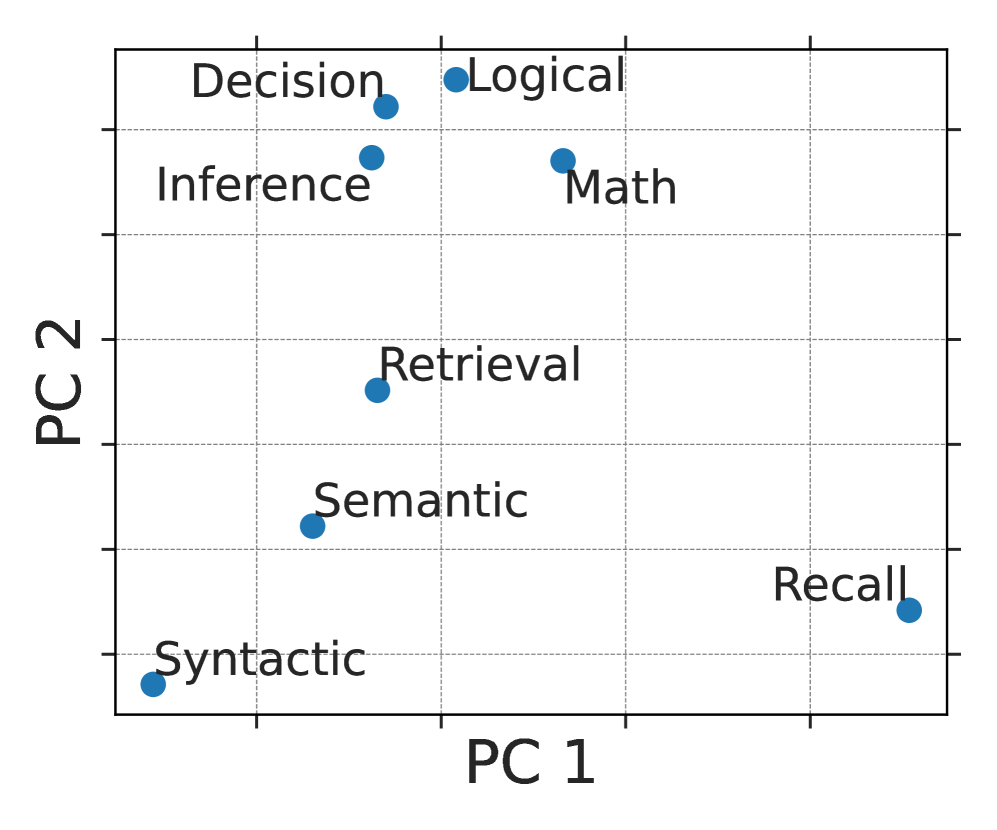
The image presents a scatter plot visualizing the distribution of various cognitive tasks across two principal components (PC1 and PC2). Each task is represented by a blue circular marker, positioned according to its coordinates on the PC1 and PC2 axes. The plot appears to be a dimensionality reduction representation of these tasks, potentially derived from a larger dataset.
### Components/Axes
* **X-axis:** Labeled "PC 1". The scale is not explicitly marked with numerical values, but it extends from left to right.
* **Y-axis:** Labeled "PC 2". The scale is not explicitly marked with numerical values, but it extends from bottom to top.
* **Data Points:** Represented by blue circles, each labeled with a cognitive task name.
* **Tasks:** The following cognitive tasks are represented:
* Syntactic
* Semantic
* Retrieval
* Inference
* Decision
* Logical
* Math
* Recall
### Detailed Analysis
The plot shows the relative positioning of each task within the PC1-PC2 space. Here's an approximate breakdown of the coordinates, noting the lack of explicit numerical scales:
* **Syntactic:** Located in the bottom-left quadrant. Approximate coordinates: (-2.5, -2.5).
* **Semantic:** Located slightly above and to the right of Syntactic. Approximate coordinates: (-1.5, -1.5).
* **Retrieval:** Located centrally, above Semantic. Approximate coordinates: (-0.5, 0.5).
* **Inference:** Located in the top-left quadrant, above Decision. Approximate coordinates: (-1.0, 2.0).
* **Decision:** Located in the top-left quadrant. Approximate coordinates: (-0.5, 2.5).
* **Logical:** Located to the right of Decision. Approximate coordinates: (1.0, 2.5).
* **Math:** Located to the right of Inference, and below Logical. Approximate coordinates: (1.0, 1.5).
* **Recall:** Located in the bottom-right quadrant. Approximate coordinates: (2.5, -1.5).
Visually, the tasks cluster into a few groups. Syntactic and Semantic are relatively close together. Retrieval is somewhat isolated. Decision, Inference, Logical, and Math form a cluster in the upper portion of the plot. Recall is distinctly separated in the bottom-right.
### Key Observations
* **Separation of Recall:** Recall is the most distant task from the others, residing in the bottom-right quadrant.
* **Clustering of Reasoning Tasks:** Decision, Inference, Logical, and Math appear to be closely related in this PC space.
* **Proximity of Syntactic and Semantic:** These two tasks are positioned near each other, suggesting a potential relationship.
* **Retrieval as a Central Task:** Retrieval is positioned near the center of the plot, potentially indicating it's a more general or foundational cognitive process.
### Interpretation
This scatter plot likely represents the results of a Principal Component Analysis (PCA) applied to a dataset of cognitive task performance or features. PCA reduces the dimensionality of the data, identifying the principal components (PC1 and PC2) that explain the most variance.
The positioning of the tasks suggests that PC1 might represent a dimension related to complexity or abstraction, with Syntactic and Semantic tasks being relatively simple and Recall being more complex. PC2 might represent a dimension related to reasoning or decision-making, with Decision, Logical, and Math tasks scoring high on this component.
The separation of Recall suggests it relies on different cognitive mechanisms than the other tasks. The clustering of reasoning tasks indicates they share underlying cognitive processes. The proximity of Syntactic and Semantic suggests a strong relationship between language understanding and structure.
The lack of numerical scales on the axes limits the quantitative interpretation of the distances between tasks. However, the plot provides a valuable visual representation of the relationships between these cognitive tasks in a reduced-dimensional space. This could be used to inform further research into the cognitive architecture underlying these tasks.