## Workflow Diagram: Code Patching and Testing
### Overview
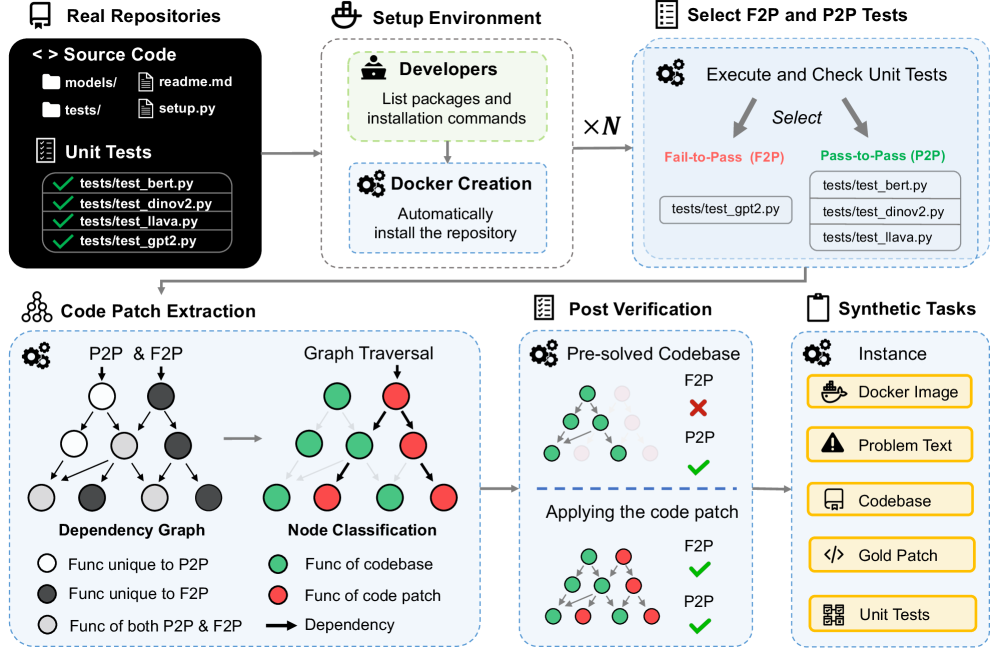
The image is a workflow diagram illustrating the process of code patching and testing, specifically focusing on Fail-to-Pass (F2P) and Pass-to-Pass (P2P) scenarios. It outlines the steps from acquiring real repositories to applying code patches and verifying the results using synthetic tasks.
### Components/Axes
* **Header:** Contains the titles of the major stages: "Real Repositories", "Setup Environment", "Select F2P and P2P Tests", "Code Patch Extraction", "Post Verification", and "Synthetic Tasks".
* **Real Repositories:**
* "Source Code": Lists example directories and files: "models/", "tests/", "readme.md", "setup.py".
* "Unit Tests": Lists example test files with green checkmarks: "tests/test\_bert.py", "tests/test\_dinov2.py", "tests/test\_llava.py", "tests/test\_gpt2.py".
* **Setup Environment:**
* "Developers": Describes the task of listing packages and installation commands.
* "Docker Creation": Describes the automatic installation of the repository.
* **Select F2P and P2P Tests:**
* "Execute and Check Unit Tests": Indicates the execution and checking of unit tests.
* "Fail-to-Pass (F2P)": Lists example test files: "tests/test\_gpt2.py".
* "Pass-to-Pass (P2P)": Lists example test files: "tests/test\_bert.py", "tests/test\_dinov2.py", "tests/test\_llava.py".
* **Code Patch Extraction:**
* "Dependency Graph": A graph showing dependencies between functions, with nodes colored according to their type (unique to P2P, unique to F2P, or both).
* Legend:
* White circle: "Func unique to P2P"
* Dark gray circle: "Func unique to F2P"
* Light gray circle: "Func of both P2P & F2P"
* Nodes are connected by arrows indicating "Dependency".
* "Node Classification": A graph showing nodes classified as either part of the codebase or the code patch.
* Legend:
* Green circle: "Func of codebase"
* Red circle: "Func of code patch"
* Nodes are connected by arrows indicating "Dependency".
* **Post Verification:**
* "Pre-solved Codebase": Shows a graph with nodes representing the codebase, indicating whether F2P and P2P tests pass or fail.
* F2P: Red "X" indicating failure.
* P2P: Green checkmark indicating success.
* "Applying the code patch": Shows a graph with nodes representing the codebase after applying the code patch, indicating whether F2P and P2P tests pass or fail.
* F2P: Green checkmark indicating success.
* P2P: Green checkmark indicating success.
* **Synthetic Tasks:**
* "Instance": Lists the components of a synthetic task: "Docker Image", "Problem Text", "Codebase", "Gold Patch", "Unit Tests".
### Detailed Analysis or ### Content Details
* **Real Repositories:** This section represents the starting point, where the source code and unit tests reside. The listed files suggest a Python project structure.
* **Setup Environment:** This stage involves setting up the environment for testing, including installing necessary packages and the repository itself, likely using Docker. The "x N" indicates that the setup environment is repeated N times.
* **Select F2P and P2P Tests:** This stage involves selecting tests that either fail initially but should pass after the patch (F2P) or pass initially and should continue to pass after the patch (P2P).
* **Code Patch Extraction:** This section details the process of extracting and classifying code patches based on their dependencies and origin (codebase or patch). The dependency graph shows the relationships between functions, while the node classification identifies which functions belong to the original codebase and which belong to the code patch.
* **Post Verification:** This stage verifies the effectiveness of the code patch by checking if the F2P tests now pass and the P2P tests continue to pass.
* **Synthetic Tasks:** This section lists the components used for synthetic testing, including Docker images, problem text, the codebase, a gold patch, and unit tests.
### Key Observations
* The diagram highlights the importance of distinguishing between F2P and P2P tests in the code patching process.
* The use of dependency graphs and node classification helps in understanding the impact of code patches on the codebase.
* The verification stage ensures that the code patch effectively fixes the failing tests without breaking existing functionality.
### Interpretation
The diagram illustrates a systematic approach to code patching and testing, emphasizing the need for rigorous verification to ensure the quality and reliability of the patched code. The distinction between F2P and P2P tests is crucial for identifying and addressing specific types of bugs. The use of synthetic tasks provides a controlled environment for evaluating the effectiveness of the code patch. The workflow demonstrates a focus on automation and reproducibility, with Docker being used to create consistent testing environments. The diagram suggests a comprehensive testing strategy that aims to minimize the risk of introducing new issues while fixing existing ones.