## Flowchart: Repository Code Patch Verification Process
### Overview
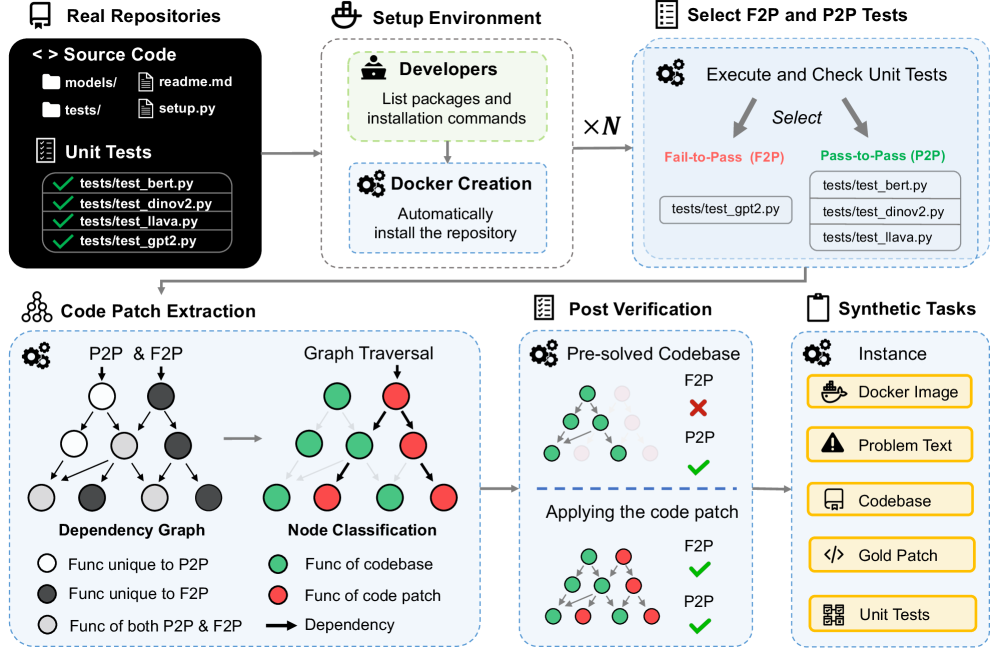
This diagram illustrates a multi-stage workflow for validating code patches in software repositories. It connects real repositories through environment setup, test execution, patch analysis, and synthetic task generation. The process emphasizes dependency mapping, function classification, and post-verification validation.
### Components/Axes
1. **Real Repositories** (Top-left)
- Contains: `models/`, `readme.md`, `tests/`, `setup.py`
- Unit Tests: `test_bert.py`, `test_dinov2.py`, `test_llava.py`, `test_gpt2.py` (all passing)
2. **Setup Environment** (Center)
- Developers: List packages/installation commands
- Docker Creation: Automated repository installation
3. **Test Execution** (Top-right)
- Selects F2P (Fail-to-Pass) and P2P (Pass-to-Pass) tests
- F2P Tests: `test_gpt2.py`
- P2P Tests: `test_bert.py`, `test_dinov2.py`, `test_llava.py`
4. **Code Patch Analysis** (Bottom-left)
- Dependency Graph:
- White nodes: Functions unique to P2P
- Black nodes: Functions unique to F2P
- Gray nodes: Functions in both
- Node Classification:
- Green: Codebase functions
- Red: Code patch functions
- Arrows: Dependency relationships
5. **Post Verification** (Bottom-center)
- Pre-solved Codebase:
- F2P: ❌ Failed
- P2P: ✅ Passed
- Post-patch Application:
- F2P: ✅ Passed
- P2P: ✅ Passed
6. **Synthetic Tasks** (Bottom-right)
- Docker Image
- Problem Text
- Codebase
- Gold Patch
- Unit Tests
### Detailed Analysis
- **Dependency Graph**: Shows 6 nodes with bidirectional dependencies between codebase and patch functions
- **Color Coding**:
- Green (codebase) vs Red (patch) nodes
- White/Black/Gray for function uniqueness
- **Test Selection**: 4 tests total (1 F2P, 3 P2P)
- **Post-verification**: Shows 100% pass rate after patch application
### Key Observations
1. All real repository tests pass initially
2. F2P test (`test_gpt2.py`) fails pre-patch but passes post-patch
3. Dependency graph shows complex interconnections between codebase and patch functions
4. Synthetic tasks mirror real repository components
### Interpretation
This workflow demonstrates a systematic approach to code patch validation:
1. **Real-world Validation**: Starts with actual repository tests
2. **Environment Replication**: Uses Docker for consistent setup
3. **Patch Analysis**: Classifies functions by origin and dependency
4. **Verification**: Confirms patch resolves failures while maintaining existing functionality
5. **Synthetic Generation**: Creates test artifacts for future validation
The process emphasizes automated testing pipelines and dependency-aware patch verification, suggesting a focus on maintaining codebase integrity through systematic patch validation. The 100% post-patch success rate indicates effective patch implementation, while the F2P test failure resolution demonstrates the process's ability to address specific issues.