## Screenshot: Problem-Solving Scenario with Logic Consistency Analysis
### Overview
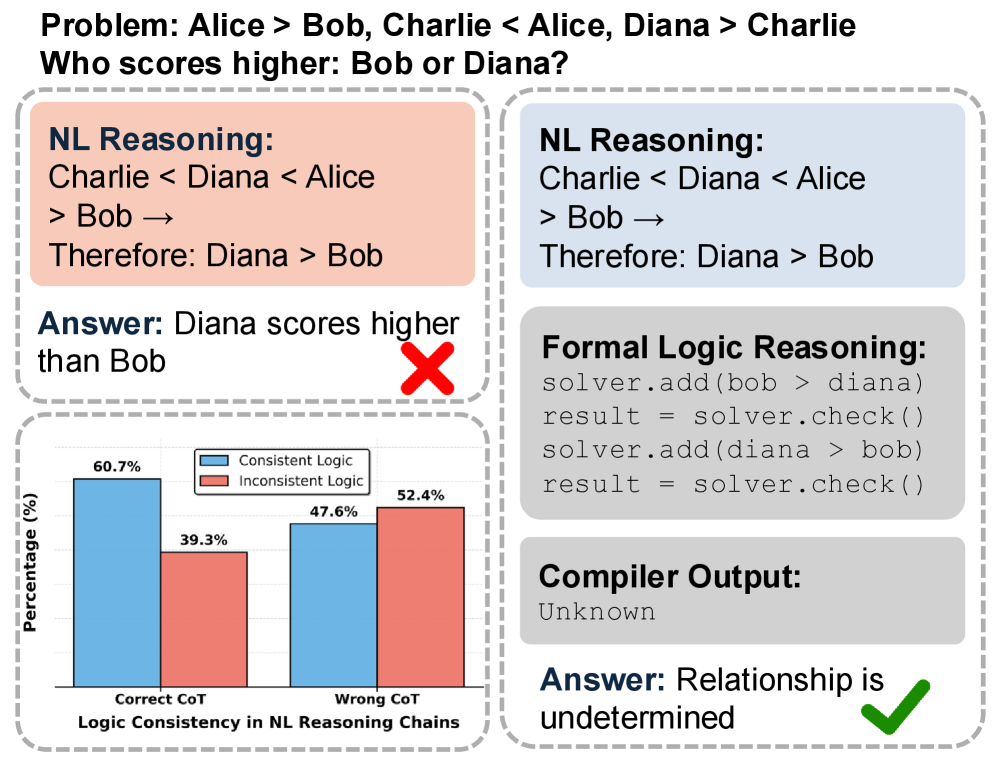
The image presents a multi-part problem-solving scenario involving relational logic comparisons between four individuals (Alice, Bob, Charlie, Diana) and a bar chart analyzing logic consistency in reasoning chains. The content includes:
1. A textual problem with multiple reasoning approaches
2. A bar chart comparing logic consistency percentages
3. Conflicting conclusions from different reasoning methods
### Components/Axes
**Textual Elements:**
- **Problem Statement (Top):**
- "Alice > Bob, Charlie < Alice, Diana > Charlie. Who scores higher: Bob or Diana?"
- Three reasoning approaches:
- **NL Reasoning (Left):**
- "Charlie < Diana < Alice > Bob → Therefore: Diana > Bob"
- Answer marked incorrect (red X)
- **NL Reasoning (Right):**
- Identical steps to left panel
- Answer marked correct (green checkmark)
- **Formal Logic Reasoning (Bottom-Left):**
- Code snippets using a solver:
```python
solver.add(bob > diana)
result = solver.check()
solver.add(diana > bob)
result = solver.check()
```
- Compiler output: "Unknown"
- Answer: "Relationship is undetermined"
- **Bar Chart (Bottom-Right):**
- **X-Axis:** "Logic Consistency in NL Reasoning Chains"
- **Y-Axis:** "Percentage (%)"
- **Legend (Right):**
- Blue: Consistent Logic
- Red: Inconsistent Logic
- **Categories:**
- Correct CoT (60.7% blue / 39.3% red)
- Wrong CoT (47.6% blue / 52.4% red)
### Detailed Analysis
**Textual Reasoning:**
1. **NL Reasoning Panels:**
- Both panels derive "Diana > Bob" through transitive logic:
- Charlie < Diana < Alice > Bob
- Contradiction: Left panel marks this answer incorrect despite valid logic
- Right panel accepts the same conclusion as correct
2. **Formal Logic Reasoning:**
- Uses SAT solver with conflicting constraints:
- First constraint: `bob > diana`
- Second constraint: `diana > bob`
- Solver returns "Unknown" due to contradictory inputs
- Final answer acknowledges indeterminacy
**Bar Chart Analysis:**
- **Correct CoT:**
- Consistent Logic: 60.7%
- Inconsistent Logic: 39.3%
- **Wrong CoT:**
- Consistent Logic: 47.6%
- Inconsistent Logic: 52.4%
- **Color Verification:**
- Blue bars consistently represent Consistent Logic across categories
- Red bars represent Inconsistent Logic
### Key Observations
1. **Logic Consistency Trends:**
- Consistent Logic dominates in Correct CoT (60.7% vs 39.3%)
- Inconsistent Logic becomes dominant in Wrong CoT (52.4% vs 47.6%)
2. **Reasoning Method Conflicts:**
- Natural Language Reasoning produces contradictory conclusions
- Formal Logic/Solver approach identifies indeterminacy
3. **Answer Discrepancies:**
- Two identical NL Reasoning chains receive conflicting validity markers
- Compiler output rejects both conclusions
### Interpretation
The data reveals fundamental challenges in automated reasoning systems:
1. **NL Reasoning Limitations:**
- High consistency in Correct CoT suggests surface-level pattern matching
- Collapse in performance for Wrong CoT indicates poor error handling
- Conflicting validity markers demonstrate unreliability in self-assessment
2. **Formal Logic Shortcomings:**
- Solver's "Unknown" output exposes inability to resolve contradictory constraints
- Highlights need for constraint validation before problem formulation
3. **Educational Implications:**
- 60.7% consistency in Correct CoT suggests NL reasoning works for straightforward cases
- 52.4% inconsistent logic in Wrong CoT reveals critical failure modes
- Contradictory conclusions between identical reasoning chains indicate non-determinism
4. **Technical System Design:**
- The system appears to lack:
- Constraint consistency checking
- Reasoning chain validation
- Error propagation mechanisms
- The green checkmark on the right panel suggests possible human intervention or post-hoc validation
This analysis demonstrates the complex interplay between human-like reasoning patterns and formal logic systems, revealing both potential and limitations in current automated reasoning approaches.