## Heatmap Grid: Object Depth Projections
### Overview
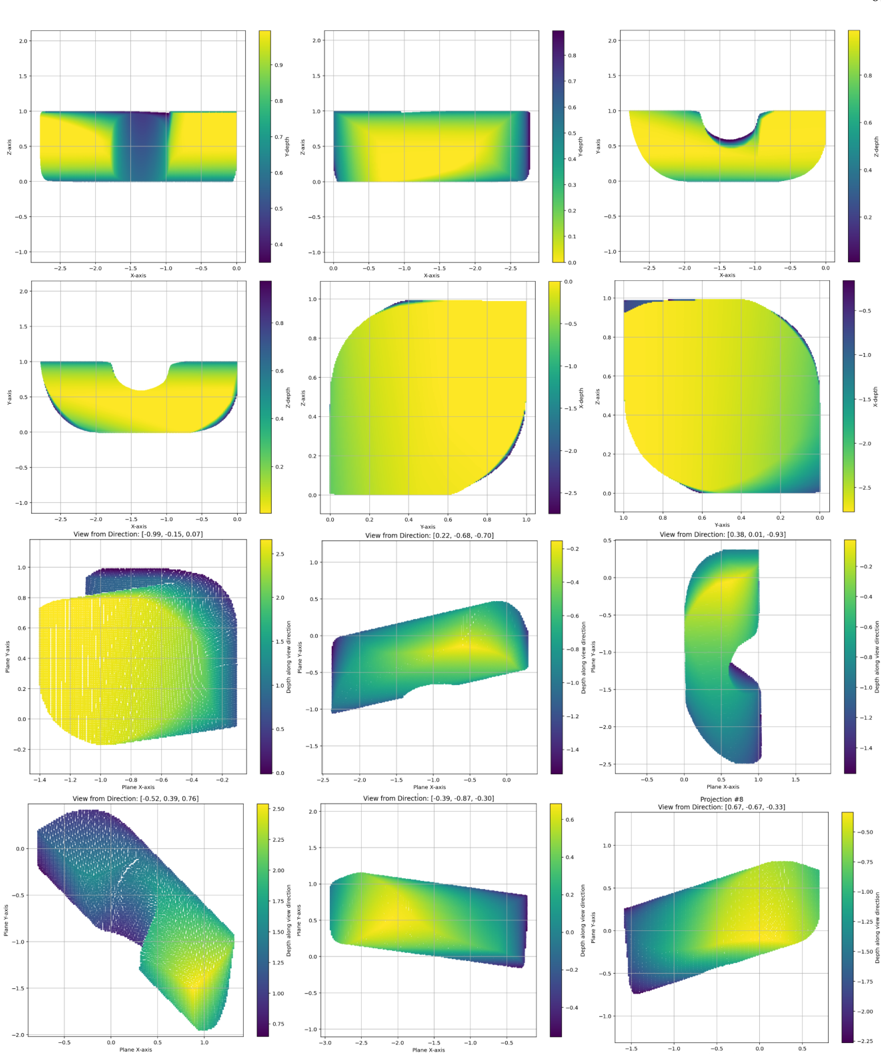
The image presents a grid of nine heatmaps, each displaying a different projection of an object's depth. The heatmaps use a color gradient to represent depth, with yellow indicating shallower regions and darker colors (blue/purple) indicating deeper regions. Each heatmap is accompanied by a "View from Direction" vector, indicating the viewing angle for that projection.
### Components/Axes
Each heatmap has the following components:
* **X-axis:** Labeled as "X-axis" or "Plane X-axis", ranging from approximately -3.0 to 0.0 or -2.0 to 1.0, depending on the projection.
* **Y-axis:** Labeled as "Z-axis" or "Plane along view direction", ranging from approximately -1.0 to 2.0 or -2.0 to 2.5, depending on the projection.
* **Color Scale:** Represents depth, with yellow indicating shallower regions and blue/purple indicating deeper regions. The color scale varies slightly between plots, but generally spans a range of approximately 0.0 to 1.0 or 0.75 to 2.5.
* **View Direction:** Text label indicating the viewing direction as a vector (e.g., "View from Direction: [-0.99, -0.15, 0.07]").
* **Projection Number:** One plot is labeled "Projection #8".
### Detailed Analysis
**Row 1**
* **Heatmap 1 (Top-Left):**
* X-axis: -3.0 to 0.0
* Z-axis: -1.0 to 2.0
* View from Direction: [-0.99, -0.15, 0.07]
* The object appears to have a rectangular shape with a recessed section in the middle. The recessed section is deeper (blue/purple), while the surrounding areas are shallower (yellow).
* **Heatmap 2 (Top-Middle):**
* X-axis: -3.0 to 1.0
* Z-axis: -1.0 to 2.0
* View from Direction: [0.22, -0.68, -0.70]
* The object appears rectangular with a slight curvature. The depth is relatively uniform (yellow), with some variation near the edges.
* **Heatmap 3 (Top-Right):**
* X-axis: -1.0 to 1.0
* Z-axis: -1.0 to 2.0
* View from Direction: [0.38, 0.01, -0.93]
* The object has a curved shape, resembling a partial cylinder. The depth varies, with the center being deeper (blue/purple) and the edges shallower (yellow).
**Row 2**
* **Heatmap 4 (Middle-Left):**
* X-axis: -3.0 to 0.0
* Z-axis: -1.0 to 2.0
* The object has a curved shape, similar to a partial cylinder. The depth varies, with the center being deeper (blue/purple) and the edges shallower (yellow).
* **Heatmap 5 (Middle-Middle):**
* X-axis: 0.0 to 1.0
* Z-axis: -0.5 to 2.0
* View from Direction: [0.22, -0.68, -0.70]
* The object appears to be a rounded block. The depth is relatively uniform (yellow), with some variation near the edges.
* **Heatmap 6 (Middle-Right):**
* X-axis: 0.0 to 1.0
* Z-axis: -2.5 to 0.5
* View from Direction: [0.38, 0.01, -0.93]
* The object has a curved shape. The depth varies, with the center being deeper (blue/purple) and the edges shallower (yellow).
**Row 3**
* **Heatmap 7 (Bottom-Left):**
* X-axis: -1.4 to -0.2
* Z-axis: -0.2 to 1.0
* View from Direction: [-0.52, 0.39, 0.76]
* The object has a complex shape with both curved and flat surfaces. The depth varies significantly across the object.
* **Heatmap 8 (Bottom-Middle):**
* X-axis: -2.5 to 1.0
* Z-axis: -1.0 to 2.5
* View from Direction: [-0.39, -0.87, -0.30]
* The object appears to be a rectangular block. The depth is relatively uniform (yellow), with some variation near the edges.
* **Heatmap 9 (Bottom-Right):**
* X-axis: -1.8 to 1.0
* Z-axis: -2.25 to 0.6
* View from Direction: [0.67, -0.67, -0.33]
* Projection #8
* The object has a complex shape. The depth varies significantly across the object.
### Key Observations
* The object's shape is complex and not easily described by a simple geometric form.
* The depth varies significantly across different regions of the object.
* The "View from Direction" vectors provide information about the viewing angle for each projection.
### Interpretation
The heatmaps provide a visual representation of the object's depth from different viewing angles. By analyzing these projections, it is possible to gain a better understanding of the object's three-dimensional shape. The variations in depth suggest that the object has a complex surface with both curved and flat regions. The "View from Direction" vectors are crucial for interpreting the heatmaps, as they indicate the orientation of the object relative to the viewer. The combination of depth information and viewing angles allows for a more complete reconstruction of the object's geometry.