## Vector Diagram: Velocity and Acceleration Components
### Overview
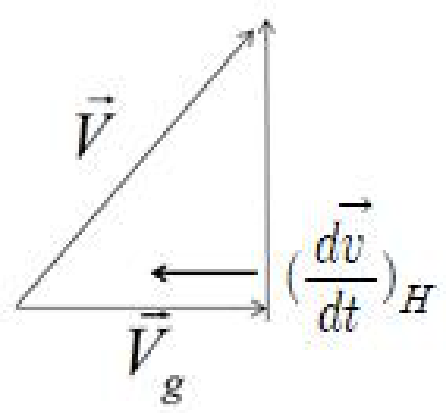
The image depicts a vector diagram illustrating the relationship between velocity and acceleration in a two-dimensional coordinate system. The diagram uses geometric decomposition to represent vector components and their derivatives, with directional arrows indicating magnitude and direction.
### Components/Axes
- **Vectors**:
- **V**: Total velocity vector (hypotenuse of the right triangle).
- **Vg**: Horizontal velocity component (base of the triangle, labeled with a rightward arrow).
- **(dv/dt)H**: Horizontal acceleration vector (vertical arrow pointing upward, labeled with the derivative of velocity with respect to time).
- **Coordinate System**:
- Implied horizontal (x-axis) and vertical (y-axis) axes, though not explicitly labeled.
- Vectors are positioned to form a right triangle, with **V** as the resultant vector.
### Detailed Analysis
- **Velocity Components**:
- **Vg** (horizontal velocity) is aligned with the x-axis.
- The vertical component of velocity is not explicitly labeled but is implied as part of the decomposition of **V**.
- **Acceleration**:
- **(dv/dt)H** represents the horizontal acceleration, pointing upward (positive y-direction). This suggests a change in the horizontal velocity component over time.
- No vertical acceleration component is labeled, implying it may be zero or irrelevant to the diagram’s focus.
### Key Observations
1. The diagram emphasizes the horizontal acceleration’s effect on velocity, as **(dv/dt)H** is explicitly labeled.
2. The right triangle structure visually links **V**, **Vg**, and the implied vertical velocity component.
3. The upward direction of **(dv/dt)H** conflicts with standard gravitational acceleration (which acts downward), suggesting a non-gravitational force (e.g., electric field, thrust).
### Interpretation
This diagram likely models motion where an object experiences horizontal acceleration while maintaining a velocity vector **V**. The decomposition of **V** into **Vg** and an unlabeled vertical component suggests:
- **Vg** is the horizontal velocity, modified by **(dv/dt)H** over time.
- The absence of a labeled vertical acceleration component implies either:
- No vertical acceleration (e.g., projectile motion in a vacuum with no air resistance), or
- A focus on horizontal dynamics (e.g., a charged particle in a uniform electric field along the x-axis).
The upward direction of **(dv/dt)H** is unconventional for gravitational systems, hinting at an external force driving horizontal acceleration. This could represent scenarios like:
- A rocket with thrust in the horizontal direction.
- A particle in an electric field accelerating horizontally.
- A mislabeled diagram where the vertical acceleration (e.g., gravity) is intended but misrepresented.
The diagram underscores the interplay between velocity components and their time derivatives, critical for analyzing motion in physics and engineering contexts.