TECHNICAL ASSET FINGERPRINT
0793e02ed30055f78da87f72
Click to view fullscreen
Press ESC or click to close
FOUND IN PAPERS
EXPERT: gemini-2.5-flash-lite-free VERSION 2
RUNTIME: google-free/gemini-2.5-flash-lite
INTEL_VERIFIED
## Diagram: Crossword Puzzle Solving Process
### Overview
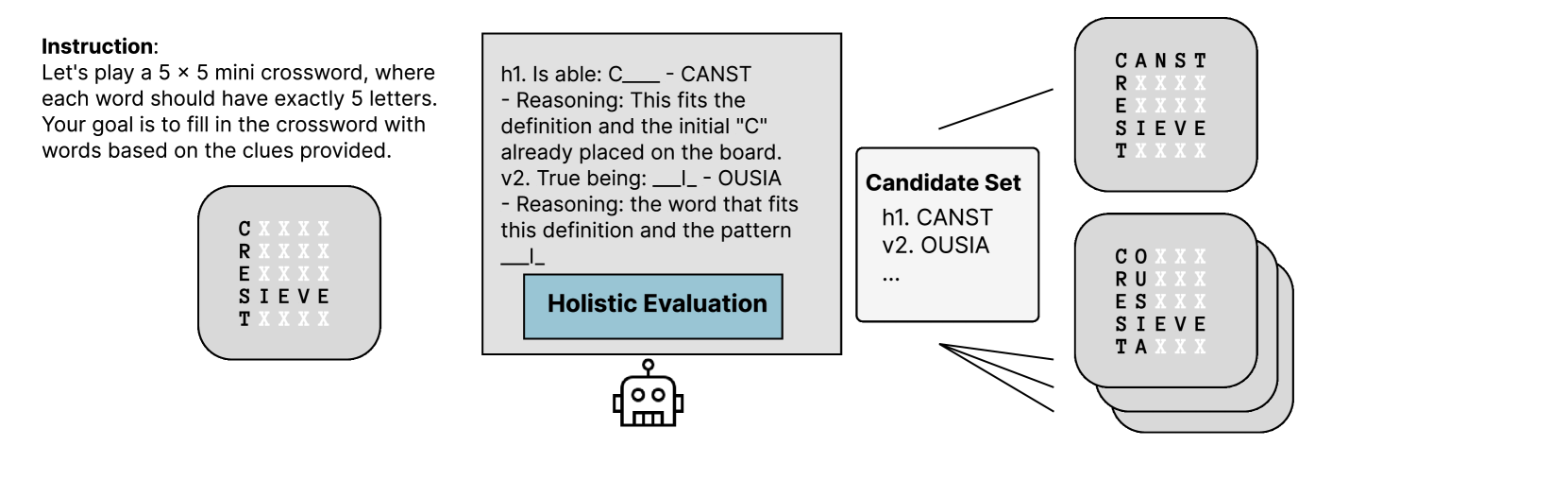
This diagram illustrates a process for solving a 5x5 mini crossword puzzle. It depicts the initial state of the crossword, a reasoning block that analyzes clues and patterns, a candidate set of potential words, and a visual representation of potential crossword solutions. A robot icon suggests an automated or algorithmic approach to this process.
### Components/Axes
The diagram is composed of several distinct blocks and elements:
1. **Instruction Block (Top-Left):**
* **Title:** "Instruction:"
* **Text:** "Let's play a 5 × 5 mini crossword, where each word should have exactly 5 letters. Your goal is to fill in the crossword with words based on the clues provided."
2. **Initial Crossword State (Left, Rounded Rectangle):**
* **Content:** A 5x5 grid representing a crossword puzzle.
* **Visible Letters:**
* Row 1: C X X X X
* Row 2: R X X X X
* Row 3: E X X X X
* Row 4: S I E V E
* Row 5: T X X X X
* **Note:** The letters 'C', 'R', 'E', 'S', 'I', 'E', 'V', 'E', 'T' are visible, with 'X' representing empty cells.
3. **Reasoning Block (Center, Light Gray Rectangle):**
* **Content:** This block details the analysis of clues and patterns.
* **Clue 1 Analysis:**
* "h1. Is able: C \_\_\_\_ - CANST"
* "Reasoning: This fits the definition and the initial 'C' already placed on the board."
* **Clue 2 Analysis:**
* "v2. True being: \_\_\_\_ - OUSIA"
* "Reasoning: The word that fits this definition and the pattern \_\_\_\_."
* **Action Button:** "Holistic Evaluation" (Light Blue Rectangle)
4. **Robot Icon (Bottom-Center):**
* A stylized robot with a square head, two circular eyes, and a rectangular body with two horizontal lines. This likely represents an automated solver or algorithm.
5. **Candidate Set Block (Center-Right, Light Gray Rectangle):**
* **Title:** "Candidate Set"
* **Content:** A list of potential words derived from the analysis.
* **List:**
* "h1. CANST"
* "v2. OUSIA"
* "..." (Indicates more candidates may exist)
6. **Potential Solution Grids (Right, Stacked Rounded Rectangles):**
* These represent possible completed crosswords or intermediate states.
* **Top Grid:**
* **Content:** A 5x5 grid.
* **Visible Letters:**
* Row 1: C A N S T
* Row 2: R X X X X
* Row 3: E X X X X
* Row 4: S I E V E
* Row 5: T X X X X
* **Note:** This grid appears to be an attempt to fill in the first row with "CANST".
* **Bottom Stacked Grids:**
* **Content:** Multiple 5x5 grids, partially obscured, suggesting alternative possibilities.
* **Visible Letters (Topmost of the stack):**
* Row 1: C O X X X
* Row 2: R U X X X
* Row 3: E S X X X
* Row 4: S I E V E
* Row 5: T A X X X
* **Note:** This grid shows a different potential filling, with "COX" in the first column and "RU" in the second, and "ES" in the third.
7. **Flow Arrows:**
* Arrows indicate the progression of the process:
* From the Reasoning Block to the Candidate Set.
* From the Candidate Set to the Potential Solution Grids.
* An arrow also originates from the Reasoning Block and points towards the Potential Solution Grids, suggesting the reasoning directly influences the proposed solutions.
### Detailed Analysis or Content Details
* **Initial Crossword:** The initial state shows a partially filled 5x5 grid. The first column has 'C', 'R', 'E', 'S', 'T'. The fourth row has 'S', 'I', 'E', 'V', 'E'.
* **Clue Analysis:**
* **h1 (horizontal clue 1):** The definition is "Is able". The clue suggests a word ending in "CANST" and starting with 'C'. The reasoning states this fits the definition and the initial 'C' on the board. This implies the word is "CANST" itself, fitting horizontally.
* **v2 (vertical clue 2):** The definition is "True being". The clue suggests a word with a pattern "\_\_\_\_" and ending in "OUSIA". The reasoning states the word fits the definition and the pattern. This implies a word like "OUSIA" or a word that fits the pattern and definition.
* **Candidate Set:** The candidates identified are "CANST" for h1 and "OUSIA" for v2.
* **Potential Solutions:**
* The top grid shows "CANST" filled into the first row, aligning with the h1 clue.
* The stacked grids show a different potential filling, with "COX" in the first column, "RU" in the second, "ES" in the third, and "SIEVE" in the fourth row. This suggests an alternative or subsequent attempt at filling the grid, possibly incorporating v2 or other clues. The presence of "SIEVE" in the fourth row of this grid matches the initial state.
### Key Observations
* The diagram outlines a systematic approach to solving a crossword puzzle, likely an automated one given the robot icon.
* The process involves identifying clues, analyzing them against existing letters and patterns, generating candidate words, and then evaluating potential solutions.
* The example uses specific clues ("Is able" and "True being") and partial word patterns to derive candidate words ("CANST", "OUSIA").
* The visual representation of potential solutions shows how candidate words are integrated into the crossword grid. The first potential solution directly incorporates "CANST" horizontally. The stacked solutions show a more complex filling, suggesting multiple possibilities or a more advanced stage of solving.
### Interpretation
This diagram demonstrates a computational approach to solving crossword puzzles. The "Instruction" block sets the stage for a 5x5 crossword. The "Initial Crossword State" represents the starting point, with some letters already filled in. The "Reasoning Block" is the core of the algorithmic process, where clues are interpreted, and constraints (like existing letters and word patterns) are applied. The "Holistic Evaluation" button suggests a step where the system synthesizes information to make a decision or generate possibilities.
The "Candidate Set" is a direct output of this reasoning, listing potential words that satisfy the analyzed clues. The "Potential Solution Grids" then visualize how these candidates might fit into the crossword. The top grid shows a straightforward placement of "CANST" horizontally. The stacked grids at the bottom suggest a more complex scenario, possibly representing alternative solutions or a more advanced stage where multiple words are being considered and placed, showing how different words might intersect. The presence of "SIEVE" in the fourth row of both the initial state and the stacked solution grids indicates that some parts of the crossword are consistent across different attempts or stages.
The diagram implies a loop or iterative process where candidate words are tested, and if they lead to conflicts or incomplete solutions, the system might backtrack or explore other candidates. The robot icon strongly suggests that this entire process is designed to be automated, mimicking human deductive reasoning in a structured, algorithmic manner. The "Holistic Evaluation" could represent a scoring mechanism or a method for combining different clues and constraints to find the most likely solution.
DECODING INTELLIGENCE...