TECHNICAL ASSET FINGERPRINT
0793e02ed30055f78da87f72
Click to view fullscreen
Press ESC or click to close
FOUND IN PAPERS
EXPERT: healer-alpha-free VERSION 1
RUNTIME: free/openrouter/healer-alpha
INTEL_VERIFIED
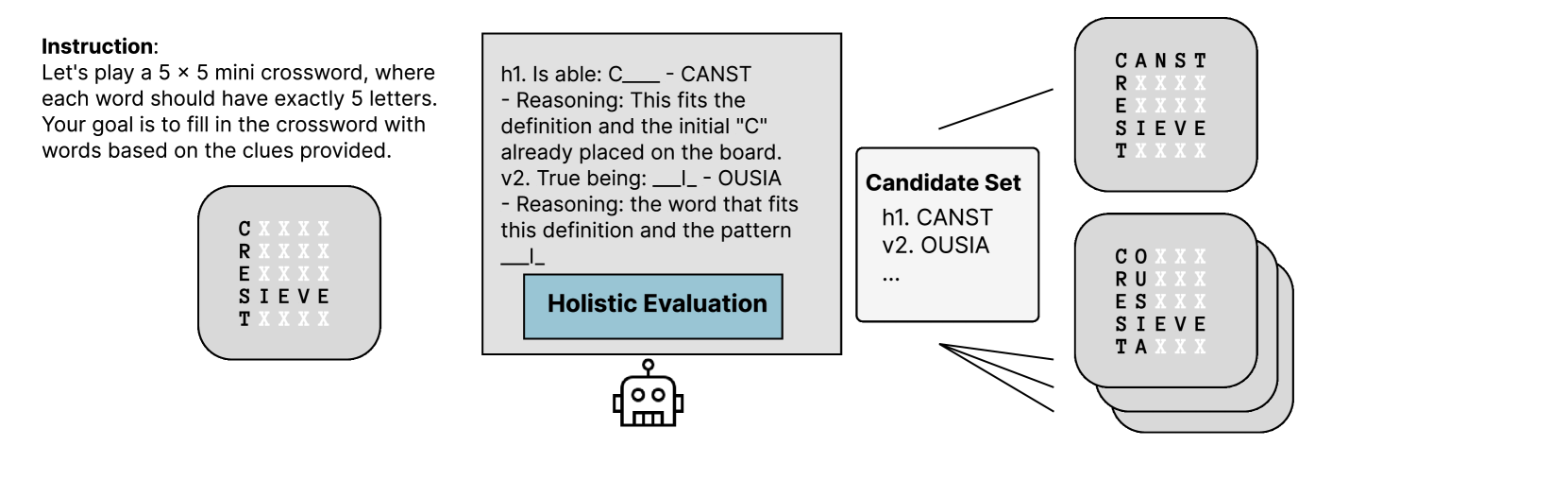
## Diagram: Crossword Puzzle Solving Process
### Overview
The image is a technical diagram illustrating a process for solving a 5x5 mini crossword puzzle. It depicts a workflow that starts with an instruction and an initial board state, moves through a reasoning and evaluation phase managed by an AI agent (represented by a robot icon), and results in the generation of candidate word sets. The diagram is composed of four main visual components connected by lines, indicating a flow of information or process steps.
### Components/Axes
The diagram is segmented into four primary regions:
1. **Left Region (Instruction & Initial State):**
* **Header Text:** "Instruction:"
* **Instruction Block:** "Let's play a 5 × 5 mini crossword, where each word should have exactly 5 letters. Your goal is to fill in the crossword with words based on the clues provided."
* **Initial Crossword Grid:** A rounded rectangle containing a 5x5 grid. The first column is partially filled with the letters `C`, `R`, `E`, `S`, `T` from top to bottom. The fourth row is filled with the word `SIEVE`. All other cells contain the placeholder `X`.
2. **Central Region (Processing & Evaluation):**
* **Main Box:** A large rectangle containing reasoning text and a button.
* **Reasoning Text:**
* "h1. Is able: C____ - CANST"
* "- Reasoning: This fits the definition and the initial "C" already placed on the board."
* "v2. True being: __I__ - OUSIA"
* "- Reasoning: the word that fits this definition and the pattern __I__"
* **Button:** A blue rectangle labeled "Holistic Evaluation".
* **Icon:** A simple line-drawing of a robot head and torso is positioned below the main box, symbolizing the AI agent performing the evaluation.
3. **Right Region (Candidate Sets):**
* **Label Box:** A small rectangle labeled "Candidate Set".
* **List:** Below the label, a partial list: "h1. CANST", "v2. OUSIA", "...".
* **Candidate Grids:** Two rounded rectangles stacked vertically, each showing a potential state of the crossword grid.
* **Top Candidate Grid:** Shows the first column as `C`, `R`, `E`, `S`, `T`. The first row is filled with `CANST`. The fourth row is `SIEVE`. All other cells are `X`.
* **Bottom Candidate Grid:** Shows the first column as `C`, `R`, `E`, `S`, `T`. The first row is `COXXX`. The second row is `RXXXX`. The third row is `EXXXX`. The fourth row is `SIEVE`. The fifth row is `TAXXX`. This grid appears to be one of several stacked, suggesting multiple candidates.
4. **Flow Indicators:**
* A line connects the top of the "Instruction" text block to the top-left of the central processing box.
* A line connects the right side of the central processing box to the "Candidate Set" label box.
* Three lines fan out from the bottom-right of the "Candidate Set" label box towards the stack of candidate grids.
### Detailed Analysis
* **Initial Puzzle State:** The starting board has the vertical word (column 1) beginning with "C", "R", "E", "S", "T" and the horizontal word (row 4) set as "SIEVE". This creates intersections at (Row 4, Column 1) with the letter 'S'.
* **Clue Processing:** The system is processing two clues:
* **h1 (Horizontal 1):** Clue "Is able:" with pattern "C____". The proposed answer is "CANST".
* **v2 (Vertical 2):** Clue "True being:" with pattern "__I__". The proposed answer is "OUSIA".
* **Reasoning Logic:** The reasoning for "CANST" explicitly references the pre-filled "C" on the board. The reasoning for "OUSIA" references the pattern constraint "__I__", which would place an 'I' at the intersection with the fourth row (S**I**EVE).
* **Candidate Generation:** The "Candidate Set" box lists the proposed words "CANST" and "OUSIA". The visual candidate grids show how these words might be placed. The top grid shows "CANST" placed in row 1. The bottom grid shows a different configuration where row 1 starts with "CO", suggesting the system is considering multiple possibilities for the same slot (h1).
### Key Observations
1. **Pattern Matching:** The process heavily relies on matching word patterns (e.g., "C____", "__I__") against clue definitions.
2. **Constraint Propagation:** The pre-filled letters ("C" in column 1, "SIEVE" in row 4) act as constraints that filter possible answers for intersecting words.
3. **Multiple Hypotheses:** The stack of candidate grids indicates the system generates and evaluates multiple potential solutions in parallel, not just a single linear path.
4. **Holistic Evaluation:** The central "Holistic Evaluation" button suggests that after generating candidate words based on individual clues and patterns, the system performs a higher-level check to ensure all words fit together consistently across the entire grid.
### Interpretation
This diagram outlines a **knowledge-based, constraint-satisfaction approach to automated crossword solving**. It demonstrates a multi-stage reasoning pipeline:
1. **Input Parsing:** The system takes a puzzle definition (grid size, initial state) and natural language clues.
2. **Clue Decoding & Candidate Generation:** For each clue, it performs lexical pattern matching (filling blanks) and semantic matching (linking clues to definitions) to produce a set of candidate words. The reasoning snippets show this dual constraint process.
3. **Constraint Integration:** The initial board state provides hard constraints (pre-filled letters) that immediately filter candidates for intersecting words.
4. **Hypothesis Management:** The system maintains multiple candidate sets, representing different combinations of word choices. The stacked grids visually represent this branching possibility space.
5. **Global Consistency Check:** The "Holistic Evaluation" is the critical final step. It likely checks for conflicts between intersecting words across the entire grid, ensuring that the chosen set of words is mutually compatible. This moves beyond solving clues in isolation to solving the puzzle as a unified system.
The presence of the robot icon and the structured reasoning text implies this is a model of an **AI agent's internal reasoning process**, making its step-by-step logic explicit. The diagram's value lies in visualizing how local, clue-based reasoning is combined with global grid constraints to converge on a valid solution.
DECODING INTELLIGENCE...