## Screenshot: Programming Task - "Incorrect Program"
### Overview
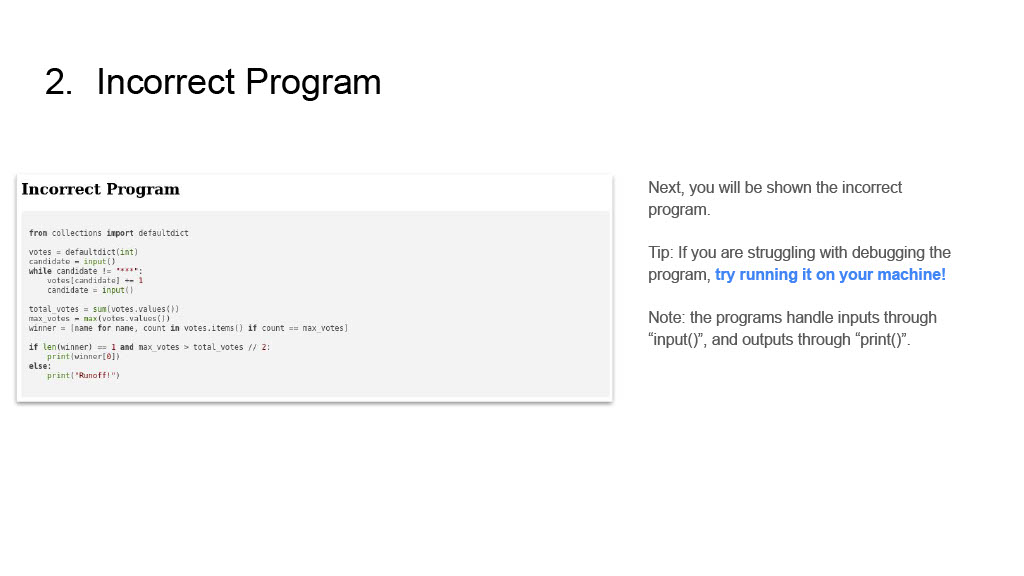
The image shows a programming task labeled **"2. Incorrect Program"** with a code snippet and explanatory text. The code is written in Python and appears to implement a voting system to determine a winner based on candidate votes. The task includes instructions for debugging the program and notes about input/output handling.
### Components/Axes
- **Title**: "2. Incorrect Program" (top-left, bold black text).
- **Code Block**:
- **Header**: "Incorrect Program" (bold black text on a light gray background).
- **Code Content**:
- Imports: `from collections import defaultdict`.
- Variable Initialization:
- `votes = defaultdict(int)`.
- `candidate = input()`.
- Loop: `while candidates[input()] != -1` (collects candidate votes).
- Voting Logic:
- `total_votes = sum(votes.values())`.
- `max_votes = max(votes.values())`.
- Conditional: `if len(candidates) == 1 and max_votes > total_votes // 2:`.
- Output: `print(candidate)`.
- Else: `print("Runoff!")`.
- **Explanatory Text** (right side):
- Instructions: "Next, you will be shown the incorrect program."
- Tip: "If you are struggling with debugging the program, **try running it on your machine!**" (blue hyperlink).
- Note: "The programs handle inputs through `input()`, and outputs through `print()`."
### Detailed Analysis
1. **Code Structure**:
- The code uses `defaultdict` to track votes for candidates.
- A loop collects candidate names and their vote counts until `-1` is entered.
- It calculates total votes and identifies the candidate with the most votes.
- If a candidate has more than half the total votes, they win; otherwise, a runoff is declared.
2. **Potential Issues in Code**:
- **Variable Mismatch**: The loop condition `while candidates[input()] != -1` may cause errors because `candidates` is not initialized before use.
- **Logic Flaw**: The condition `if len(candidates) == 1 and max_votes > total_votes // 2` is redundant. If there’s only one candidate, `max_votes` will always equal `total_votes`, making the condition always false.
- **Input Handling**: The code does not validate inputs (e.g., non-integer votes).
3. **Explanatory Text**:
- The task emphasizes debugging the provided code.
- The blue hyperlink suggests practical experimentation as a debugging strategy.
- Input/output conventions (`input()`/`print()`) are explicitly stated.
### Key Observations
- The code’s logic for determining a winner is flawed due to uninitialized variables and redundant conditions.
- The task’s instructions and notes are designed to guide users toward identifying and fixing these issues.
- The blue hyperlink ("try running it on your machine!") is a critical clue for debugging.
### Interpretation
This task simulates a real-world debugging scenario where a voting system’s code contains subtle errors. The primary issues are:
1. **Uninitialized Variables**: The `candidates` dictionary is used before being defined, leading to a `NameError`.
2. **Logical Redundancy**: The condition for declaring a winner is logically inconsistent, as a single candidate cannot have more than half the votes if they are the only one.
3. **Input Validation**: The code assumes valid integer inputs but lacks error handling for invalid data.
The task’s design encourages users to:
- Identify syntax and runtime errors.
- Analyze the flow of data (e.g., how votes are aggregated).
- Test edge cases (e.g., single candidate, tie votes).
The blue hyperlink reinforces the importance of empirical testing in debugging, aligning with the note about input/output conventions. The code’s flaws likely stem from oversight in variable initialization and logical conditions, common pitfalls in iterative programming tasks.