\n
## Text Document: Download Time Calculation
### Overview
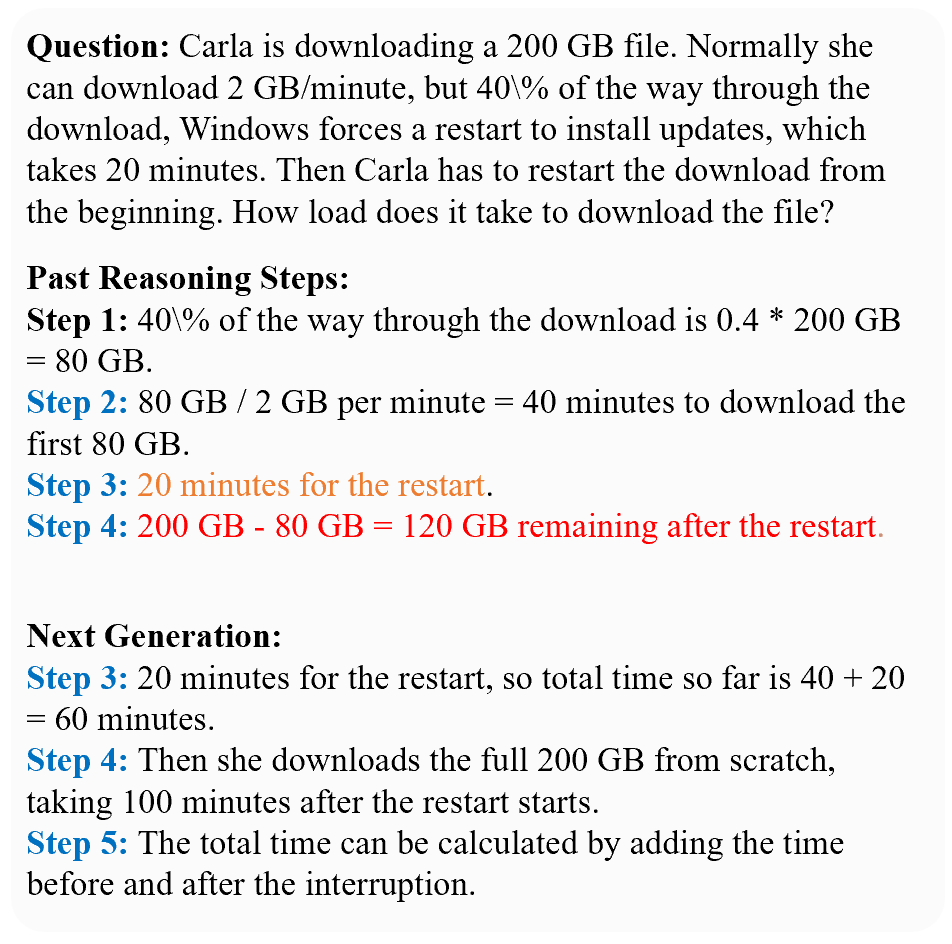
The image presents a problem statement and a step-by-step reasoning process to solve it. The problem involves calculating the total time it takes to download a file given an interruption and a restart. The reasoning is presented in two sections: "Past Reasoning Steps" and "Next Generation".
### Components/Axes
The document consists of:
* **Question:** The initial problem statement.
* **Past Reasoning Steps:** A series of calculations leading up to a certain point.
* **Next Generation:** Continuation of the reasoning process.
* **Step Numbers:** Each step is numbered sequentially.
* **Mathematical Equations:** Calculations are presented as equations.
### Detailed Analysis or Content Details
**Question:**
"Carla is downloading a 200 GB file. Normally she can download 2 GB/minute, but 40% of the way through the download, Windows forces a restart to install updates, which takes 20 minutes. Then Carla has to restart the download from the beginning. How long does it take to download the file?"
**Past Reasoning Steps:**
* **Step 1:** 40% of the way through the download is 0.4 * 200 GB = 80 GB.
* **Step 2:** 80 GB / 2 GB per minute = 40 minutes to download the first 80 GB.
* **Step 3:** 20 minutes for the restart.
* **Step 4:** 200 GB - 80 GB = 120 GB remaining after the restart.
**Next Generation:**
* **Step 3:** 20 minutes for the restart, so total time so far is 40 + 20 = 60 minutes.
* **Step 4:** Then she downloads the full 200 GB from scratch, taking 100 minutes after the restart starts.
* **Step 5:** The total time can be calculated by adding the time before and after the interruption.
### Key Observations
The "Next Generation" section re-numbers Step 3, which is a potential source of confusion. The final calculation is missing, but the setup is provided. The problem is solved by breaking it down into smaller steps, calculating the time for each part, and then summing them up.
### Interpretation
The document demonstrates a problem-solving approach using sequential reasoning. The initial steps correctly calculate the progress before the interruption and the remaining data. The "Next Generation" section correctly accounts for the restart time and the full re-download. The missing final step would be to add the time before the interruption (40 minutes + 20 minutes = 60 minutes) and the time after the interruption (100 minutes) to get the total download time (160 minutes). The document highlights a common scenario in software downloads where interruptions can significantly increase the overall time required. The re-numbering of Step 3 in the "Next Generation" section is an error that could lead to confusion. The document is a clear example of how to approach a quantitative problem by breaking it down into smaller, manageable steps.