## Line Graph: Accuracy vs. Rejection Threshold
### Overview
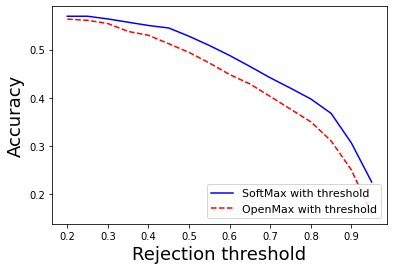
The image depicts a line graph comparing the accuracy of two models ("SoftMax with threshold" and "OpenMax with threshold") across varying rejection thresholds. The x-axis represents the rejection threshold (0.2 to 0.9), and the y-axis represents accuracy (0.2 to 0.55). Both models show declining accuracy as the rejection threshold increases, but "SoftMax with threshold" consistently underperforms "OpenMax with threshold" across most thresholds.
### Components/Axes
- **X-axis (Rejection threshold)**: Labeled "Rejection threshold," ranging from 0.2 to 0.9 in increments of 0.1.
- **Y-axis (Accuracy)**: Labeled "Accuracy," ranging from 0.2 to 0.55 in increments of 0.1.
- **Legend**: Located in the bottom-right corner, with:
- Solid blue line: "SoftMax with threshold"
- Dashed red line: "OpenMax with threshold"
### Detailed Analysis
- **SoftMax with threshold (blue line)**:
- Starts at ~0.55 accuracy at a threshold of 0.2.
- Declines steadily to ~0.25 accuracy at a threshold of 0.9.
- Slope: Approximately linear decrease.
- **OpenMax with threshold (red line)**:
- Starts at ~0.52 accuracy at a threshold of 0.2.
- Declines more gradually to ~0.2 accuracy at a threshold of 0.9.
- Slope: Less steep than SoftMax, maintaining higher accuracy at higher thresholds.
### Key Observations
1. Both models exhibit a negative correlation between rejection threshold and accuracy.
2. SoftMax with threshold consistently lags behind OpenMax with threshold across all thresholds.
3. The performance gap narrows slightly at higher thresholds (e.g., at 0.8, SoftMax ≈ 0.35 vs. OpenMax ≈ 0.32).
4. At the highest threshold (0.9), SoftMax drops to ~0.25 accuracy, while OpenMax reaches ~0.2.
### Interpretation
The data suggests that **OpenMax with threshold** is more robust to increasing rejection thresholds, maintaining higher accuracy even as thresholds rise. This could indicate better generalization or noise tolerance in OpenMax compared to SoftMax. The steeper decline in SoftMax’s accuracy implies it is more sensitive to threshold adjustments, potentially making it less reliable in high-stakes scenarios requiring strict rejection criteria. The narrowing gap at higher thresholds may reflect diminishing returns for both models as they approach their operational limits.