# Technical Document Extraction: Memory Controller and DRAM Bank Architecture
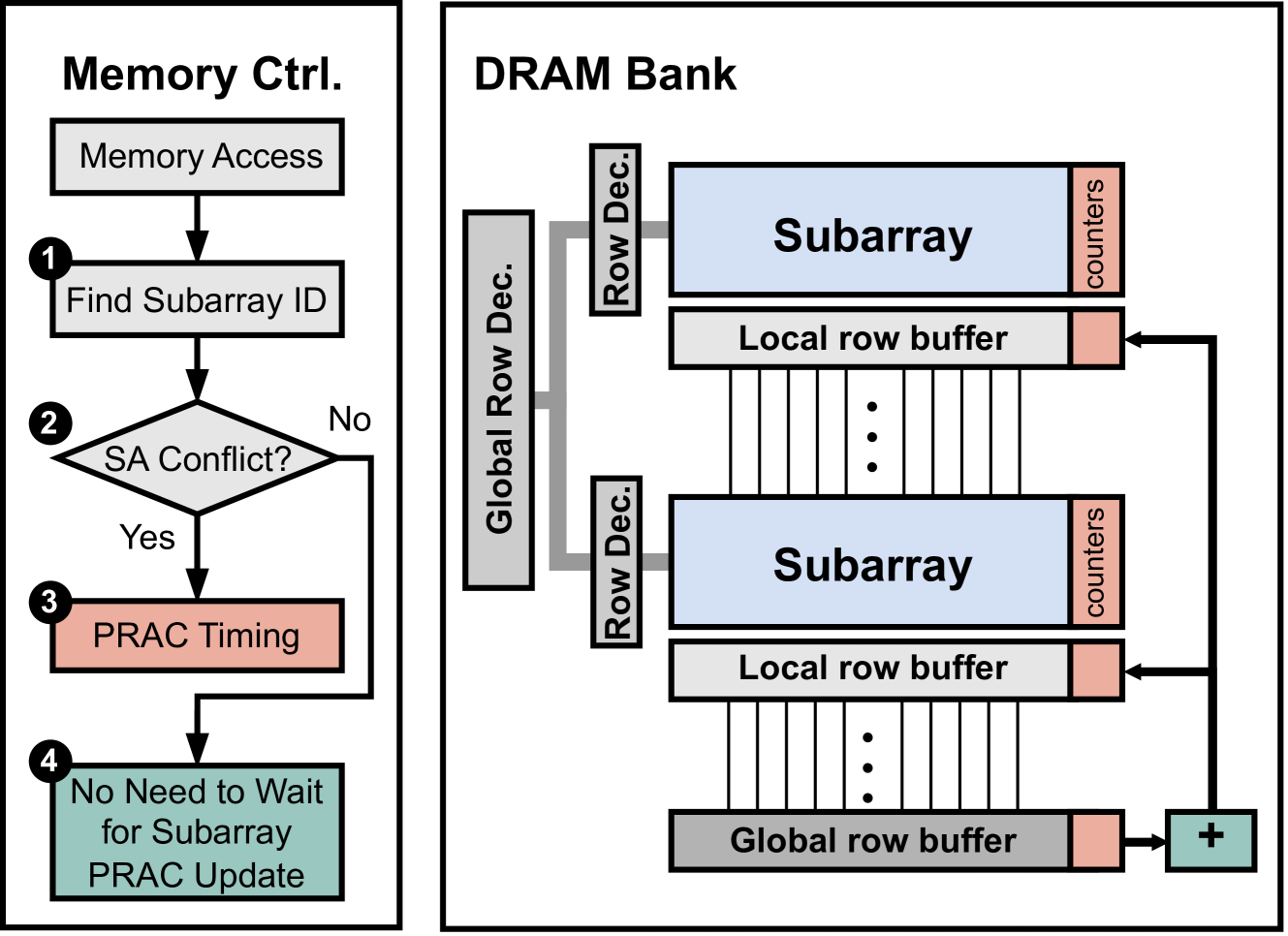
## Left Section: Memory Controller (Memory Ctrl.) Flowchart
### Components and Flow:
1. **Memory Access**
- **Input**: Initiates memory access request.
- **Output**: Triggers "Find Subarray ID" step.
2. **Find Subarray ID**
- **Purpose**: Identifies the target subarray for memory access.
- **Output**: Feeds into "SA Conflict?" decision node.
3. **SA Conflict?** (Decision Diamond)
- **Yes Path**:
- **PRAC Timing** (Step 3):
- **Function**: Manages PRAC (Precharge to Active) timing constraints.
- **Output**: Triggers "No Need to Wait for Subarray PRAC Update" (Step 4).
- **No Path**:
- **Loop**: Returns to "Find Subarray ID" (Step 1).
4. **No Need to Wait for Subarray PRAC Update**
- **Function**: Confirms subarray is ready for access without PRAC delay.
- **Output**: Completes memory access cycle.
### Color Coding:
- **Pink**: Decision nodes and timing steps (e.g., "SA Conflict?", "PRAC Timing").
- **Green**: Final confirmation step ("No Need to Wait...").
---
## Right Section: DRAM Bank Architecture
### Hierarchical Structure:
1. **Global Row Decoder**
- **Input**: Receives row address signals.
- **Output**: Routes signals to individual subarrays.
2. **Subarrays** (2 instances shown)
- **Structure**:
- **Blue Blocks**: Represent subarray memory cells.
- **Pink Counters**: Track access operations (e.g., row activations).
- **Connections**:
- Linked to **Local Row Buffers** via vertical lines.
3. **Local Row Buffers** (2 instances)
- **Function**: Temporarily store data during row access.
- **Connections**:
- Feed into **Global Row Buffer** via horizontal lines.
4. **Global Row Buffer**
- **Role**: Aggregates data from all local buffers for output.
- **Output**: Final data path marked with a "+" symbol.
### Spatial Grounding:
- **Vertical Flow**:
- Global Row Decoder → Subarrays → Local Row Buffers → Global Row Buffer.
- **Color Legend**:
- **Blue**: Subarrays.
- **Gray**: Buffers (Local/Global).
- **Pink**: Counters.
---
## Key Observations:
1. **Memory Controller Logic**:
- Prioritizes conflict resolution ("SA Conflict?") to optimize PRAC timing.
- Avoids unnecessary delays via conditional checks.
2. **DRAM Bank Design**:
- Hierarchical buffering (local → global) minimizes latency.
- Counters enable real-time monitoring of access patterns.
3. **Integration**:
- Memory controller coordinates with DRAM bank via subarray ID resolution.
- PRAC timing management ensures synchronization between controller and bank.
## Notes:
- No numerical data or trends present; diagram focuses on architectural flow and component interactions.
- All labels and textual elements transcribed verbatim.
- Color coding aligns with component roles (e.g., pink for timing/counters).