## Chart Type: Line Chart: Gemini-2.0-Flash Performance Over Iterations
### Overview
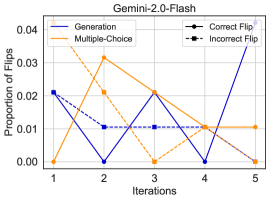
This image displays a 2D line chart titled "Gemini-2.0-Flash," illustrating the "Proportion of Flips" across five "Iterations" for four distinct categories: "Generation," "Multiple-Choice," "Correct Flip," and "Incorrect Flip." The chart uses different line styles and markers to differentiate these categories, showing their trends and values over time or sequential steps.
### Components/Axes
The chart is structured with the following elements:
* **Title**: "Gemini-2.0-Flash" (positioned at the top-center).
* **X-axis**: Labeled "Iterations" (positioned at the bottom-center).
* The axis ranges from 1 to 5, with major tick marks and labels at each integer (1, 2, 3, 4, 5).
* **Y-axis**: Labeled "Proportion of Flips" (positioned on the left, rotated vertically).
* The axis ranges from 0.00 to 0.04, with major tick marks and labels at 0.00, 0.01, 0.02, 0.03, and 0.04.
* **Grid**: A light gray grid is present, extending from both X and Y axis major tick marks, aiding in data point estimation.
* **Legend**: Located in the top-left corner of the plot area, it defines the four data series:
* **Generation**: Represented by a solid blue line with square markers.
* **Multiple-Choice**: Represented by a solid orange line with circular markers.
* **Correct Flip**: Represented by a solid black line with circular markers.
* **Incorrect Flip**: Represented by a dashed black line with square markers.
### Detailed Analysis
The chart presents four data series, each tracking the "Proportion of Flips" across five iterations:
1. **Generation (Solid Blue Line, Square Markers)**:
* **Trend**: This series shows an oscillating pattern. It starts at a moderate level, drops to zero, rises, drops to zero again, and then sharply increases to its highest point.
* **Data Points**:
* Iteration 1: Approximately 0.021
* Iteration 2: Approximately 0.000
* Iteration 3: Approximately 0.021
* Iteration 4: Approximately 0.000
* Iteration 5: Approximately 0.038 (This is the highest proportion for this series and the second highest overall on the chart).
2. **Multiple-Choice (Solid Orange Line, Circular Markers)**:
* **Trend**: This series starts at zero, peaks significantly at Iteration 2, then shows a general downward trend, flattening out towards the end.
* **Data Points**:
* Iteration 1: Approximately 0.000
* Iteration 2: Approximately 0.031 (This is the peak proportion for this series and the highest overall on the chart).
* Iteration 3: Approximately 0.021
* Iteration 4: Approximately 0.011
* Iteration 5: Approximately 0.011
3. **Correct Flip (Solid Black Line, Circular Markers)**:
* **Trend**: This series exhibits a consistent oscillating pattern, alternating between a low positive value and zero.
* **Data Points**:
* Iteration 1: Approximately 0.011
* Iteration 2: Approximately 0.000
* Iteration 3: Approximately 0.011
* Iteration 4: Approximately 0.000
* Iteration 5: Approximately 0.011
4. **Incorrect Flip (Dashed Black Line, Square Markers)**:
* **Trend**: This series starts at a moderate level, drops, then remains flat for two iterations, before dropping to zero.
* **Data Points**:
* Iteration 1: Approximately 0.021
* Iteration 2: Approximately 0.011
* Iteration 3: Approximately 0.011
* Iteration 4: Approximately 0.011
* Iteration 5: Approximately 0.000
### Key Observations
* **Peak Proportions**: The highest "Proportion of Flips" observed is for "Multiple-Choice" at Iteration 2 (approx. 0.031), followed closely by "Generation" at Iteration 5 (approx. 0.038).
* **Zero Flips**: Both "Generation" and "Correct Flip" show zero flips at Iterations 2 and 4. "Multiple-Choice" starts at zero flips at Iteration 1, and "Incorrect Flip" ends at zero flips at Iteration 5.
* **Inverse Relationship (Generation vs. Multiple-Choice)**: When "Generation" is at its lowest (0.000 at Iterations 2 and 4), "Multiple-Choice" is relatively high (0.031 at Iteration 2) or moderate (0.011 at Iteration 4). Conversely, when "Generation" peaks at Iteration 5, "Multiple-Choice" is at a lower, flat level.
* **Consistent Oscillation**: "Generation" and "Correct Flip" both show a clear pattern of alternating between a positive value and zero, though at different magnitudes.
* **Plateau**: "Incorrect Flip" maintains a constant proportion of approximately 0.011 from Iteration 2 to Iteration 4.
* **Initial State**: At Iteration 1, "Generation" and "Incorrect Flip" have the same proportion (approx. 0.021), while "Multiple-Choice" is at zero and "Correct Flip" is at approx. 0.011.
* **Final State**: At Iteration 5, "Generation" is highest (approx. 0.038), "Multiple-Choice" and "Correct Flip" are at similar lower levels (approx. 0.011), and "Incorrect Flip" drops to zero.
### Interpretation
This chart, "Gemini-2.0-Flash," likely represents performance metrics related to a model or system, where "flips" could refer to changes in prediction, state, or classification. The "Proportion of Flips" suggests a normalized frequency of these events.
The data suggests that the "Gemini-2.0-Flash" system exhibits dynamic behavior across iterations, with different aspects ("Generation," "Multiple-Choice," "Correct Flip," "Incorrect Flip") showing distinct patterns.
1. **"Generation" vs. "Multiple-Choice"**: These two categories appear to represent different modes or types of operations. "Multiple-Choice" seems to be highly active early on (peaking at Iteration 2) and then declines, while "Generation" starts with moderate activity, becomes inactive at certain iterations, and then shows a strong surge in activity at the final iteration. This could imply a shift in the system's primary mode of operation or a sequential process where "Multiple-Choice" tasks are more prevalent initially, and "Generation" tasks become more dominant later. The inverse relationship at certain points (e.g., Iteration 2 where MC is high and Gen is zero) might indicate a trade-off or mutual exclusivity in their activity.
2. **"Correct Flip" vs. "Incorrect Flip"**: These categories likely measure the quality or accuracy of the "flips."
* "Correct Flip" shows a consistent, albeit low, oscillating pattern, suggesting that even when flips occur, a certain proportion are consistently correct in an alternating fashion.
* "Incorrect Flip" starts high, stabilizes, and then drops to zero. This could indicate an improvement in the system's accuracy over time, as the proportion of incorrect flips decreases significantly by the final iteration. The plateau from Iteration 2 to 4 suggests a period where the rate of incorrect flips was stable before a final reduction.
3. **Overall System Behavior**: The "Gemini-2.0-Flash" system appears to be evolving or undergoing a process over these five iterations. The initial high "Incorrect Flip" and "Generation" activity, followed by a peak in "Multiple-Choice," and then a final surge in "Generation" with zero "Incorrect Flips," could suggest a learning or optimization process. The system might be initially exploring or making more errors ("Incorrect Flip" high), then stabilizing ("Incorrect Flip" plateau), and finally achieving higher confidence or a more refined output ("Generation" high, "Incorrect Flip" zero). The "Correct Flip" remaining consistently low but present suggests that even during periods of high "Incorrect Flip," some correct changes were still occurring.
In essence, the chart provides insights into the operational dynamics and potential performance improvements of "Gemini-2.0-Flash" across different stages of its execution or development, highlighting shifts in activity and accuracy.