## Line Graph: Continual Train
### Overview
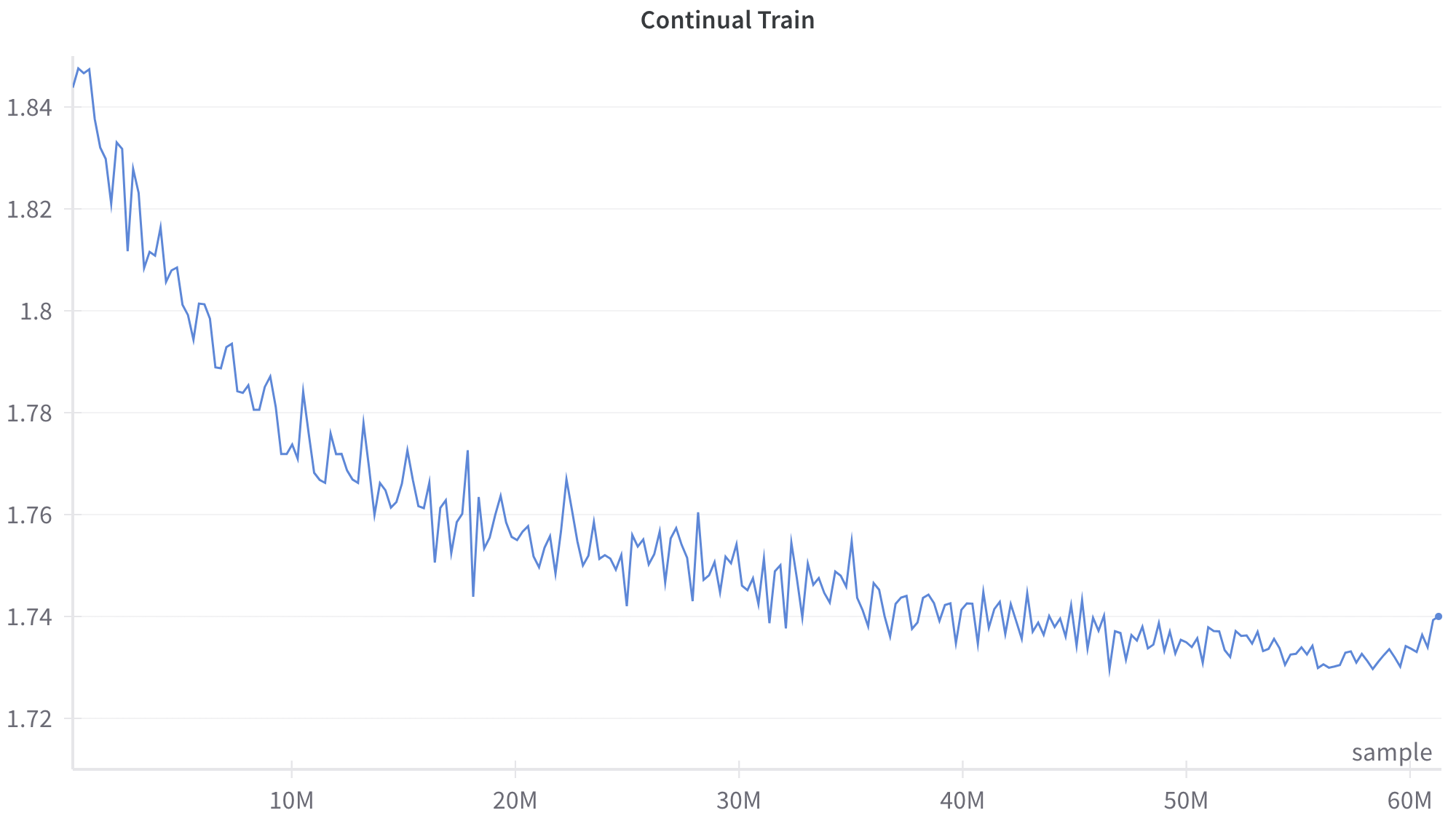
The image depicts a line graph titled "Continual Train," showing a fluctuating trend over a range of "sample" values. The y-axis represents numerical values between 1.72 and 1.84, while the x-axis spans from 0M to 60M samples. The line begins at approximately 1.84 and exhibits a general downward trend with intermittent fluctuations, ending near 1.74 at 60M samples.
### Components/Axes
- **Title**: "Continual Train" (centered at the top).
- **X-Axis**: Labeled "sample," with increments of 10M (0M, 10M, 20M, 30M, 40M, 50M, 60M).
- **Y-Axis**: Numerical values from 1.72 to 1.84, increasing by 0.02 per step.
- **Legend**: Located at the bottom-right corner, labeled "sample" with a blue line.
- **Line**: A single blue line representing the data series, starting at the top-left (0M, 1.84) and ending at the bottom-right (60M, 1.74).
### Detailed Analysis
- **Initial Value**: At 0M samples, the line starts at ~1.84.
- **Downward Trend**: The line decreases steadily, reaching ~1.74 by 60M samples.
- **Fluctuations**: Notable peaks and troughs occur throughout, e.g., a dip to ~1.76 at 20M samples and a rise to ~1.78 at 10M samples.
- **Final Stabilization**: The line stabilizes around 1.73–1.74 after 50M samples, with minor oscillations.
### Key Observations
1. **Initial High Value**: The metric begins at its highest point (1.84) before declining.
2. **Consistent Decline**: The overall trend is a gradual reduction in the y-axis value as sample size increases.
3. **Noise in Data**: The line exhibits irregular fluctuations, suggesting variability in the measured parameter.
4. **Plateau Effect**: After 50M samples, the value stabilizes near 1.74, indicating potential convergence or saturation.
### Interpretation
The graph suggests a **negative correlation** between sample size and the measured value, possibly indicating improvement or stabilization over time. For example:
- If the y-axis represents an error rate, the decline could reflect model refinement with more data.
- If it represents a physical parameter (e.g., temperature), the trend might indicate cooling or stabilization.
- The fluctuations highlight inherent variability, which could stem from noise in data collection or external factors.
The stabilization at ~1.74 after 50M samples implies a potential **asymptotic limit** or optimal performance threshold. The absence of additional labels or legends suggests the focus is on the singular trend, with no explicit categorization of data series.