## Histogram: PRM800K Per-step Length Distribution
### Overview
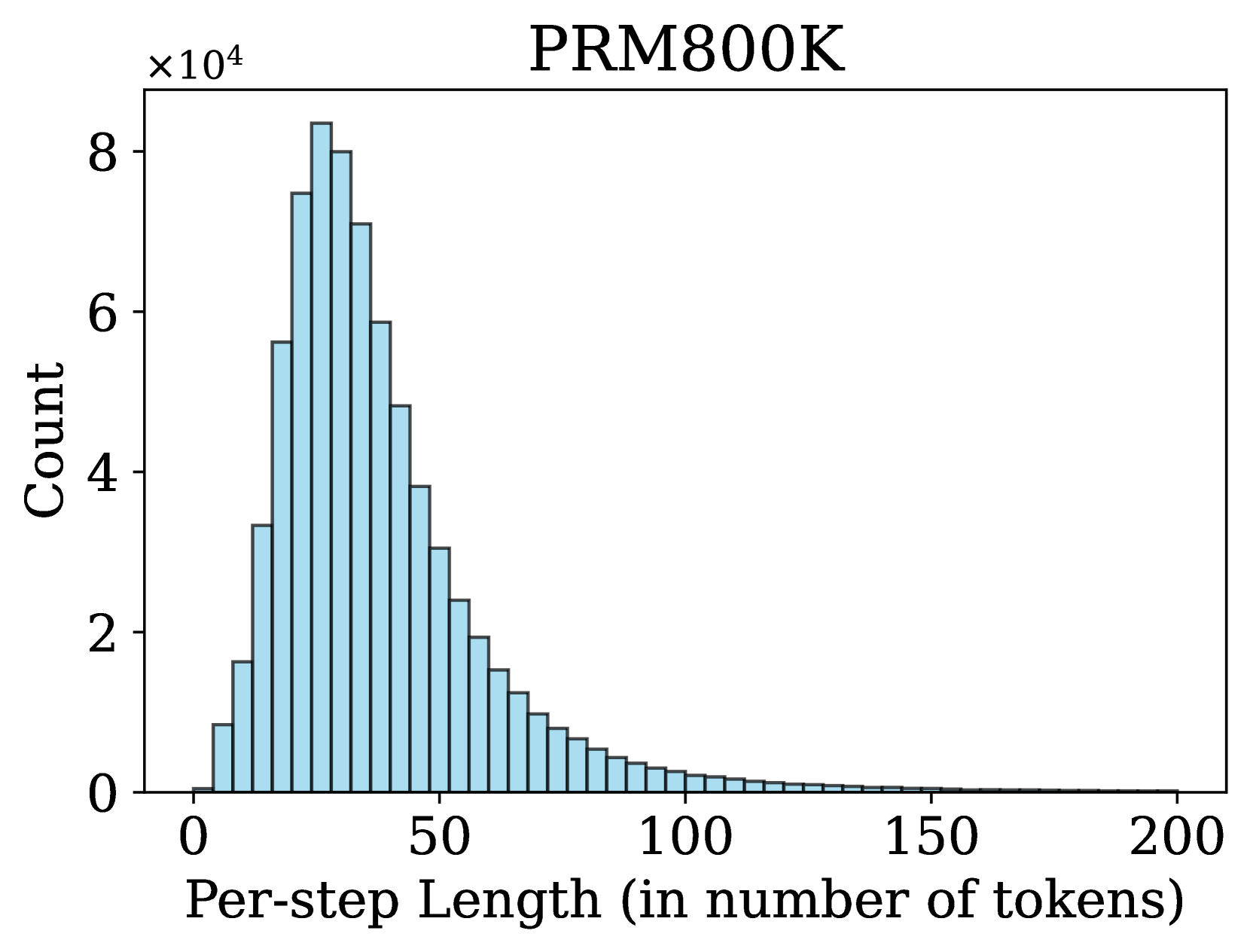
The image displays a histogram titled "PRM800K" that visualizes the frequency distribution of per-step lengths, measured in the number of tokens. The chart shows a right-skewed distribution, indicating that most steps are relatively short, with a long tail of less frequent, longer steps.
### Components/Axes
* **Title:** "PRM800K" (centered at the top).
* **Y-axis:**
* **Label:** "Count" (rotated vertically on the left).
* **Scale:** Linear scale with a multiplier of `×10⁴` (indicated at the top-left of the axis).
* **Tick Marks:** Major ticks are labeled at 0, 2, 4, 6, and 8. These correspond to counts of 0, 20,000, 40,000, 60,000, and 80,000, respectively.
* **X-axis:**
* **Label:** "Per-step Length (in number of tokens)" (centered at the bottom).
* **Scale:** Linear scale.
* **Tick Marks:** Major ticks are labeled at 0, 50, 100, 150, and 200.
* **Data Series:** A single series represented by light blue vertical bars. Each bar's height represents the count of steps falling within a specific token-length bin.
### Detailed Analysis
* **Distribution Shape:** The histogram is unimodal and strongly right-skewed (positively skewed). The tail extends far to the right.
* **Peak (Mode):** The highest frequency occurs in the bin centered approximately at **25 tokens**. The bar height at this peak is approximately **8.2 × 10⁴ (82,000)**.
* **Range:** The visible data spans from near 0 tokens to just beyond 200 tokens. The vast majority of the data is concentrated below 100 tokens.
* **Key Frequency Estimates (Approximate):**
* **~10 tokens:** ~1.8 × 10⁴ (18,000)
* **~20 tokens:** ~7.5 × 10⁴ (75,000)
* **~25 tokens (Peak):** ~8.2 × 10⁴ (82,000)
* **~30 tokens:** ~8.0 × 10⁴ (80,000)
* **~50 tokens:** ~3.0 × 10⁴ (30,000)
* **~75 tokens:** ~1.0 × 10⁴ (10,000)
* **~100 tokens:** ~0.3 × 10⁴ (3,000)
* **Beyond 150 tokens:** The counts become very low, approaching zero on this scale.
### Key Observations
1. **Concentration of Short Steps:** The overwhelming majority of per-step lengths are short, with the bulk of the distribution lying between approximately 10 and 60 tokens.
2. **Sharp Rise and Gradual Decline:** The frequency rises sharply from 0 to the peak at ~25 tokens and then declines more gradually, creating the characteristic right skew.
3. **Long Tail:** There is a persistent, low-frequency tail extending to 200 tokens and likely beyond, indicating the presence of rare but significantly longer steps.
4. **Mode vs. Median/Mean:** Due to the right skew, the mode (~25 tokens) is less than the median, which in turn is less than the mean. The average step length is pulled higher by the long tail.
### Interpretation
This histogram characterizes the step-length profile of the "PRM800K" dataset or process. The data suggests a system where the typical operational unit (a "step") is concise, often involving around 20-30 tokens. This could reflect, for example, the length of reasoning steps in a process reward model (PRM), short dialogue turns, or brief procedural instructions.
The right-skewed distribution is common in natural language and behavioral data. It implies that while efficiency or brevity is the norm (the high peak), the system must also accommodate occasional, substantially more complex or verbose steps (the long tail). The sparsity of data beyond 100 tokens indicates that such long steps are exceptional events. For technical planning, this distribution informs requirements for context window allocation, memory usage, and performance optimization, highlighting that resources must be sized to handle the common short cases efficiently while not failing on the rare long ones.