## Diagram Type: Mathematical Commutative Diagram
### Overview
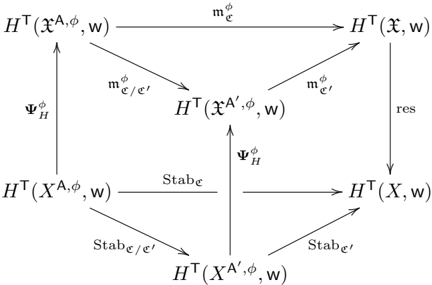
This image displays a complex commutative diagram from a mathematical context, likely within algebraic topology or algebraic geometry, specifically dealing with equivariant cohomology or a similar generalized cohomology theory. The diagram is structured as a cube, showing relationships between eight different mathematical objects (cohomology groups or modules) connected by various homomorphisms (maps). The commutativity of the diagram implies that composing maps along different paths between the same two objects yields the same result.
### Components
**Objects (Nodes):**
The diagram features eight objects, which are cohomology groups denoted by $H^T(\cdot, w)$. They are arranged in two planes, a "top" plane involving the space $\mathfrak{X}$ and a "bottom" plane involving the space $X$.
* **Top Plane (Back to Front):**
* Top-Left-Back: $H^T(\mathfrak{X}^{A,\phi}, w)$
* Top-Right-Back: $H^T(\mathfrak{X}, w)$
* Top-Center-Front: $H^T(\mathfrak{X}^{A',\phi}, w)$
* **Bottom Plane (Back to Front):**
* Bottom-Left-Back: $H^T(X^{A,\phi}, w)$
* Bottom-Right-Back: $H^T(X, w)$
* Bottom-Center-Front: $H^T(X^{A',\phi}, w)$
**Maps (Arrows):**
There are twelve arrows indicating maps between these objects.
* **Horizontal Maps (Top Plane):**
* $m_{\mathfrak{C}}^\phi$: From $H^T(\mathfrak{X}^{A,\phi}, w)$ to $H^T(\mathfrak{X}, w)$
* $m_{\mathfrak{C}/\mathfrak{C}'}^\phi$: From $H^T(\mathfrak{X}^{A,\phi}, w)$ to $H^T(\mathfrak{X}^{A',\phi}, w)$
* $m_{\mathfrak{C}'}^\phi$: From $H^T(\mathfrak{X}^{A',\phi}, w)$ to $H^T(\mathfrak{X}, w)$
* **Horizontal Maps (Bottom Plane):**
* $\text{Stab}_{\mathfrak{C}}$: From $H^T(X^{A,\phi}, w)$ to $H^T(X, w)$
* $\text{Stab}_{\mathfrak{C}/\mathfrak{C}'}$: From $H^T(X^{A,\phi}, w)$ to $H^T(X^{A',\phi}, w)$
* $\text{Stab}_{\mathfrak{C}'}$: From $H^T(X^{A',\phi}, w)$ to $H^T(X, w)$
* **Vertical Maps (Connecting Planes):**
* $\Psi_H^\phi$ (Left): From $H^T(X^{A,\phi}, w)$ to $H^T(\mathfrak{X}^{A,\phi}, w)$
* $\Psi_H^\phi$ (Center): From $H^T(X^{A',\phi}, w)$ to $H^T(\mathfrak{X}^{A',\phi}, w)$
* $\text{res}$ (Right): From $H^T(\mathfrak{X}, w)$ to $H^T(X, w)$
### Detailed Analysis of Commutative Faces
The diagram's cubic structure implies the commutativity of its various faces.
1. **Top Face (Triangle):** The composition of maps $m_{\mathfrak{C}'}^\phi \circ m_{\mathfrak{C}/\mathfrak{C}'}^\phi$ equals the map $m_{\mathfrak{C}}^\phi$.
* Path 1: $H^T(\mathfrak{X}^{A,\phi}, w) \xrightarrow{m_{\mathfrak{C}/\mathfrak{C}'}^\phi} H^T(\mathfrak{X}^{A',\phi}, w) \xrightarrow{m_{\mathfrak{C}'}^\phi} H^T(\mathfrak{X}, w)$
* Path 2: $H^T(\mathfrak{X}^{A,\phi}, w) \xrightarrow{m_{\mathfrak{C}}^\phi} H^T(\mathfrak{X}, w)$
2. **Bottom Face (Triangle):** The composition of maps $\text{Stab}_{\mathfrak{C}'} \circ \text{Stab}_{\mathfrak{C}/\mathfrak{C}'}$ equals the map $\text{Stab}_{\mathfrak{C}}$.
* Path 1: $H^T(X^{A,\phi}, w) \xrightarrow{\text{Stab}_{\mathfrak{C}/\mathfrak{C}'}} H^T(X^{A',\phi}, w) \xrightarrow{\text{Stab}_{\mathfrak{C}'}} H^T(X, w)$
* Path 2: $H^T(X^{A,\phi}, w) \xrightarrow{\text{Stab}_{\mathfrak{C}}} H^T(X, w)$
3. **Back Face (Square):** The composition $\text{res} \circ m_{\mathfrak{C}}^\phi$ equals $\text{Stab}_{\mathfrak{C}} \circ \Psi_H^\phi$.
* Path 1: $H^T(\mathfrak{X}^{A,\phi}, w) \xrightarrow{m_{\mathfrak{C}}^\phi} H^T(\mathfrak{X}, w) \xrightarrow{\text{res}} H^T(X, w)$
* Path 2: $H^T(\mathfrak{X}^{A,\phi}, w) \xleftarrow{\Psi_H^\phi} H^T(X^{A,\phi}, w) \xrightarrow{\text{Stab}_{\mathfrak{C}}} H^T(X, w)$
4. **Left Face (Square):** The composition $\Psi_H^\phi \circ \text{Stab}_{\mathfrak{C}/\mathfrak{C}'}$ equals $m_{\mathfrak{C}/\mathfrak{C}'}^\phi \circ \Psi_H^\phi$.
* Path 1: $H^T(X^{A,\phi}, w) \xrightarrow{\text{Stab}_{\mathfrak{C}/\mathfrak{C}'}} H^T(X^{A',\phi}, w) \xrightarrow{\Psi_H^\phi} H^T(\mathfrak{X}^{A',\phi}, w)$
* Path 2: $H^T(X^{A,\phi}, w) \xrightarrow{\Psi_H^\phi} H^T(\mathfrak{X}^{A,\phi}, w) \xrightarrow{m_{\mathfrak{C}/\mathfrak{C}'}^\phi} H^T(\mathfrak{X}^{A',\phi}, w)$
5. **Right/Front Face (Implied Square):** The composition $\text{res} \circ m_{\mathfrak{C}'}^\phi$ equals $\text{Stab}_{\mathfrak{C}'} \circ \Psi_H^\phi$.
* Path 1: $H^T(\mathfrak{X}^{A',\phi}, w) \xrightarrow{m_{\mathfrak{C}'}^\phi} H^T(\mathfrak{X}, w) \xrightarrow{\text{res}} H^T(X, w)$
* Path 2: $H^T(\mathfrak{X}^{A',\phi}, w) \xleftarrow{\Psi_H^\phi} H^T(X^{A',\phi}, w) \xrightarrow{\text{Stab}_{\mathfrak{C}'}} H^T(X, w)$
### Key Observations
* **Parallel Structure:** The top and bottom planes have an identical structure of maps between the cohomology of a space and its fixed-point sets (e.g., $\mathfrak{X}$ vs. $\mathfrak{X}^{A,\phi}$ and $X$ vs. $X^{A,\phi}$).
* **Connecting Maps:** The vertical maps $\Psi_H^\phi$ and $\text{res}$ connect the theory for $\mathfrak{X}$ with the theory for $X$. The map $\text{res}$ is likely a restriction map, and $\Psi_H^\phi$ appears to be a map related to fixed-point sets.
* **Notation:** The notation $H^T$ suggests equivariant cohomology with respect to a torus $T$. The superscripts $A, A', \phi$ likely denote fixed points under certain actions or twists. The subscripts $\mathfrak{C}, \mathfrak{C}'$ on the maps $m$ and $\text{Stab}$ likely refer to chambers or cones in a related geometric structure.
### Interpretation
This diagram expresses the compatibility of various maps in an equivariant cohomology theory. It shows how maps related to fixed-point sets (the horizontal maps $m$ and $\text{Stab}$) interact with maps relating two different spaces $\mathfrak{X}$ and $X$ (the vertical maps $\Psi_H^\phi$ and $\text{res}$). The commutativity of the diagram asserts that these interactions are consistent, meaning the order in which these operations are applied does not change the final result. This is a common feature in powerful mathematical invariants, ensuring their well-definedness and utility in calculations.