## Diagram: Knowledge Graph Claim Verification
### Overview
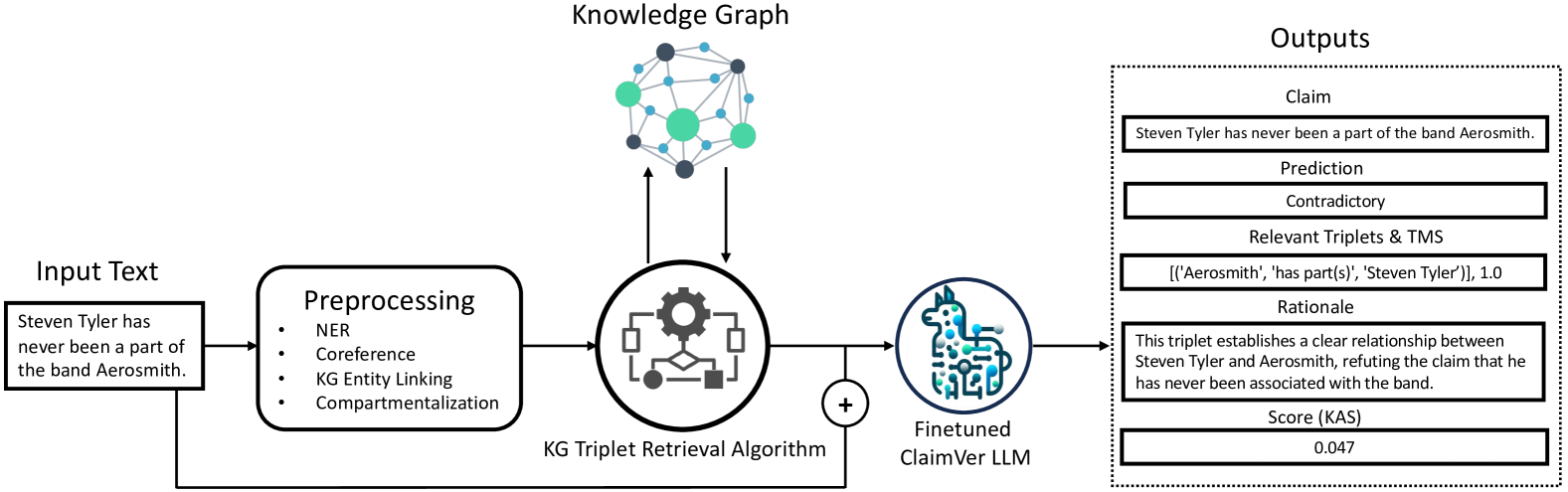
The image is a diagram illustrating a knowledge graph-based claim verification process. It starts with input text, preprocesses it, retrieves relevant triplets from a knowledge graph, and uses a fine-tuned language model to generate a prediction and rationale.
### Components/Axes
* **Header:** "Knowledge Graph" and "Outputs" are positioned at the top.
* **Input Text:** A block of text stating "Steven Tyler has never been a part of the band Aerosmith."
* **Preprocessing:** A rounded rectangle listing the following steps:
* NER (Named Entity Recognition)
* Coreference
* KG Entity Linking
* Compartmentalization
* **Knowledge Graph:** A visual representation of a knowledge graph with interconnected nodes in teal and dark blue.
* **KG Triplet Retrieval Algorithm:** A circular icon representing the algorithm.
* **Finetuned ClaimVer LLM:** A stylized llama icon representing the language model.
* **Outputs:** A box with a dotted border containing the following elements:
* **Claim:** "Steven Tyler has never been a part of the band Aerosmith."
* **Prediction:** "Contradictory"
* **Relevant Triplets & TMS:** "[('Aerosmith', 'has part(s)', 'Steven Tyler')], 1.0"
* **Rationale:** "This triplet establishes a clear relationship between Steven Tyler and Aerosmith, refuting the claim that he has never been associated with the band."
* **Score (KAS):** "0.047"
### Detailed Analysis or Content Details
1. **Input Text:** The input text is a claim about Steven Tyler's association with the band Aerosmith.
2. **Preprocessing:** The preprocessing step involves several NLP techniques to prepare the input text for knowledge graph retrieval.
3. **Knowledge Graph:** The knowledge graph provides structured information about entities and their relationships.
4. **KG Triplet Retrieval Algorithm:** This algorithm retrieves relevant triplets from the knowledge graph based on the preprocessed input.
5. **Finetuned ClaimVer LLM:** The language model uses the retrieved triplets to predict the veracity of the claim and generate a rationale.
6. **Outputs:** The outputs include the original claim, the model's prediction (Contradictory), the relevant triplets used for the prediction, a rationale explaining the prediction, and a score (KAS) indicating the confidence of the prediction.
### Key Observations
* The diagram illustrates a complete pipeline for claim verification using knowledge graphs and language models.
* The prediction is "Contradictory," indicating that the model believes the input claim is false.
* The rationale explains that the triplet "('Aerosmith', 'has part(s)', 'Steven Tyler')" establishes a relationship between Steven Tyler and Aerosmith, contradicting the claim that he has never been associated with the band.
* The score (0.047) suggests a relatively low confidence in the prediction.
### Interpretation
The diagram demonstrates how knowledge graphs can be used to verify claims by providing structured information about entities and their relationships. The language model leverages this information to make predictions and provide explanations. The low score suggests that the model may not be highly confident in its prediction, possibly due to the complexity of the claim or limitations in the knowledge graph. The system effectively uses the knowledge graph to refute the claim by identifying a relationship between Steven Tyler and Aerosmith.