## Text Block: Instance Reflection Query Template
### Overview
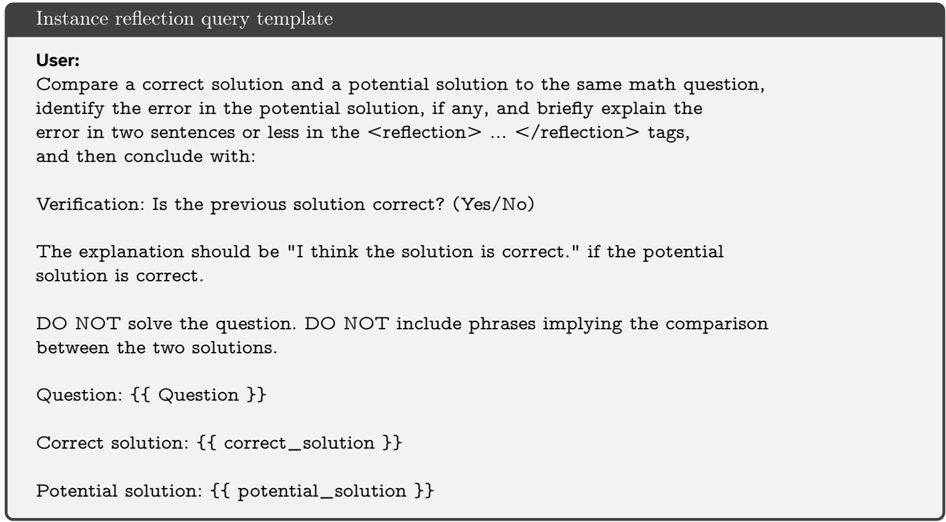
The image presents a template for an instance reflection query, likely used in a system that evaluates solutions to math questions. The template provides instructions for a user to compare a correct solution with a potential solution, identify errors, and provide a verification.
### Components/Axes
The template includes the following sections:
* **Title:** "Instance reflection query template"
* **User Instructions:**
* Compare a correct solution and a potential solution to the same math question.
* Identify the error in the potential solution, if any.
* Briefly explain the error in two sentences or less within `<reflection>` and `</reflection>` tags.
* Conclude with a verification.
* **Verification Prompt:** "Verification: Is the previous solution correct? (Yes/No)"
* **Explanation Guidance:** "The explanation should be 'I think the solution is correct.' if the potential solution is correct."
* **Prohibitions:**
* "DO NOT solve the question."
* "DO NOT include phrases implying the comparison between the two solutions."
* **Input Fields:**
* "Question: {{ Question }}"
* "Correct solution: {{ correct\_solution }}"
* "Potential solution: {{ potential\_solution }}"
### Detailed Analysis or ### Content Details
The template is designed to elicit a comparative analysis of two solutions to the same math problem. The user is expected to identify and explain any errors in the "potential solution" while avoiding solving the problem themselves or explicitly comparing the solutions. The `<reflection>` tags suggest a specific formatting requirement for the error explanation. The template also includes placeholders for the question, correct solution, and potential solution, indicated by double curly braces.
### Key Observations
The template emphasizes error identification and explanation over problem-solving. The constraints on the explanation (two sentences or less, use of `<reflection>` tags) suggest a focus on concise and structured feedback. The prohibition against direct comparison implies a desire for independent evaluation of the potential solution.
### Interpretation
This template is likely used in an automated system for evaluating or learning from solutions to math problems. The structured format allows for consistent and potentially automated analysis of user feedback. The focus on error identification and explanation suggests a goal of improving the quality of solutions or training algorithms to recognize and correct errors. The template is designed to guide users towards providing specific and actionable feedback, which can then be used to improve the system's understanding of mathematical problem-solving.