\n
## Document: Instance Reflection Query Template
### Overview
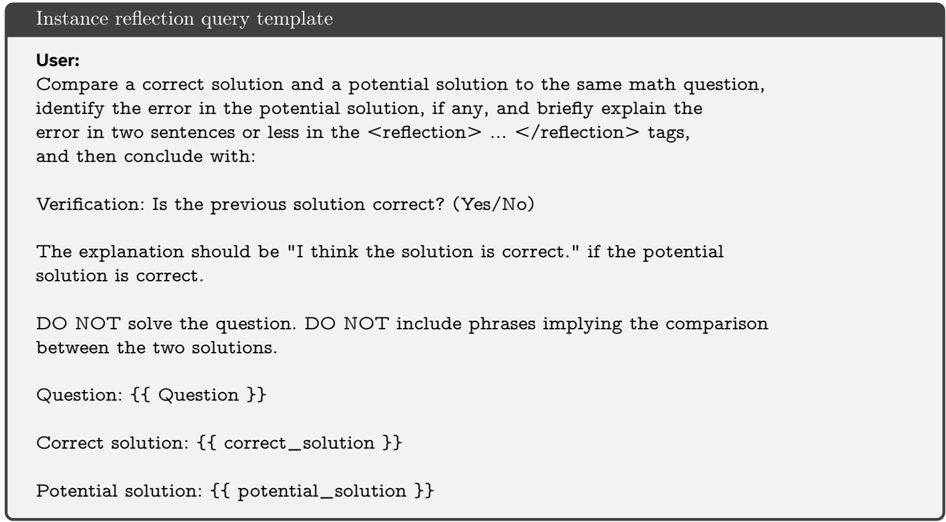
The image presents a text-based document outlining instructions for an "Instance Reflection Query Template". This template is designed for evaluating the correctness of a potential solution to a math problem by comparing it to a correct solution. The document details the expected format of the user's response, including specific phrasing and constraints.
### Components/Axes
The document is structured as a set of instructions, with the following key elements:
* **Title:** "Instance reflection query template" (top-left)
* **User Instruction:** A detailed description of the task, including constraints on the response format.
* **Verification Question:** "Verification: Is the previous solution correct? (Yes/No)"
* **Explanation Rule:** "The explanation should be “I think the solution is correct.” if the potential solution is correct."
* **Negative Constraints:** "DO NOT solve the question. DO NOT include phrases implying the comparison between the two solutions."
* **Template Fields:**
* "Question: {{ Question }}"
* "Correct solution: {{ correct_solution }}"
* "Potential solution: {{ potential_solution }}"
### Detailed Analysis or Content Details
The document provides a precise set of instructions for a user interacting with a system designed to evaluate mathematical solutions. The core task is to identify errors in a "Potential solution" by comparing it to a "Correct solution", but *without* explicitly solving the problem or making direct comparisons. The response must be formatted within `<reflection> ... </reflection>` tags and limited to two sentences. The verification question requires a "Yes/No" answer. A specific phrasing is required for correct potential solutions ("I think the solution is correct.").
The template fields, denoted by double curly braces `{{ ... }}`, indicate placeholders for the actual question, correct solution, and potential solution.
### Key Observations
The document emphasizes a very specific and constrained response format. The instructions are designed to elicit a focused evaluation of the potential solution, rather than a full re-solving of the problem. The requirement to use a specific phrase for correct solutions suggests a system that may be automatically parsing the user's response.
### Interpretation
This document describes a system for automated evaluation of mathematical problem-solving. The template is designed to gather feedback on the correctness of a potential solution *without* requiring the evaluator to fully understand or re-solve the problem. This approach could be used for large-scale evaluation of student work or for debugging automated problem-solving systems. The constraints on the response format suggest that the system is likely using natural language processing (NLP) techniques to analyze the user's feedback. The use of template fields indicates that the system is designed to handle a variety of mathematical problems. The emphasis on avoiding direct comparison between solutions suggests that the system may be looking for specific types of errors or reasoning patterns.