## Screenshot: Instance Reflection Query Template
### Overview
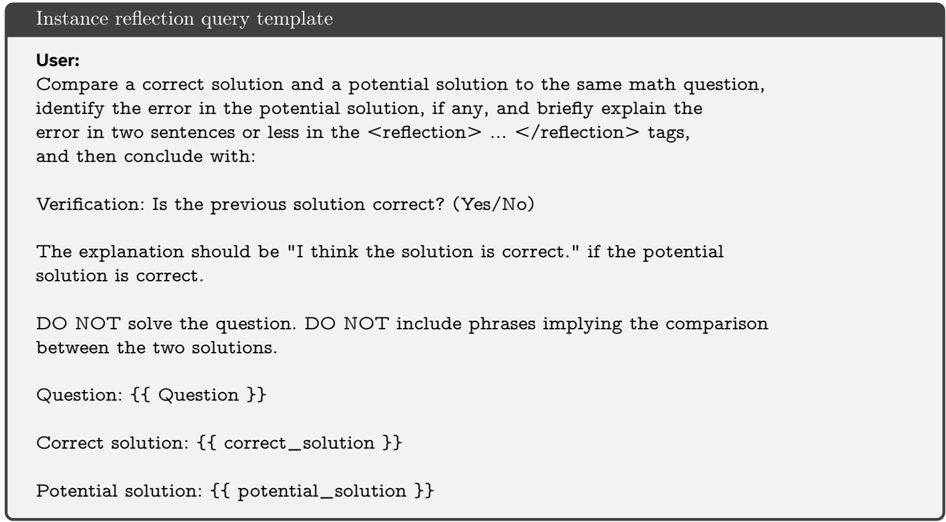
The image displays a structured template for comparing a correct solution and a potential solution to a math problem. It includes explicit instructions for error identification, formatting requirements, and verification steps.
### Components/Axes
- **Title**: "Instance reflection query template" (top-left, bold black text).
- **User Section**: Contains step-by-step instructions for comparing solutions.
- **Placeholders**:
- `{{ Question }}`
- `{{ correct_solution }}`
- `{{ potential_solution }}`
- **Verification Prompt**: "Verification: Is the previous solution correct? (Yes/No)"
- **Explanation Guideline**: Requires a specific phrase ("I think the solution is correct.") if the potential solution is valid.
### Detailed Analysis
1. **User Instructions**:
- Compare two solutions to the same math question.
- Identify errors in the potential solution (if any).
- Explain the error in **two sentences or less** within `<reflection>` tags.
- Conclude with a verification question.
- Prohibits solving the question or implying comparisons between solutions.
2. **Formatting Rules**:
- Use `<reflection>` tags for error explanations.
- Avoid phrases like "Compare..." or "Difference between...".
3. **Placeholders**:
- `{{ Question }}`: Replaced with the actual math problem.
- `{{ correct_solution }}`: The accurate solution.
- `{{ potential_solution }}`: The solution to be evaluated.
### Key Observations
- The template enforces strict formatting (e.g., `<reflection>` tags, no comparative language).
- The verification step is binary (Yes/No), with a predefined explanation for correct solutions.
- Placeholders are enclosed in double curly braces (`{{ }}`), indicating variables to be filled.
### Interpretation
This template is designed for automated or semi-automated evaluation of solutions, likely in an educational or AI-driven context. The emphasis on brevity (`<reflection>` tags) and prohibition of comparative language suggests it prioritizes concise, direct error analysis. The verification step acts as a final check, ensuring consistency in grading or feedback. The structure implies integration with a system that parses these placeholders and instructions programmatically.
No numerical data, charts, or diagrams are present. The focus is entirely on textual instructions and placeholders.