## Flowchart: Impact of Paper a on Follow-up Study Paper b
### Overview
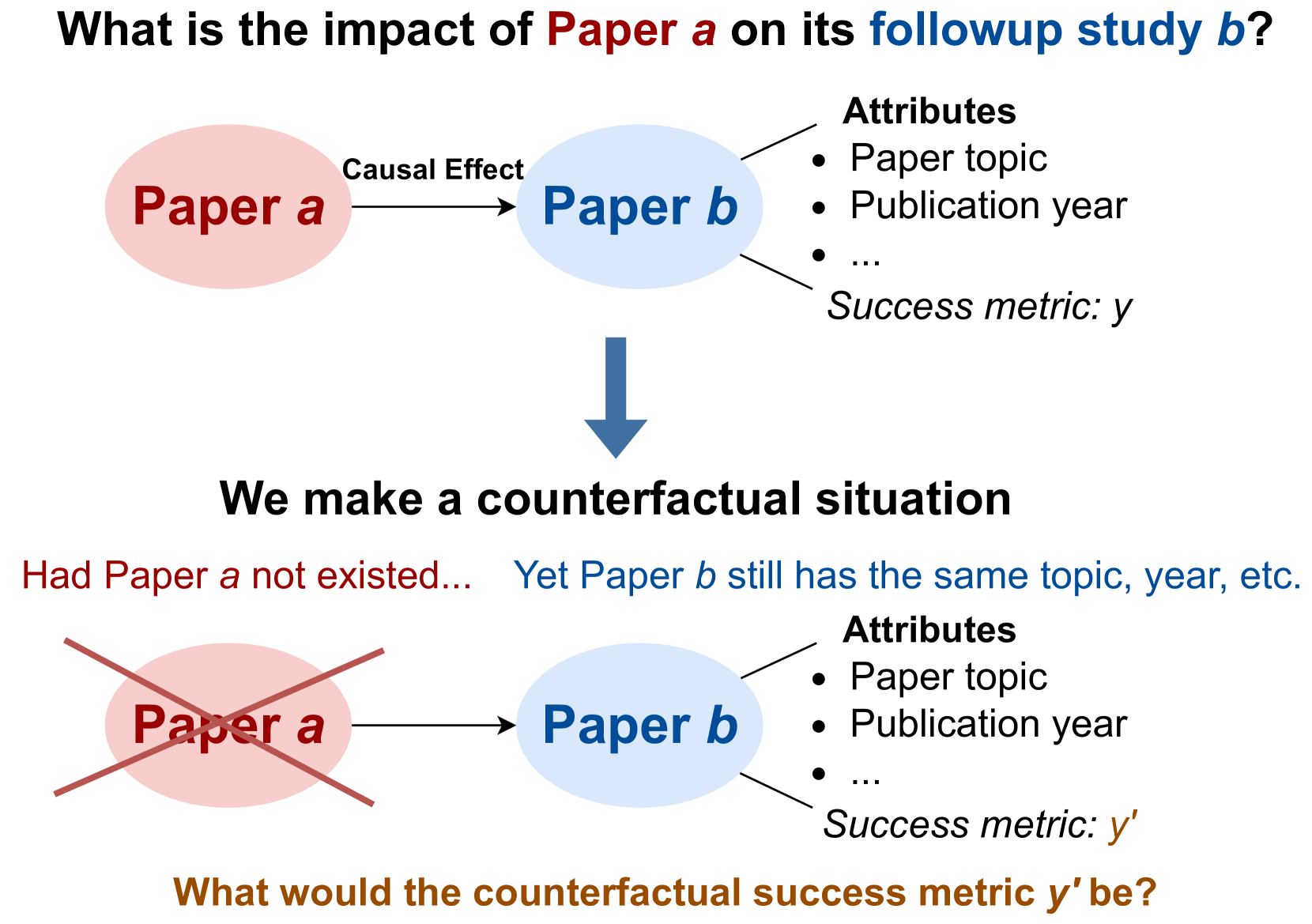
The diagram illustrates a causal relationship between two academic papers (Paper a and Paper b) and explores a counterfactual scenario where Paper a does not exist. It compares the success metrics of Paper b in both scenarios.
### Components/Axes
- **Ovals**:
- Red oval labeled "Paper a" (left side)
- Blue oval labeled "Paper b" (right side)
- **Arrows**:
- Black arrow labeled "Causal Effect" from Paper a to Paper b
- Blue arrow labeled "We make a counterfactual situation" pointing downward
- **Text Labels**:
- Top: "What is the impact of Paper a on its followup study b?"
- Middle: "Had Paper a not existed... Yet Paper b still has the same topic, year, etc."
- Bottom: "What would the counterfactual success metric y’ be?"
- **Attributes**:
- For Paper b: "Paper topic," "Publication year," "...", "Success metric: y"
- For counterfactual Paper b: "Success metric: y’"
### Detailed Analysis
- **Causal Scenario**:
- Paper a (red) directly influences Paper b (blue) via a labeled "Causal Effect" arrow.
- Paper b's success metric is denoted as **y**.
- **Counterfactual Scenario**:
- Paper a is crossed out (red oval with red X).
- Paper b retains the same attributes (topic, year) but has a modified success metric **y’**.
### Key Observations
1. The diagram explicitly contrasts two scenarios:
- Actual: Paper a exists and affects Paper b.
- Counterfactual: Paper a is absent, but Paper b retains identical attributes.
2. Success metrics are differentiated as **y** (actual) and **y’** (counterfactual).
3. No numerical values or quantitative data are provided; the focus is on conceptual relationships.
### Interpretation
This diagram frames a **causal inference** problem, asking:
- How much of Paper b's success (y) can be attributed to Paper a?
- What would Paper b's success metric (y’) look like without Paper a's influence?
The counterfactual approach suggests a **thought experiment** to isolate Paper a's impact by holding all other variables constant (topic, year). The absence of numerical data implies this is a conceptual framework for designing an impact assessment study rather than presenting empirical results.