## Chart Type: Line Chart - Proportion of Flips over Iterations
### Overview
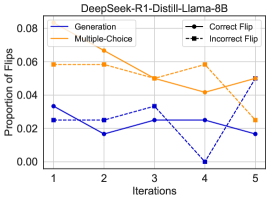
This image displays a line chart titled "DeepSeek-R1-Distill-Llama-8B", illustrating the "Proportion of Flips" across five "Iterations" for four distinct data series. These series represent combinations of two conditions: "Generation" versus "Multiple-Choice" (distinguished by color) and "Correct Flip" versus "Incorrect Flip" (distinguished by line style and marker). The chart tracks how the proportion of these different types of flips changes as iterations progress.
### Components/Axes
The chart is structured with a main plotting area, an X-axis, a Y-axis, and a legend in the top-center.
* **Chart Title**: "DeepSeek-R1-Distill-Llama-8B"
* **X-axis**: Labeled "Iterations". The axis ranges from 1 to 5, with integer markers at 1, 2, 3, 4, and 5.
* **Y-axis**: Labeled "Proportion of Flips". The axis ranges from 0.00 to 0.08, with major grid lines and markers at 0.00, 0.02, 0.04, 0.06, and 0.08. Minor grid lines indicate increments of approximately 0.004.
* **Legend**: Located in the top-center of the plot area. It defines the four data series by combining color (for task type) and line style/marker (for flip correctness).
* **Blue solid line**: Represents the "Generation" task type.
* **Orange solid line**: Represents the "Multiple-Choice" task type.
* **Black solid line with circular markers**: Represents "Correct Flip".
* **Black dashed line with square markers**: Represents "Incorrect Flip".
Combining these, the four data series plotted are:
1. **Generation - Correct Flip**: Blue solid line with circular markers.
2. **Generation - Incorrect Flip**: Blue dashed line with square markers.
3. **Multiple-Choice - Correct Flip**: Orange solid line with circular markers.
4. **Multiple-Choice - Incorrect Flip**: Orange dashed line with square markers.
### Detailed Analysis
The chart presents the following data points for each series across the 5 iterations:
1. **Generation - Correct Flip (Blue solid line with circular markers)**:
* **Trend**: Starts at a moderate level, dips, then rises slightly, remains stable, and finally dips again.
* **Data Points**:
* Iteration 1: ~0.033
* Iteration 2: ~0.017
* Iteration 3: ~0.026
* Iteration 4: ~0.026
* Iteration 5: ~0.017
2. **Generation - Incorrect Flip (Blue dashed line with square markers)**:
* **Trend**: Starts at a low level, remains stable, rises, then drops sharply to zero, and finally rises significantly.
* **Data Points**:
* Iteration 1: ~0.025
* Iteration 2: ~0.025
* Iteration 3: ~0.033
* Iteration 4: ~0.000
* Iteration 5: ~0.049
3. **Multiple-Choice - Correct Flip (Orange solid line with circular markers)**:
* **Trend**: Starts at a high level, remains stable, then gradually declines over iterations.
* **Data Points**:
* Iteration 1: ~0.058
* Iteration 2: ~0.058
* Iteration 3: ~0.050
* Iteration 4: ~0.042
* Iteration 5: ~0.025
4. **Multiple-Choice - Incorrect Flip (Orange dashed line with square markers)**:
* **Trend**: Starts at a high level, peaks at iteration 2, then fluctuates, generally staying at a high proportion.
* **Data Points**:
* Iteration 1: ~0.058
* Iteration 2: ~0.066
* Iteration 3: ~0.050
* Iteration 4: ~0.058
* Iteration 5: ~0.050
### Key Observations
* **Overall Proportions**: The "Multiple-Choice" task generally exhibits higher proportions of both correct and incorrect flips compared to the "Generation" task across most iterations.
* **Dominant Flip Type**: For the "Multiple-Choice" task, "Incorrect Flips" (orange dashed line) are consistently higher than "Correct Flips" (orange solid line) from iteration 2 onwards.
* **Generation Task Volatility**: The "Generation" task shows more volatile behavior, particularly the "Incorrect Flip" series (blue dashed line), which drops to 0.000 at Iteration 4 before sharply increasing to ~0.049 at Iteration 5.
* **Convergence/Divergence**: The "Multiple-Choice - Correct Flip" series shows a clear downward trend, while "Multiple-Choice - Incorrect Flip" remains relatively high. For "Generation", the "Correct Flip" series is generally low, while the "Incorrect Flip" series shows a dramatic spike at the end.
* **Initial State (Iteration 1)**: At the first iteration, both "Multiple-Choice" flip types start at a high proportion (~0.058), while "Generation" flip types start at lower proportions (~0.033 for correct, ~0.025 for incorrect).
### Interpretation
This chart likely illustrates the dynamic behavior of a language model (DeepSeek-R1-Distill-Llama-8B) during a multi-iteration process, possibly fine-tuning or evaluation. "Flips" probably refer to instances where the model changes its prediction or classification for a given input across iterations.
* **Task Type Impact**: The "Multiple-Choice" task appears to be more prone to "flips" overall, suggesting either greater uncertainty, more complex decision boundaries, or a different learning dynamic compared to the "Generation" task. The higher proportion of "Incorrect Flips" in "Multiple-Choice" could indicate that the model struggles more with refining its choices in this setting, or that the task itself presents more opportunities for incorrect changes.
* **Learning Dynamics**: The decreasing trend of "Multiple-Choice - Correct Flip" suggests that as iterations progress, the model might be settling on its correct answers, leading to fewer *new* correct flips. However, the sustained high level of "Multiple-Choice - Incorrect Flip" is concerning, implying persistent instability or errors in decision-making for this task.
* **Anomalous Behavior in Generation Task**: The sharp drop of "Generation - Incorrect Flip" to zero at Iteration 4 is a significant anomaly. This could indicate a temporary phase where the model became extremely stable in its incorrect predictions (i.e., no *new* incorrect flips occurred), or it could be an artifact of the evaluation process. The subsequent sharp rise at Iteration 5 suggests this stability was short-lived, and the model started making new incorrect changes again. The "Generation - Correct Flip" remains relatively low throughout, suggesting that the model isn't making many *new* correct changes in this mode.
* **Model Stability and Refinement**: Ideally, one would expect "Incorrect Flips" to decrease over iterations as a model refines its understanding, and "Correct Flips" might also decrease if the model becomes more confident and stable in its correct predictions. The observed trends, especially the high and fluctuating "Incorrect Flips" for "Multiple-Choice" and the dramatic spike for "Generation", suggest that the model's behavior is not smoothly converging towards optimal stability in all conditions. The title "DeepSeek-R1-Distill-Llama-8B" implies a distillation or refinement process, and these "flip" metrics are likely used to monitor the effectiveness and stability of that process. The data suggests that while some aspects might be improving (e.g., decreasing "Multiple-Choice - Correct Flip"), other areas (like "Incorrect Flips") show persistent challenges or unexpected dynamics.