## Diagram: Comparison of Tactic Selection Methods
### Overview
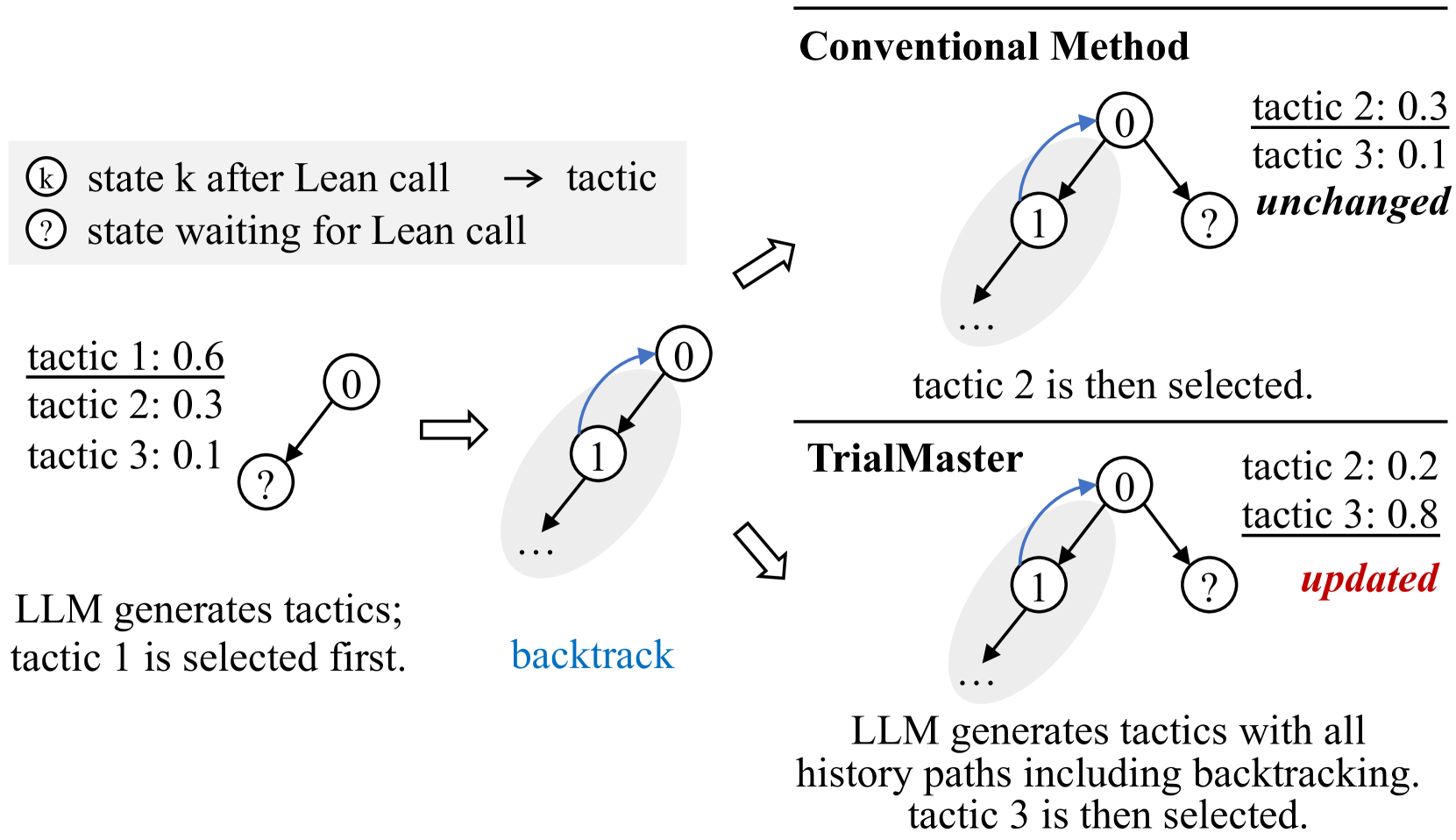
The image presents a diagram comparing two methods for tactic selection: a "Conventional Method" and "TrialMaster". It illustrates the process of generating tactics using a Language Model (LLM) and selecting a tactic based on associated probabilities. The diagram highlights the difference in how these methods handle backtracking and updating tactic probabilities.
### Components/Axes
* **Legend (Top-Left)**:
* (k): state k after Lean call -> tactic
* (?): state waiting for Lean call
* **Nodes**: Represent states in the tactic selection process.
* Nodes are labeled with numbers (0, 1) or a question mark (?).
* **Arrows**: Indicate transitions between states, representing the application of a tactic.
* Blue curved arrows indicate backtracking.
* **Text Labels**: Describe the process and probabilities associated with each tactic.
* **Sections**:
* Left: Initial tactic generation and selection.
* Top-Right: Conventional Method.
* Bottom-Right: TrialMaster.
### Detailed Analysis or ### Content Details
**1. Initial Tactic Generation (Left Side)**:
* "LLM generates tactics; tactic 1 is selected first."
* Node (0) is connected to Node (?)
* Tactic probabilities:
* tactic 1: 0.6
* tactic 2: 0.3
* tactic 3: 0.1
**2. Conventional Method (Top-Right)**:
* Node (0) has two outgoing arrows: one to Node (1) and one to Node (?).
* A blue curved arrow goes from Node (1) back to Node (0), indicating backtracking.
* "tactic 2 is then selected."
* Tactic probabilities:
* tactic 2: 0.3
* tactic 3: 0.1
* "unchanged" - indicating the probabilities remain the same as the initial state.
**3. TrialMaster (Bottom-Right)**:
* Node (0) has two outgoing arrows: one to Node (1) and one to Node (?).
* A blue curved arrow goes from Node (1) back to Node (0), indicating backtracking.
* "LLM generates tactics with all history paths including backtracking. tactic 3 is then selected."
* Tactic probabilities:
* tactic 2: 0.2
* tactic 3: 0.8
* "updated" - indicating the probabilities have been updated after backtracking.
### Key Observations
* The initial tactic probabilities are the same for both methods.
* The Conventional Method does not update tactic probabilities after backtracking, while TrialMaster does.
* The TrialMaster method significantly increases the probability of tactic 3 after backtracking.
### Interpretation
The diagram illustrates the key difference between the Conventional Method and TrialMaster in tactic selection: TrialMaster updates tactic probabilities based on the history of the search, including backtracking steps. This allows TrialMaster to learn from its mistakes and adjust its strategy, potentially leading to more efficient and effective tactic selection. The Conventional Method, on the other hand, maintains static probabilities, which may limit its ability to adapt to the specific problem being solved. The diagram suggests that TrialMaster's ability to update tactic probabilities based on backtracking history is a significant advantage.