\n
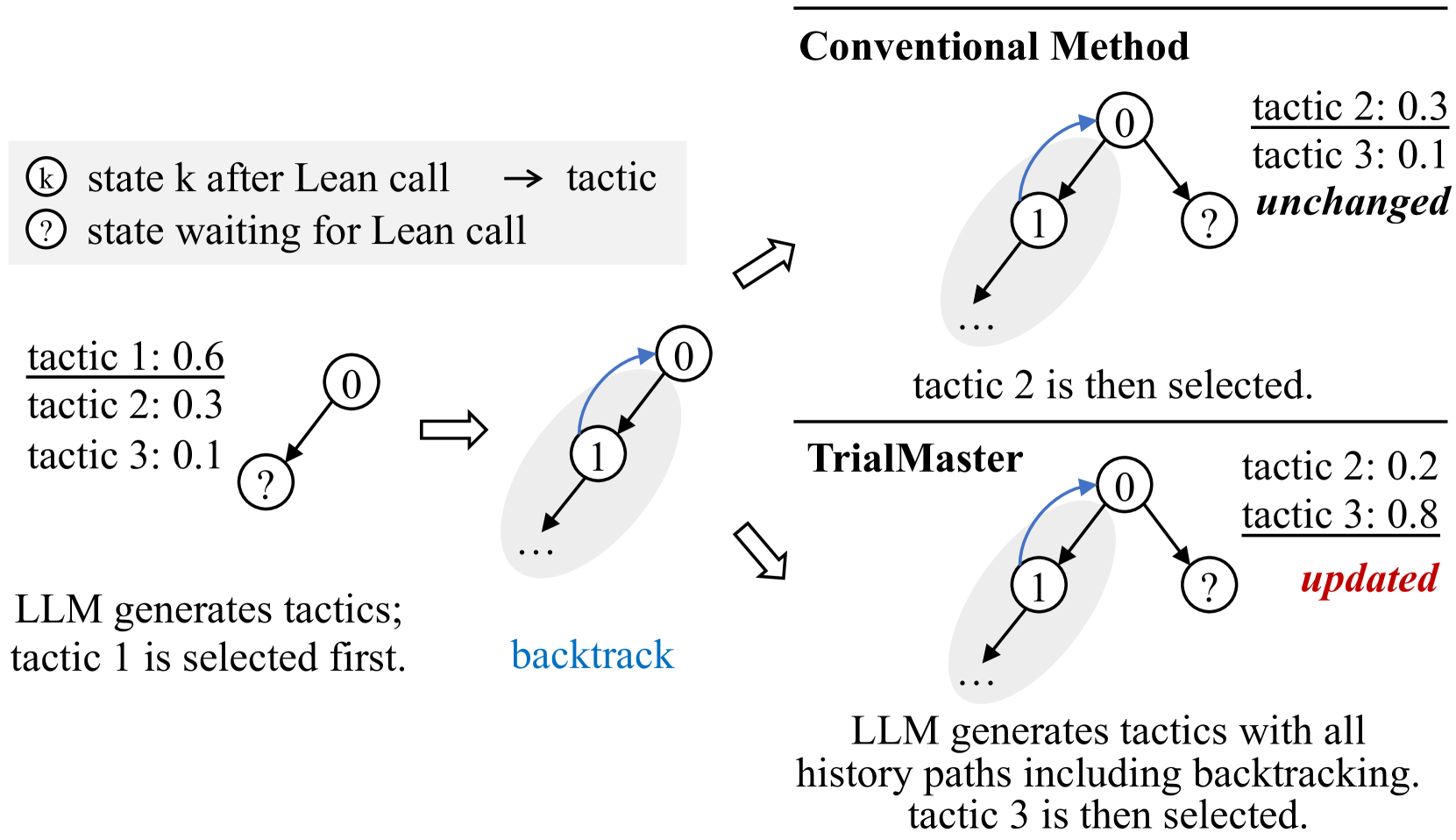
## Diagram: Comparison of Conventional Method and TrialMaster for LLM Tactic Selection
### Overview
This diagram illustrates a comparison between a "Conventional Method" and "TrialMaster" approach to selecting tactics generated by a Large Language Model (LLM). It depicts state transitions and associated probabilities for tactic selection in each method. The diagram uses circular nodes to represent states and arrows to indicate transitions between states, with probabilities associated with each transition.
### Components/Axes
The diagram is divided into two main sections: "Conventional Method" (top-right) and "TrialMaster" (bottom-right). Each section shows a state transition diagram. A key at the top-left defines the states:
* **(1)** state k after Lean call → tactic
* **(2)** state waiting for Lean call
Each transition arrow is labeled with a tactic number and a probability value. The diagram also includes text descriptions explaining the process in each method.
### Detailed Analysis or Content Details
**Conventional Method:**
* **Initial State:** A circular node labeled "0" is the initial state.
* **Transition Probabilities (from 0):**
* tactic 1: 0.6
* tactic 2: 0.3
* tactic 3: 0.1
* **State Transition:** An arrow points from state "0" to state "1".
* **Next State:** A circular node labeled "1" represents the next state.
* **Transition Probabilities (from 1):**
* tactic 2: 0.3
* tactic 3: 0.1 (labeled as "unchanged")
* **Text Description:** "LLM generates tactics; tactic 1 is selected first." and "tactic 2 is then selected."
**TrialMaster:**
* **Initial State:** A circular node labeled "0" is the initial state.
* **Transition Probabilities (from 0):**
* tactic 1: 0.6
* tactic 2: 0.3
* tactic 3: 0.1
* **State Transition:** An arrow labeled "backtrack" points from state "0" to state "1".
* **Next State:** A circular node labeled "1" represents the next state.
* **Transition Probabilities (from 1):**
* tactic 2: 0.2
* tactic 3: 0.8 (labeled as "updated")
* **Text Description:** "LLM generates tactics with all history paths including backtracking." and "tactic 3 is then selected."
**Arrows:**
* Grey arrows connect the diagrams, indicating the flow of the process.
### Key Observations
* The "TrialMaster" method incorporates a "backtrack" step, which is absent in the "Conventional Method."
* The probabilities associated with tactic selection change between the two methods. Specifically, tactic 3 has a significantly higher probability (0.8) in "TrialMaster" compared to the "Conventional Method" (0.1).
* The "Conventional Method" labels the probabilities from state 1 as "unchanged", while "TrialMaster" labels them as "updated".
### Interpretation
The diagram demonstrates how the "TrialMaster" method improves upon the "Conventional Method" by incorporating a backtracking mechanism. This allows the LLM to consider all possible history paths, leading to a more informed tactic selection process. The increased probability of tactic 3 in "TrialMaster" suggests that the backtracking step identifies and prioritizes tactics that might have been overlooked in the "Conventional Method." The labels "unchanged" and "updated" highlight that the probabilities are dynamically adjusted in "TrialMaster" based on the history of tactic selections and backtracking. This suggests a more adaptive and potentially more effective approach to LLM tactic selection. The diagram implies that the conventional method is more rigid, while TrialMaster is more flexible and responsive to the LLM's generated tactics and their history.