\n
## Diagram: STDP Learning Rule & Associated Matrices
### Overview
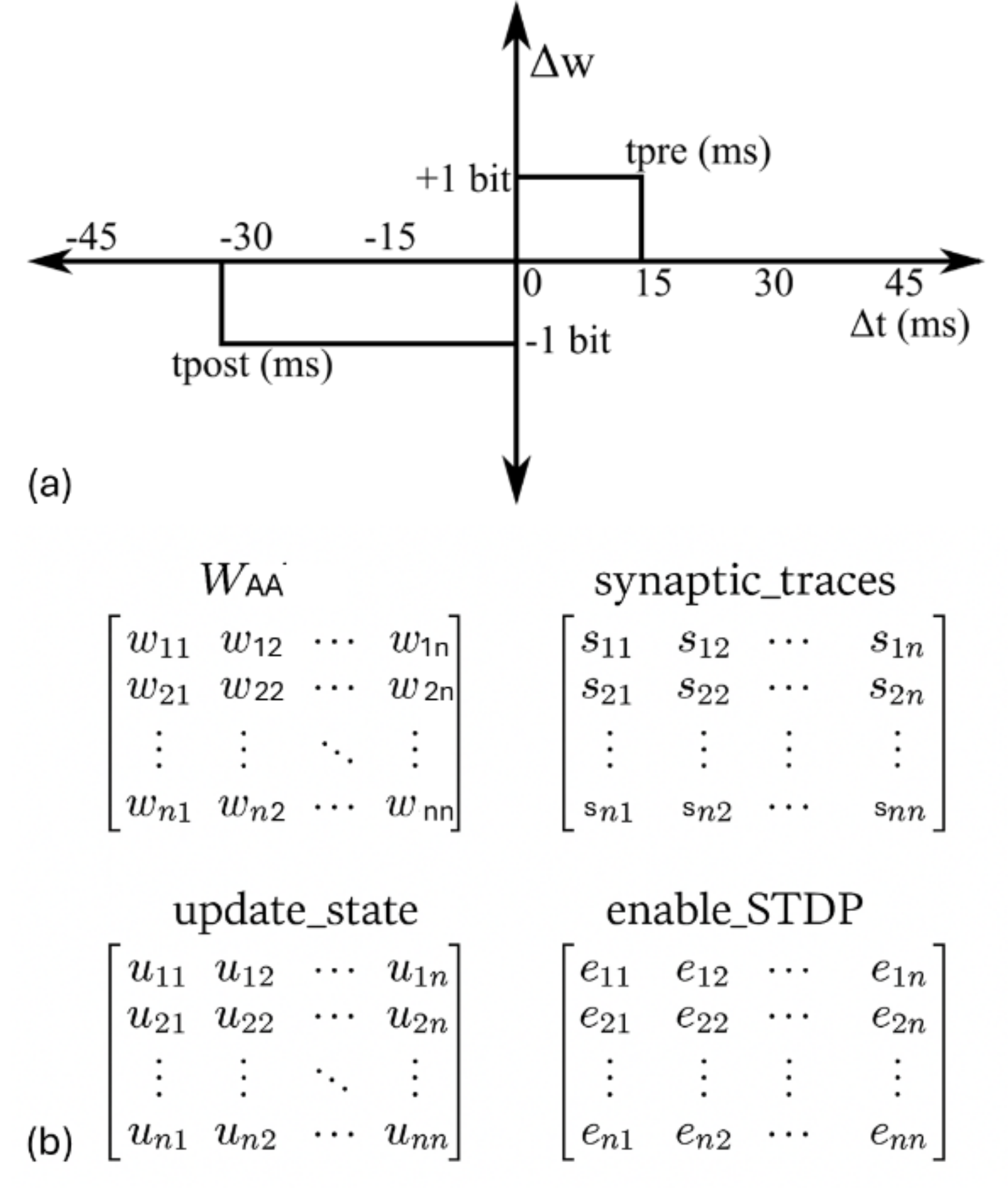
The image presents a diagram illustrating the Spike-Timing-Dependent Plasticity (STDP) learning rule and associated matrices used in its implementation. The top portion depicts the STDP learning window as a function of spike timing differences, while the bottom portion shows four matrices representing synaptic weights, synaptic traces, update states, and enable signals for STDP.
### Components/Axes
* **Top Plot:**
* **Axes:**
* x-axis: Δt (ms) - ranging from -45ms to +45ms.
* y-axis: Δw - representing the change in synaptic weight. No explicit scale is provided, but it indicates +1 bit and -1 bit changes.
* **Curve:** A single curve representing the STDP learning window. It peaks around -15ms (positive Δw) and 15ms (negative Δw), crossing zero at 0ms.
* **Labels:** tpost (ms) and tpre (ms) are indicated along the x-axis, representing the timing of the post-synaptic and pre-synaptic spikes, respectively.
* **Bottom Matrices (labeled (a) and (b)):**
* **WAA:** A matrix representing synaptic weights. Elements are denoted as w<sub>ij</sub>, where 'i' and 'j' range from 1 to n.
* **synaptic_traces:** A matrix representing synaptic traces. Elements are denoted as s<sub>ij</sub>, where 'i' and 'j' range from 1 to n.
* **update_state:** A matrix representing update states. Elements are denoted as u<sub>ij</sub>, where 'i' and 'j' range from 1 to n.
* **enable_STDP:** A matrix representing enable signals for STDP. Elements are denoted as e<sub>ij</sub>, where 'i' and 'j' range from 1 to n.
* **Ellipsis:** Each matrix contains an ellipsis (...) indicating that the matrices are larger than explicitly shown.
### Detailed Analysis or Content Details
* **STDP Window:** The STDP window shows that if the pre-synaptic spike occurs *before* the post-synaptic spike (negative Δt), the synaptic weight increases (positive Δw). Conversely, if the pre-synaptic spike occurs *after* the post-synaptic spike (positive Δt), the synaptic weight decreases (negative Δw). The magnitude of the weight change is greatest around ±15ms and diminishes as the timing difference increases.
* **Matrices:** All four matrices are n x n matrices. The indices 'i' and 'j' likely represent the pre- and post-synaptic neuron indices, respectively.
* **WAA:** Represents the strength of the connection between neurons.
* **synaptic_traces:** Likely stores the recent activity of the synapse, influencing the STDP update.
* **update_state:** Indicates whether a synaptic update should be performed.
* **enable_STDP:** Controls whether STDP is active for a particular synapse.
### Key Observations
* The STDP window is symmetrical around 0ms, although the exact symmetry is difficult to assess without numerical values.
* The matrices are all of the same dimensions (n x n), suggesting a fully connected network or a consistent representation of synaptic connections.
* The use of matrices implies a computational implementation of the STDP rule, likely within a neural network model.
### Interpretation
The diagram illustrates the core principle of STDP, a biologically plausible learning rule that adjusts synaptic weights based on the relative timing of pre- and post-synaptic spikes. This rule is crucial for learning temporal patterns and causal relationships in neural circuits. The matrices represent the data structures used to implement this rule computationally.
* **WAA** stores the learned synaptic weights, which are modified by the STDP rule.
* **synaptic_traces** provide a short-term memory of synaptic activity, influencing the magnitude of the weight change.
* **update_state** and **enable_STDP** provide control mechanisms for selectively applying the STDP rule to specific synapses.
The diagram suggests a model where STDP is used to dynamically adjust synaptic weights in a network, potentially enabling the network to learn and adapt to temporal patterns in its input. The use of matrices indicates a computational approach to modeling this biological learning process. The diagram does not provide specific values for 'n' or the magnitude of Δw, so the scale and complexity of the network are not fully defined.