## Technical Diagram: Spike-Timing-Dependent Plasticity (STDP) Rule and Associated Matrices
### Overview
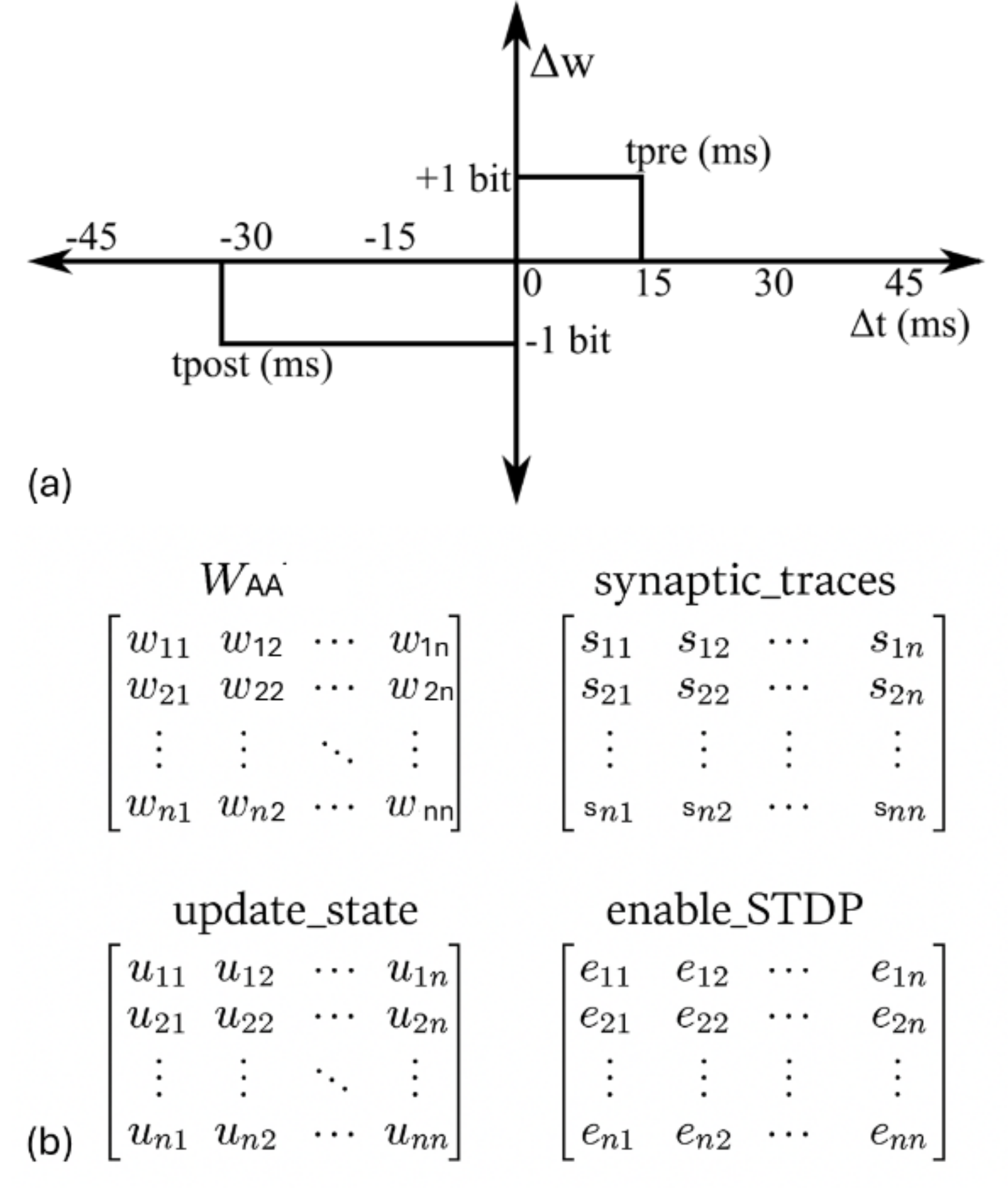
The image is a two-part technical diagram illustrating a simplified, binary model of Spike-Timing-Dependent Plasticity (STDP) and the matrix representations of its associated variables in a neural network context. Part (a) is a graph defining the weight update rule based on spike timing differences. Part (b) displays four generic matrices representing the state variables of a network implementing this rule.
### Components/Axes
#### Part (a): STDP Rule Graph
* **Vertical Axis (Y-axis):** Labeled **Δw**. Represents the change in synaptic weight. The axis has two discrete levels marked: **+1 bit** (positive change) and **-1 bit** (negative change).
* **Horizontal Axis (X-axis):** Labeled **Δt (ms)**. Represents the time difference between pre-synaptic and post-synaptic spikes in milliseconds. The axis has tick marks at **-45, -30, -15, 0, 15, 30, 45**.
* **Regions and Labels:**
* A rectangular region in the positive quadrant (Δt > 0, Δw = +1 bit) is labeled **tpre (ms)**. This region spans from Δt = 0 to Δt = 15 ms.
* A rectangular region in the negative quadrant (Δt < 0, Δw = -1 bit) is labeled **tpost (ms)**. This region spans from Δt = -30 ms to Δt = 0.
* **Sub-label:** The graph is labeled **(a)** in the bottom-left corner.
#### Part (b): Matrix Representations
Four matrices are presented, all sharing an identical n x n structure with elements indexed from 1 to n. Ellipses (`...`) indicate the continuation of rows and columns.
1. **Top-Left Matrix:** Labeled **W<sub>AA</sub>**. Elements are denoted as **w<sub>ij</sub>** (e.g., w<sub>11</sub>, w<sub>12</sub>, ..., w<sub>1n</sub>; w<sub>21</sub>, w<sub>22</sub>, ..., w<sub>2n</sub>; ...; w<sub>n1</sub>, w<sub>n2</sub>, ..., w<sub>nn</sub>).
2. **Top-Right Matrix:** Labeled **synaptic_traces**. Elements are denoted as **s<sub>ij</sub>** (e.g., s<sub>11</sub>, s<sub>12</sub>, ..., s<sub>1n</sub>; s<sub>21</sub>, s<sub>22</sub>, ..., s<sub>2n</sub>; ...; s<sub>n1</sub>, s<sub>n2</sub>, ..., s<sub>nn</sub>).
3. **Bottom-Left Matrix:** Labeled **update_state**. Elements are denoted as **u<sub>ij</sub>** (e.g., u<sub>11</sub>, u<sub>12</sub>, ..., u<sub>1n</sub>; u<sub>21</sub>, u<sub>22</sub>, ..., u<sub>2n</sub>; ...; u<sub>n1</sub>, u<sub>n2</sub>, ..., u<sub>nn</sub>).
4. **Bottom-Right Matrix:** Labeled **enable_STDP**. Elements are denoted as **e<sub>ij</sub>** (e.g., e<sub>11</sub>, e<sub>12</sub>, ..., e<sub>1n</sub>; e<sub>21</sub>, e<sub>22</sub>, ..., e<sub>2n</sub>; ...; e<sub>n1</sub>, e<sub>n2</sub>, ..., e<sub>nn</sub>).
* **Sub-label:** This group of matrices is labeled **(b)** in the bottom-left corner.
### Detailed Analysis
* **STDP Rule (Part a):** The graph defines a **binary, asymmetric Hebbian learning rule**.
* **Potentiation (+1 bit):** Occurs when the pre-synaptic spike precedes the post-synaptic spike (Δt > 0). The potentiation window is **tpre = 15 ms**. Any spike pair with a positive timing difference within this window results in a fixed weight increase of +1 bit.
* **Depression (-1 bit):** Occurs when the post-synaptic spike precedes the pre-synaptic spike (Δt < 0). The depression window is **tpost = 30 ms**. Any spike pair with a negative timing difference within this window results in a fixed weight decrease of -1 bit.
* **Asymmetry:** The depression window (30 ms) is twice as long as the potentiation window (15 ms).
* **Discretization:** Weight changes are quantized to single bits, suggesting a digital or highly simplified implementation.
* **Matrix Structure (Part b):** The four matrices represent the core data structures for a network of *n* neurons.
* **W<sub>AA</sub>:** The primary synaptic weight matrix connecting a population of neurons (likely all-to-all, given the square matrix).
* **synaptic_traces:** A matrix of the same dimension, likely holding eligibility traces or other temporal variables necessary for computing the STDP updates.
* **update_state:** A matrix that may control or log the update process for each synapse.
* **enable_STDP:** A binary or control matrix that likely gates whether the STDP rule is active for a given synapse (i,j).
### Key Observations
1. **Binary and Discrete:** The STDP model is highly abstracted, using only +1 or -1 bit changes instead of continuous values.
2. **Temporal Asymmetry:** The rule is asymmetric in time, with a longer window for depression than for potentiation, a common feature in biological STDP models.
3. **Structured State Management:** The use of four parallel matrices indicates a systematic approach to managing synaptic weights, traces, and update logic in a computational model, possibly for efficient parallel processing or hardware implementation.
### Interpretation
This diagram outlines a **computational framework for implementing a simplified, binary STDP learning rule in a neural network**. The graph in (a) defines the fundamental learning principle: synaptic connections are strengthened if the pre-synaptic neuron fires shortly before the post-synaptic neuron, and weakened if the order is reversed, with fixed, discrete changes. The matrices in (b) provide the data architecture to execute this rule across a network of *n* neurons. The `synaptic_traces` matrix is crucial, as it would store the temporal information (e.g., last spike times) needed to compute Δt for each synapse. The `enable_STDP` matrix suggests the learning rule can be selectively applied, allowing for plasticity control. This model is likely designed for **digital neuromorphic hardware or efficient simulation**, where binary weights and structured matrix operations are advantageous. The asymmetry in the time windows (tpost > tpre) biases the network towards depression, which can be important for stability and preventing runaway excitation in learning systems.