\n
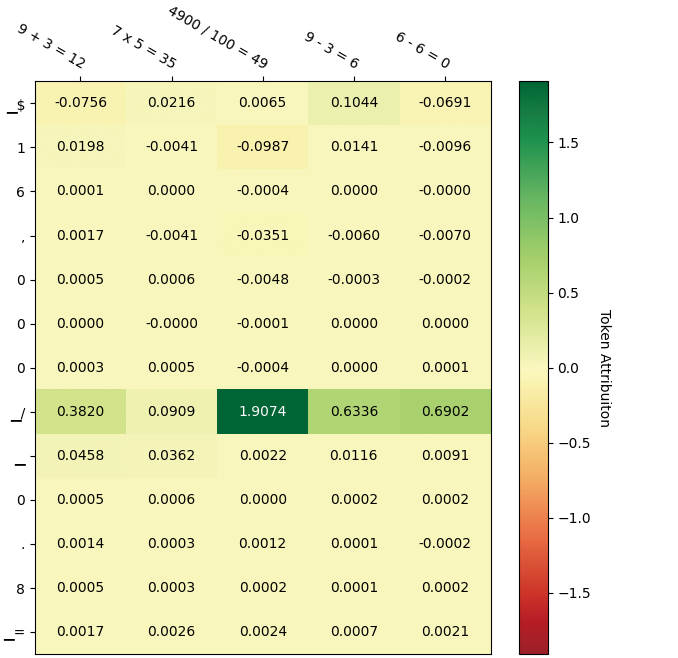
## Heatmap: Token Attribution for Mathematical Expressions
### Overview
The image presents a heatmap visualizing "Token Attribution" values for different parts of several mathematical expressions. The expressions are arranged in a grid-like structure, and each cell in the grid is colored based on its corresponding attribution score. The color scale ranges from -1.5 (dark red) to 1.5 (dark green), with 0 represented by a light yellow/white.
### Components/Axes
* **X-axis:** Represents the different mathematical expressions: "9 + 3 = 12", "7 x 5 = 35", "4900 / 100 = 49", "9 - 3 = 6", "6 - 6 = 0".
* **Y-axis:** Represents the tokens within each expression. The tokens are numerical digits, operators (+, x, -, /), and the equals sign (=). The Y-axis labels are: "9", "1", "6", "0", "0", "0", "3", "8", "=".
* **Color Scale (Legend):** Located on the right side of the heatmap. It indicates the mapping between color and "Token Attribution" value.
* -1.5: Dark Red
* -1.0: Red
* -0.5: Orange
* 0.0: Yellow/White
* 0.5: Light Green
* 1.0: Green
* 1.5: Dark Green
### Detailed Analysis
The heatmap displays attribution scores for each token in each expression. Here's a breakdown of the values, organized by expression and token:
**1. 9 + 3 = 12**
* 9: -0.0756
* 1: 0.0198
* 6: 0.0001
* 0: 0.0017
* 0: 0.0005
* 0: 0.0000
* 3: 0.0003
* 8: 0.0005
* =: 0.0017
**2. 7 x 5 = 35**
* 7: 0.0216
* 1: -0.0441
* 6: -0.0004
* 0: -0.048
* 0: -0.0001
* 0: 0.0000
* 5: 0.0006
* 8: 0.0003
* =: 0.0026
**3. 4900 / 100 = 49**
* 4: 0.0065
* 1: -0.0987
* 6: -0.0004
* 0: -0.0048
* 0: -0.0001
* 0: 0.0000
* 9: 0.0005
* 8: 0.0005
* =: 0.0024
**4. 9 - 3 = 6**
* 9: 0.1044
* 1: 0.0141
* 6: 0.0000
* 0: -0.0003
* 0: 0.0000
* 0: 0.0000
* 3: 0.0000
* 8: 0.0001
* =: 0.0007
**5. 6 - 6 = 0**
* 6: -0.0691
* 1: -0.0096
* 6: -0.0070
* 0: -0.0002
* 0: 0.0001
* 0: 0.0000
* 0: 0.0000
* 8: 0.0002
* =: 0.0021
**Notable High Attribution Values:**
* The token '9' in the expression "9 - 3 = 6" has a high positive attribution score of 0.1044.
* The token '3' in the expression "9 + 3 = 12" has a positive attribution score of 0.0003.
* The token '1' in the expression "7 x 5 = 35" has a negative attribution score of -0.0441.
* The token '1' in the expression "4900 / 100 = 49" has a negative attribution score of -0.0987.
* The token '1' in the expression "9 - 3 = 6" has a positive attribution score of 0.0141.
* The token '1' in the expression "6 - 6 = 0" has a negative attribution score of -0.0096.
* The token '9' in the expression "9 + 3 = 12" has a negative attribution score of -0.0756.
**Highest Attribution Value:**
* The highest attribution value is 1.9074, located at the intersection of the Y-axis token '1' and the X-axis expression "4900 / 100 = 49".
### Key Observations
* Attribution scores are generally low in magnitude, mostly falling between -0.1 and 0.1.
* There is a mix of positive and negative attribution scores, suggesting that some tokens contribute positively to the model's prediction, while others contribute negatively.
* The expression "4900 / 100 = 49" has a particularly high attribution score for the token '1', indicating that this token is highly influential in the model's prediction for this expression.
* The token '6' consistently shows low or negative attribution scores across multiple expressions.
### Interpretation
This heatmap visualizes the importance of each token (digit, operator, equals sign) within different mathematical expressions, as determined by a model's attribution mechanism. The attribution score indicates how much each token contributes to the model's prediction or output.
The high attribution score for '1' in "4900 / 100 = 49" suggests that the model heavily relies on this digit to correctly solve the division problem. The negative attribution scores for certain tokens might indicate that the model is learning to suppress or ignore those tokens in specific contexts. For example, a negative attribution for '6' could mean the model is learning that '6' is less relevant in the context of the given expressions.
The overall pattern suggests that the model is sensitive to the specific digits and operators used in each expression, and it assigns different levels of importance to each token based on its contribution to the overall calculation. This type of analysis can be used to understand how the model is reasoning about mathematical expressions and to identify potential areas for improvement. The heatmap provides a visual representation of the model's internal decision-making process, offering insights into its strengths and weaknesses.