## Score Rubric: C++ Program Implementation Evaluation
### Overview
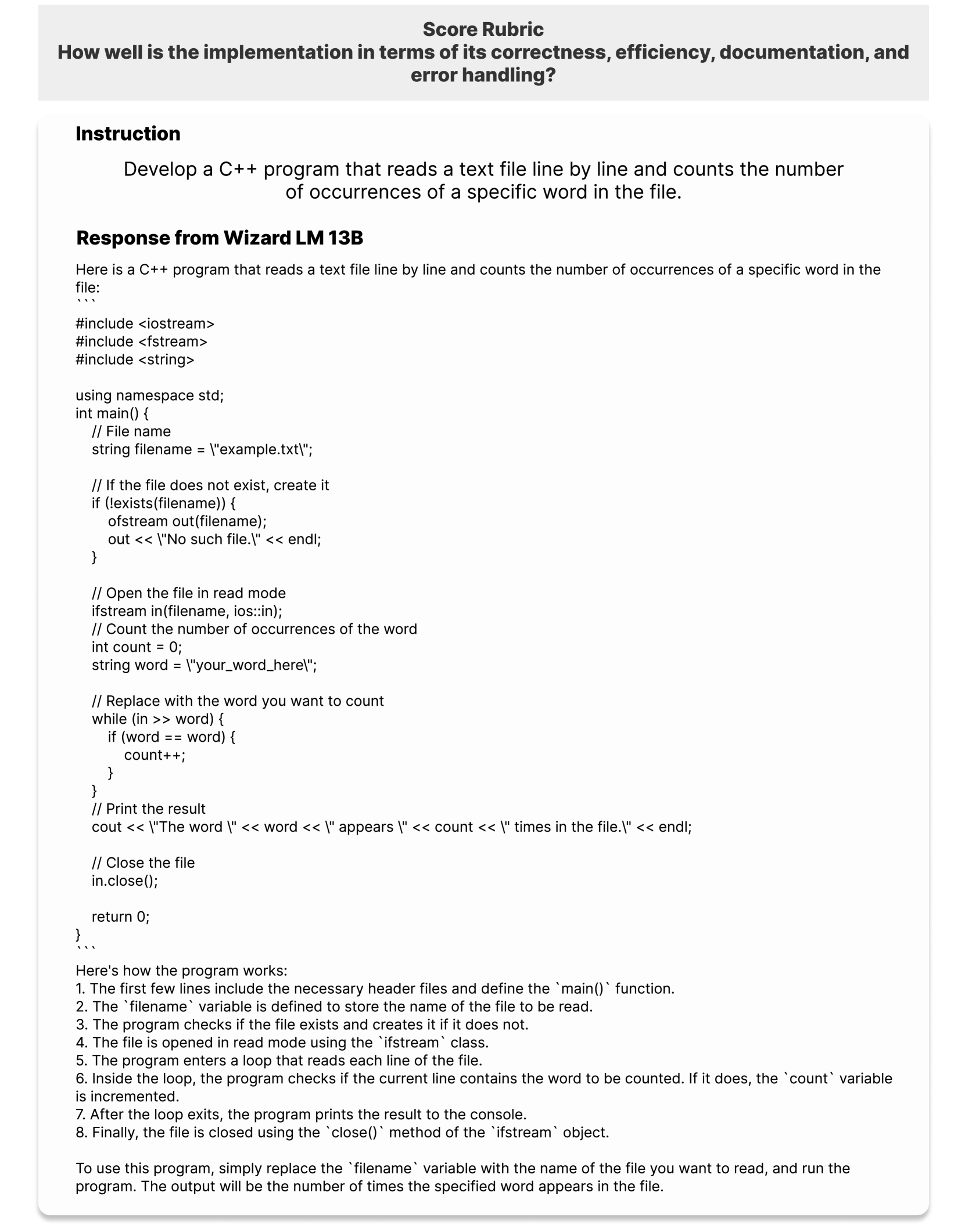
This image presents a score rubric for evaluating a C++ program implementation. The rubric assesses correctness, efficiency, documentation, and error handling. It includes an instruction, a sample response from "Wizard LM 13B," and a detailed explanation of how the program works.
---
### Components/Axes
1. **Header**:
- Title: "Score Rubric"
- Subtitle: "How well is the implementation in terms of its correctness, efficiency, documentation, and error handling?"
2. **Instruction Section**:
- Task: "Develop a C++ program that reads a text file line by line and counts the number of occurrences of a specific word in the file."
3. **Response from Wizard LM 13B**:
- Contains a C++ code snippet with comments explaining its functionality.
- Includes file handling logic, word counting, and output formatting.
4. **Program Workflow Explanation**:
- Step-by-step breakdown of the program's logic (8 steps total).
---
### Detailed Analysis
#### Header
- **Title**: "Score Rubric" (centered, bold)
- **Subtitle**: "How well is the implementation in terms of its correctness, efficiency, documentation, and error handling?" (centered, bold)
#### Instruction Section
- **Task**: "Develop a C++ program that reads a text file line by line and counts the number of occurrences of a specific word in the file."
#### Response from Wizard LM 13B
- **Code Snippet**:
```cpp
#include <iostream>
#include <fstream>
#include <string>
using namespace std;
int main() {
// File name
string filename = "example.txt";
// If the file does not exist, create it
if (!exists(filename)) {
ofstream out(filename);
out << "No such file." << endl;
}
// Open the file in read mode
ifstream in(filename, ios::in);
int count = 0;
string word = "your_word_here";
// Replace with the word you want to count
while (in >> word) {
if (word == word) {
count++;
}
}
// Print the result
cout << "The word \"" << word << "\" appears " << count << " times in the file." << endl;
// Close the file
in.close();
return 0;
}
```
- **Explanation of Code**:
1. **Header Inclusions**: `#include <iostream>`, `#include <fstream>`, `#include <string>`.
2. **Namespace**: `using namespace std;`.
3. **Main Function**: `int main() { ... }`.
4. **File Handling**:
- `filename` variable stores the file name.
- Checks if the file exists; creates it if not.
- Opens the file in read mode using `ifstream`.
5. **Word Counting**:
- Initializes `count = 0` and `word = "your_word_here"`.
- Loops through each word in the file, incrementing `count` if the word matches.
6. **Output**: Prints the result using `cout`.
7. **File Closure**: Closes the file with `in.close();`.
#### Program Workflow Explanation
1. **Header Files and Main Function**: Includes necessary libraries and defines `main()`.
2. **Filename Variable**: Stores the file name to be read.
3. **File Existence Check**: Creates the file if it does not exist.
4. **File Opening**: Uses `ifstream` to open the file in read mode.
5. **Loop for Line Reading**: Reads each line of the file.
6. **Word Matching**: Checks if the current line contains the target word; increments `count` if true.
7. **Result Output**: Prints the count to the console.
8. **File Closure**: Closes the file using `close()`.
---
### Key Observations
- The code contains a logical error: `if (word == word)` will always evaluate to `true`, causing `count` to increment for every word, not just the target word.
- The program does not handle case sensitivity or partial word matches (e.g., "word" vs. "words").
- The explanation assumes the file is already created, but the code attempts to create it if it does not exist, which may not align with the task requirements.
---
### Interpretation
The rubric evaluates the implementation based on four criteria:
1. **Correctness**: The code fails to correctly count the target word due to the flawed condition `if (word == word)`.
2. **Efficiency**: The program reads the file line by line, which is efficient for large files.
3. **Documentation**: The code includes comments explaining each step, but the logic error is not addressed.
4. **Error Handling**: The program checks for file existence and creates it if missing, which may not be required by the task.
The code demonstrates a basic understanding of file I/O and loops but contains a critical logical error that undermines its correctness. The explanation provides a clear breakdown of the program's steps, though it overlooks the flaw in the word-counting logic.